How To Find Your True MBTI Type

Are you curious about your personality type and how it influences your thoughts, feelings, and behaviors? One popular tool for understanding personality is the Myers-Briggs Type Indicator (MBTI), which is based on the theory of cognitive functions developed by Carl Jung. If you’re interested in learning more about your MBTI type, there are several different ways to do so. In this article, we’ll explore some of the most common methods, including taking an online personality assessment, working with a qualified practitioner, and taking the official MBTI assessment.

Here is a summary of some of the most common methods, along with some pros and cons of each:

  1. Taking an online personality assessment: One of the most popular and convenient ways to determine your MBTI type is to take an online personality assessment. There are many free and paid options available, such as 16Personalities and PersonalityPerfect.

    Pros: Convenient and easily accessible; can be completed in a short amount of time; often provides detailed feedback about strengths and potential career paths.
    Cons: May not be as reliable or valid as more formal assessments; results may be influenced by self-perception and self-awareness.
  2. Working with a qualified practitioner: Another option is to work with a qualified practitioner, such as a psychologist or career counselor, who is trained in administering and interpreting the MBTI. To find a qualified practitioner, you can try searching online directories of psychologists or career counselors in your area, or you can contact professional organizations such as the American Psychological Association (https://www.apa.org/) or the National Career Development Association (https://www.ncda.org/) for recommendations.

    Some pros of working with a qualified practitioner include:
    • Personalized feedback: A qualified practitioner can provide more personalized and in-depth feedback about your personality type, as they are able to take into account your unique experiences and background.
    • Reliability: Working with a qualified practitioner may result in more reliable and valid results, as they are trained in administering and interpreting the MBTI.

      Some potential cons of working with a qualified practitioner include:
    • Cost: Working with a qualified practitioner may be more expensive than taking an online assessment.
    • Time and effort: Working with a qualified practitioner may require more time and effort, as it typically involves multiple sessions or meetings.
  3. Taking the official MBTI assessment: The official MBTI assessment is administered by trained professionals and is considered the most reliable and valid measure of personality type.
    Pros: Highly reliable and valid; provides detailed feedback about strengths and potential career paths.
    Cons: More expensive than online assessments; may require more time and effort to complete.
    To sign up for the official test, visit website: https://www.myersbriggs.org/my-mbti-personality-type/take-the-mbti-instrument/
  4. Getting typing service from enthusiasts who specialize in MBTI and typology. This is different from option 2 above in the sense that, many of these people are more of social influencers and celebrities who gain trusts and followers through their social media channels over the years. They tend to not have serious professional qualifications but their services are often cheaper and less time-consuming. It’s recommended that you check out their channels to see whether you like and agree with their content and maybe read the reviews of the other customers.

    Some of the well-known channels and people you can check out are Dave and Shannon from Objective Personality, Lindsey Johnson (Lijo), Gray Capen Cietek (Augmented Personality) or Joyce Meng.
  5. Type yourself based on your own understanding of the MBTI.
    This might be the more time-consuming option but it’s free given the vast amount of content available online and will tremendously aid you in your personal growth journey through accumulated knowledge in this wonderful system. The simplest form is to understand the cognitive functions and determine which functions you identify with the most. The dominant and auxilarry function will then point you towards the corresponding type.

    For a quick guide to understanding the various cognitive functions, click here. To find the corresponding MBTI type for each cognitive function, read here.

    Another even better method is to combine your self-knowledge with online test. You can take any of the online test below and see if the description fit you. You can read the description of other types that possibly might fit you better by varying the result you get by 1 or 2 letter depending on whether you think you might be actually different. For example, if your test result is INFP, you might want to check out ENFP, INTP or ISFP etc.

Recommendation of other options for Online MBTI Tests:

  1. 16Personalities: 16Personalities is a free online personality assessment tool based on the MBTI theory of personality. It offers a detailed personality report and includes information about an individual’s strengths, weaknesses, and potential career paths. One potential drawback of 16Personalities is that it is based on self-report and may not be as reliable or valid as the official MBTI assessment. Website: https://www.16personalities.com/
  2. PersonalityPerfect: PersonalityPerfect is a free online personality assessment tool that is based on the MBTI theory of personality. It offers a detailed personality report and includes information about an individual’s strengths, weaknesses, and potential career paths. Like 16Personalities, PersonalityPerfect is based on self-report and may not be as reliable or valid as the official MBTI assessment. Website: https://www.personalityperfect.com
  3. Typefinder: Typefinder is an online personality assessment tool that is based on the MBTI theory of personality. It is not free, but it is widely available through a network of qualified practitioners and licensed organizations. Typefinder is a reliable and valid measure of personality type and is widely used in a variety of settings. One potential drawback of Typefinder is that it is based on self-report, so the results may be influenced by an individual’s level of self-awareness and self-perception. Website: https://www.typefinder.com/

Ultimately, the best way to determine your MBTI type will depend on your personal preferences, needs, and budget. Each of the methods discussed in this article has its own pros and cons, so it’s important to consider your goals and resources when deciding which option is best for you. Whether you choose to take an online assessment, work with a qualified practitioner, or take the official MBTI assessment, you can gain valuable insights into your personality and how it influences your life.

The MBTI Cognitive Functions Handbook

Carl Jung, a Swiss psychiatrist and psychoanalyst, developed a theory of personality that included eight cognitive functions that he believed influenced the way individuals perceive and process information. According to Jung’s theory, each individual has a dominant function that strongly shapes the personality.

His theory on cognitive functions are closely related to the personality types described in the Myers-Briggs Type Indicator (MBTI). The MBTI is a psychological assessment tool that is based on Jung’s theory of personality and is used to identify an individual’s personality type based on their preferences for certain cognitive functions.

According to the MBTI, each individual has a dominant function, followed by a an auxiliary function, which work together to form their personality. The eight cognitive functions identified by Jung are:

  • Introverted Sensing (Si)
  • Extraverted Sensing (Se)
  • Introverted Intuition (Ni)
  • Extraverted Intuition (Ne)
  • Introverted Thinking (Ti)
  • Extraverted Thinking (Te)
  • Introverted Feeling (Fi)
  • Extraverted Feeling (Fe)

Here is a brief overview of how the MBTI personality types correspond to Jung’s cognitive functions:

  • ISTJ (Introverted, Sensing, Thinking, Judging): Dominant function is Introverted Sensing (Si), auxiliary function is Extraverted Thinking (Te)
  • ISFJ (Introverted, Sensing, Feeling, Judging): Dominant function is Introverted Sensing (Si), auxiliary function is Extraverted Feeling (Fe)
  • INFJ (Introverted, Intuitive, Feeling, Judging): Dominant function is Introverted Intuition (Ni), auxiliary function is Extraverted Feeling (Fe)
  • INTJ (Introverted, Intuitive, Thinking, Judging): Dominant function is Introverted Intuition (Ni), auxiliary function is Extraverted Thinking (Te)
  • ISTP (Introverted, Sensing, Thinking, Perceiving): Dominant function is Introverted Thinking (Ti), auxiliary function is Extraverted Sensing (Se)
  • ISFP (Introverted, Sensing, Feeling, Perceiving): Dominant function is Introverted Feeling (Fi), auxiliary function is Extraverted Sensing (Se)
  • INFP (Introverted, Intuitive, Feeling, Perceiving): Dominant function is Introverted Feeling (Fi), auxiliary function is Extraverted Intuition (Ne)
  • INTP (Introverted, Intuitive, Thinking, Perceiving): Dominant function is Introverted Thinking (Ti), auxiliary function is Extraverted Intuition (Ne)
  • ESTJ (Extraverted, Sensing, Thinking, Judging): Dominant function is Extraverted Thinking (Te), auxiliary function is Introverted Sensing (Si)
  • ESFJ (Extraverted, Sensing, Feeling, Judging): Dominant function is Extraverted Feeling (Fe), auxiliary function is Introverted Sensing (Si)
  • ENFJ (Extraverted, Intuitive, Feeling, Judging): Dominant function is Extraverted Feeling (Fe), auxiliary function is Introverted Intuition (Ni)
  • ENTJ (Extraverted, Intuitive, Thinking, Judging): Dominant function is Extraverted Thinking (Te), auxiliary function is Introverted Intuition (Ni)
  • ESTP (Extraverted, Sensing, Thinking, Perceiving): Dominant function is Extraverted Sensing (Se), auxiliary function is Introverted Thinking (Ti)
  • ESFP (Extraverted, Sensing, Feeling, Perceiving): Dominant function is Extraverted Sensing (Se), auxiliary function is Introverted Feeling (Fi)
  • ENFP (Extraverted, Intuitive, Feeling, Perceiving): Dominant function is Extraverted Intuition (Ne), auxiliary function is Introverted Feeling (Fi)
  • ENTP (Extraverted, Intuitive, Thinking, Perceiving): Dominant function is Extraverted Intuition (Ne), auxiliary function is Introverted Thinking (Ti)

Definitions & Examples of the Functions

  1. Extraverted Sensing (Se) – This function involves the use of the five senses to gather and process information about the physical world. People who are strong in this function are practical, detail-oriented, and focused on the present.

Example: A person who is strong in sensing might be a skilled craftsman who is able to accurately measure and cut wood using a ruler and saw.

Or a person who is strong in sensing might be a successful farmer who is able to observe and understand the needs of their crops and animals, and use their practical skills to care for them.

  1. Extraverted Intuition (Ne) – This function involves the ability to process information through pattern recognition and the interpretation of symbolic meaning. People who are strong in this function are imaginative, open-minded, and focused on the future.

Example: A person who is strong in intuition might be a successful entrepreneur who is able to see the potential in a new business idea and take risks to bring it to fruition.

Another example is, a person who is strong in intuition might be a successful writer who is able to generate new ideas and explore multiple possibilities in their writing, and use their imagination to create compelling and engaging stories.

  1. Extraverted Thinking (Te) is a cognitive function that involves the ability to organize and implement ideas in a practical way. People who are strong in this function are organized, efficient, and action-oriented. They tend to focus outwardly on the practical implementation of their ideas, and they are skilled at getting things done.

Example: A person who is strong in extraverted thinking might be a successful project manager who is able to develop and implement plans to complete projects on time and within budget. They might be adept at organizing tasks and resources, and at communicating effectively with team members to ensure that projects are completed successfully.

  1. Introverted Feeling (Fi) is a cognitive function that involves the ability to understand and process one’s own emotions, values, and beliefs. People who are strong in this function are self-aware, independent, and true to their own values and beliefs. They tend to focus inwardly on their own emotions and values, and they are skilled at understanding their own feelings and motivations.

Example: A person who is strong in introverted feeling might be a successful poet who is able to express their own emotions and values through their writing. They might be adept at understanding and exploring their own feelings, and at using their writing to express those emotions in a deeply personal and authentic way.

  1. Introverted Sensing (Si) – This function involves the ability to recall and compare past experiences to inform present actions. People who are strong in this function are reliable, grounded, and detail-oriented.

Example: A person who is strong in introverted sensing might be a successful chef who is able to recall the flavors and textures of various ingredients and use that knowledge to create new dishes.

  1. Introverted Intuition (Ni) – This function involves the ability to foresee and predict the most likely outcome and scenarios, using the whole brain to unconsciously see the hidden patterns and to see the aha moment.

Example: A person with strong Ni can be a visionary business man who foresees potential shift in the market and invest in the right market and products way ahead of his competitors.

  1. Introverted Thinking (Ti) – This function involves the ability to analyze and understand complex systems and concepts. People who are strong in this function are independent, analytical, and logical.

Example: A person who is strong in introverted thinking might be a successful scientist who is able to conduct experiments, analyze data, and develop theories to explain natural phenomena.

  1. Extraverted Feeling (Fe) – This function involves the ability to understand and respond to the emotions of others. People who are strong in this function are outgoing, empathetic, and sensitive to the feelings of others.

Example: A person who is strong in extraverted feeling might be a successful teacher who is able to connect with and understand the emotional needs of their students, and use that understanding to create a positive and supportive learning environment.

I hope the above has shed more light on the various cognitive functions in Jungian psychology & MBTI. Have questions? Feel free to comment below and I will answer promptly!

Overview of MBTI Dimensions: Introversion, Intuition, Thinking, Judging

If you do not know or remember your Myers Briggs Type Indicator (MBTI) results, you can take one of the many free tests available such as 16personalities.com or http://www.truity.com/test/ or http://www.humanmetrics.com

Your result is a personality type with a corresponding 4-letter combo such as INFP (The Mediator) or ENTJ (The Commander). The 4 letters come from 4 dichotomies: Introversion (I)-Extroversion (E), Intuition (N) – Sensing (S), Thinking (T) – Feeling (F), and Perceiving (P) – Judging (J).

What do these letter and dichotomies mean? Those free online tests often come with a general description of your type and functions. You can read them on your own. Below is my own brief but somewhat more advanced description of the functions in these 4 dichotomies that might be worth learning.

1. Introversion vs Extroversion

introvert-or-extrovert

An extroverted behavior is one where objective (environmental) data contributes more weight than subjective input in decision making. If extroverted behaviors become habitual, then such individual is considered an extroverted type. Conversely, if a person spends more energy staying detached from objective data to listen to their own mind, he or she is considered introverted.

A very important point put forth by Jung is that introversion and extroversion are not mere deliberate choices that can be easily changed.  They are more likely to be assigned by birth randomly in the population, representing two distinct yet balancing survival strategies in organisms. An organism can be greedy and aggressively grab food and mate around to maximize successful reproduction. While another is more selective to conserve energy, strike only when absolutely necessary. Basically, introverts prefer to conserve energy while extrovers expand.

Projecting the above strategies further into humans, Jung further points out that extroverts are more likely to adjust their behaviors faster to objective data and immediate surroundings. They are more driven by short-term immediate gains, be it business opportunities or valuable things. Their morals are heavily dictated by the prevailing demand from the society at the moment.

Extroverted behaviors may allow for quick adjustments and gains to a change in environment, but can be at odds with the universal trends or laws. This is where the introverts step in to gain advantage. They listen deeper within themselves and abide by the more universal, but often misunderstood rules coded in their genes and minds since birth.

Can one really change his attitude from introvert to extrovert and vice versa? According to Jung, it could happen, but with significant resulted psychological strains and disorders. For example, a kid having to suppress his natural attitude due to unfavorable parental influence will develop neuroticism  when grow up, which can only be remedied by allowing his natural tendency to redevelop.

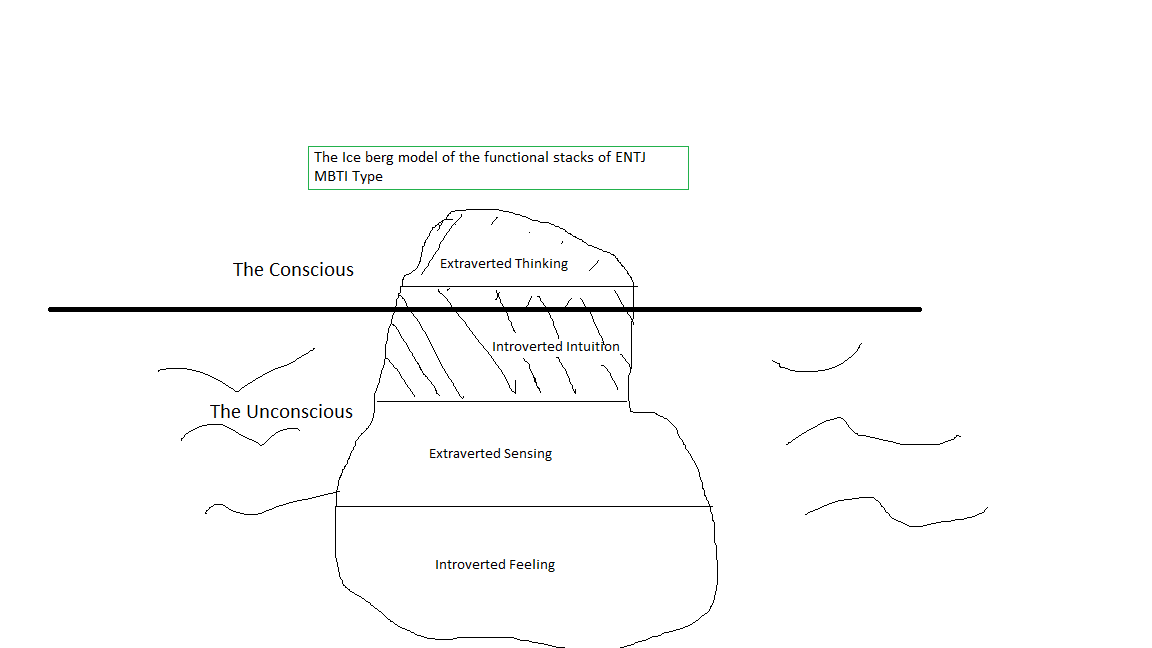
Another essential model to keep in mind as proposed by Jung is the insidious influence of the unconscious to the other functions which received less conscious energy from the subject.  He emphasized the importance of the unconscious in balancing the conscious, which is most evident in the case of dreams. Dreams often have prophetic qualities in response to anything done excessive in a person’s waking moments.

According to Jung, no function will be entirely eliminated, it can only be greatly distorted. The suppressed functions become merged with unconscious content and become bizarre in character, though one of great importance to the overall psychological well-being.

Illustration of the functional stack of ENTJ type

 2. Thinking vs Feeling

photo of two women lying on grass

At the most basic level, thinking and feeling point to 2 contrasting approaches of survival for human beings as rational yet social creatures. On one hand, one may prefer collaboration and building relationships as a survival strategy. On the other hand, some choose a more independent approach with the aim of accumulating resources for oneself and devise plans to better compete with others. Of course anyone would need some mixture of these 2 strategies to navigate human’s complex social structures.

At individual level, thinking and feeling are somewhat more visible  and easier to understand than the other dichotomies, especially in the case of extroverts. I find Socionic offered more detailed and interesting description to contrast this dichotomy (Note that they are often referred to as logic versus ethic in socionic, which I find less misleading than the term thinking and feeling): https://www.the16types.info/vbulletin/content.php/429

By Socionic models, thinking individuals are more energized by changes in the “logical world”, which are rules, systems, logical criteria and measurable results. They pay more attention to the demand of the material worlds, and are more black-and-white in terms of statement of facts being correct or incorrect etc. Feeling individuals, on the other hand, are often more expressive and energized by the “ethical world”, which ranges from overall momentary atmosphere to deeply held individual values.

3. Intuition vs Sensing

intuition-versus-sensing

Intuition and sensing are often harder to understand and very often mis-typed in my experience. People would often prefer to be viewed as intuitive than sensing-dominant. Because if thinking is considered a more advanced function which develops later in human’s evolution, the same thing can be said about intuition. Another term for intuition is abstraction, the ability to perceive beyond immediate sensory data to see the hidden patterns and concepts. Intuitive people are big-picture oriented and energized more by abstract parameters such as timing, potential, expectations, meaning etc. 

The rest of the animal kingdom is mostly unable to perform any intuitive task. Everything to them is immediate sensory input and responses. They live in the moment with no concept of time, let alone higher abstract thoughts such as the meaning of life.

Sensor is the term often used to refer to individuals dominant in sensing perception. They are often quicker in noticing surrounding movements and superficial impression: aesthetic beauty, vibe, concrete results and actions. They are often more attuned with pop culture and have highly-discriminated aesthetic tastes, making for great athletes, cooks, singers and artists. They prefer quick and concrete results and action, with little patience for theories or abstract discussions.

With that being said, there are pros and cons in being intuitive or sensing dominant. Intuitive people are stereotyped as being absent-minded professors, bland in taste and impractical. Meanwhile, sensors often have a bad reputation, especially on personality forums, as shallow, conformist, superficial, impulsive and lacking in foresight. Sensors may be the majority in the general population, but they are probably too bored to discuss personality theories online, thus being the minority here.

4. Judging vs Perceiving

This last dichotomy is probably the biggest pain point for many MBTI and Jungian purists. Judging and Perceiving are actually NOT psychological functions. They simply point out how your other two dichotomies, thinking-feeling and intuitive-sensing, orientate. If you are a P, your Dominant Extraverted function is an Perceiving function. Similarly, if you are J, your Dominant Extraverted function is a Judging function.

This is extremely confusing, I know. Perceiving functions are Intuitive or Sensing, while Rational functions refer to either Thinking or Feeling. I will have to explain the difference another time, but in short, jugding functions prioritize the perception of the objects, result or expectations of results while perceiving ones are process-oriented. If you are an INFP, your dominant extraverted function is Extraverted Intuition as compared to an INFJ who possesses a Judging extraverted function of Extraverted Feeling. 

Even though they are important, (INFJ and INFP actually have no function in common), beginners of MBTI should be more comfortable to regard the J and P letter as functions denoting abstract concepts of Being Organized versus Being Impulsive. 

It is important to remember to take them at face value, especially in the case of introverts, because they only denote the outward behaviours. An INFP is actually a Judger at heart because their dominant function is Introverted Feeling, a judging function. They would prefer to start the day with a goal and plan in mind, while an INFJ would actually go with the flow despite their outward quality of being more organized.

Jung, C. G. (2017). Psychological types. Abingdon, Oxon: Routledge.