Most of us have experienced disappointment and disillusionment in relationships. We met someone wonderful only to discover later that they were not as who they appear to be as there are always downsides or “the catch” that catches us off guard…
What if I tell you that’s a fact of life caused by human nature? That our egoistic fixation causes everyone including ourselves to over focus on certain aspect of the egos at the expense of other. This is a quick intro/exploratory video on the imperfect and one-sided nature of human so that hopefully we can all be more prepared and even better, embrace our next relationships and loved ones for their strengths and corresponding flaws…
Brough to you by Tuan Le, founder of OHM and a veteran personality coach and the use of Enneagram – a powerful personality frameworks on different type of ego fixation and emotional patterns.. Enjoy the video!
The Enneagram, a personality system with roots in ancient spiritual traditions, stands as a profound tool for self-discovery and personal growth, much like the popular Myers-Briggs Type Indicator (MBTI). What makes the Enneagram unique is its rich history, with numerous contributors shaping its complexity over centuries. If the MBTI focusses on cognition or the information-processing aspect of the mind, the Enneagram provides a road map to understand the deeper emotional drives. If MBTI is the skeleton, Enneagram is like the beating heart of the individual.
If you are a visual learner, you can also watch the video version. Otherwise, please continue below.
Enneagram presentation by Teodora Paucean
From a modern psychological perspective, the Enneagram highlights each person’s expertise in a particular coping mechanism. By revealing insecurities and fears, this system offers a roadmap for growth. The Enneagram posits that each individual carries a “lost message” from childhood – something crucial for their emotional development that they may not have received.
For instance, if someone needed to hear that they were worthy of love but didn’t, they might grow up feeling the need to constantly prove their worth to others.
Contrary to the misconception that the Enneagram puts people in boxes, it encourages flexibility and understanding. Rather than dictating who one is, it reveals patterns and suggests avenues for personal growth. The Enneagram defines personality as a protective mask comprising fears, beliefs, and reactions, emphasizing the importance of discovering one’s true self or essence beyond this mask.
The Nine Enneagram Types
At the core of this system are the distinctive description of the nine Enneagram types. To better understand and remember them, we group them into three triads – Heart, Head, and Gut.
The Heart Triad
Types 2, 3, and 4 focus on self-image and the desire for love, revealing deep-seated fears of unworthiness or inadequacy.
Type 2: The Helper
The Helper, or Type 2, embodies the caring and interpersonal personality. Twos are characterized by their empathy, sincerity, and warm-hearted nature. Friendly, generous, and self-sacrificing, they often go out of their way to support others, driven by a deep need to be close to people. At their best, healthy Twos display unselfishness and altruism, fostering unconditional love for both themselves and others.
On the downside, the Helper faces challenges when their desire to be needed results in neglecting their own well-being. The tendency to people-please might lead to self-neglect and difficulty in recognizing personal needs. Healthy Twos strike a balance between caring for others and maintaining self-care.
Type 3: The Achiever
The Achiever, or Type 3, is the adaptable and success-oriented individual. Threes exude self-assurance, attractiveness, and charm. Ambitious, competent, and energetic, they are often focused on personal advancement and success. At their best, healthy Threes embrace self-acceptance, authenticity, and serve as inspiring role models.
However, the Achiever encounters challenges when their drive for success transforms into an obsession with their image. Workaholism and excessive competitiveness may hinder genuine connections with others. Healthy Threes understand the importance of balance, achieving success while maintaining authenticity and healthy relationships.
Type 4: The Individualist
The Individualist, or Type 4, possesses a romantic and introspective nature. Fours are characterized by self-awareness, sensitivity, and reserved tendencies. They are self-revealing, emotionally honest, and often have a personal and unique approach to life. At their best, healthy Fours are inspired and highly creative, capable of transforming their experiences.
On the flip side, the Individualist faces challenges when their introspection turns into self-indulgence and self-pity. The desire for uniqueness may lead to feelings of disdain and detachment from ordinary ways of living. Healthy Fours appreciate their individuality while understanding the importance of connecting with others and avoiding excessive self-focus.
The Head Triad
Types 5, 6, and 7 centers around security and safety, with each type adopting strategies to cope with anxiety.
Type 5: The Investigator
The Investigator, or Type 5, represents the intense and cerebral personality. Fives are alert, insightful, and curious individuals who focus on developing complex ideas and skills. Independent and innovative, they may become detached and preoccupied with their thoughts. At their best, healthy Fives are visionary pioneers, offering new perspectives ahead of their time.
However, Investigators encounter challenges when their intense focus leads to isolation and detachment. The pursuit of knowledge may result in eccentricity and a sense of nihilism. Healthy Fives balance their intellectual pursuits with a connection to the world, avoiding excessive withdrawal.
Type 6: The Loyalist
The Loyalist, or Type 6, is the committed and security-oriented individual. Sixes are reliable, hardworking, and responsible, often running on stress while complaining about it. Healthy Sixes become internally stable, self-confident, and self-reliant. They courageously support the weak and powerless at their best.
On the contrary, the Loyalist faces challenges when their commitment turns into excessive anxiety and defensiveness. Unchecked self-doubt and suspicion can hinder personal growth and relationships. Healthy Sixes maintain a balance between vigilance and trust, fostering internal stability and supporting others without succumbing to overwhelming fear.
Type 7: The Enthusiast
The Enthusiast, or Type 7, embodies the busy and productive personality. Sevens are versatile, optimistic, and spontaneous, seeking new and exciting experiences. Playful and high-spirited, they may, at times, become overextended, scattered, and undisciplined.
However, Enthusiasts encounter challenges when their pursuit of excitement leads to superficiality and a lack of discipline. Overextension and constant activity may result in exhaustion. Healthy Sevens understand the importance of balance, channeling their enthusiasm into meaningful pursuits while avoiding impulsive and superficial behaviors.
The Gut Triad
Types 8, 9, and 1 highlights the pursuit of autonomy and independence. These types resist external control and, in unique ways, strive for personal integrity, peace, or protection from harm.
Type 1: The Reformer
The Reformer, or Type 1, is characterized as the principled and idealistic type. Individuals of this type are known for their strong ethical values and conscientious nature, always guided by a clear sense of right and wrong. Reformers often take on the roles of teachers and crusaders, driven by a continuous desire to improve the world around them. Their organized and orderly approach, coupled with a meticulous attention to detail, reflects their commitment to maintaining high standards. Healthy Ones exhibit wisdom, discernment, realism, and nobility, embodying moral heroism at their best.
On the flip side, the Reformer faces challenges when their pursuit of perfection transforms into excessive criticism. The fear of making mistakes can hinder their progress, and their well-organized nature might border on rigidity. Acknowledging and managing repressed anger and impatience becomes crucial for a balanced and healthy Type 1. Despite their noble intentions, an overemphasis on perfectionism may inadvertently distance them from others.
Type 8: The Challenger
The Challenger, or Type 8, exudes self-confidence, strength, and assertiveness. Eights are characterized by their protective and resourceful nature, often making decisive and impactful decisions. Healthy Eights transform into self-masters, channeling their strength to positively impact the lives of those around them. In their prime, healthy Eights showcase heroism, magnanimity, and sometimes even historical greatness.
However, the Challenger encounters difficulties when their assertiveness turns into excessive pride, hindering their ability to connect with others. The need for control may result in confrontations and a reluctance to show vulnerability. Healthy Eights recognize the importance of balance, utilizing their strength for the greater good without succumbing to dominating tendencies.
Type 9: The Peacemaker
The Peacemaker, or Type 9, embodies an easygoing and self-effacing personality. Nines are characterized by their accepting and stable nature, fostering an environment of trust. Good-natured, kind-hearted, and easygoing, they play the role of supporters, often going along with others to maintain peace. Heathy Nines exhibit indomitable qualities, bringing people together and resolving conflicts seamlessly.
On the downside, the Peacemaker faces challenges when their desire for peace transforms into complacency. The reluctance to address conflicts head-on can hinder personal growth, and the tendency to minimize issues may lead to unresolved problems. Healthy Nines embrace their innate ability to unite people and address conflicts, realizing the significance of balancing their easygoing nature with assertiveness when necessary.
Conclusion
The Enneagram, with its profound insights into human behavior, serves as a guide to breaking free from limitations, understanding one’s triggers, and fostering compassion towards oneself and others. It invites individuals to embrace their unique paths of growth, acknowledging that it’s a gradual process rather than an overnight transformation.
It offers a nuanced understanding of personality, combining ancient wisdom with modern psychology. While the Enneagram provides valuable insights, we emphasizes caution against extreme or overuse, just like with any other typology systems. It should serve as a tool for self-education, not as an excuse for negative behavior. Cultivating awareness, acknowledging triggers, and promoting personal growth are essential steps in the journey.
Behaviors are like the tip of an iceberg. Two people can show similar outward behaviors, but which originate from very different core motivations. A systematic way to quickly pierce through the façade of behaviors will be tremendously useful. In this crash course, you will discover the hidden gem of typology, the arts of reading people patterns using the latest psychological frameworks.
Tuan Le is a TypeCoach (MBTI) certified coach who has spent over 8 years study the different psychometric/personality system such as MBTI and Enneagram. He is passionate in promoting the under-utilized gems of typology and theory of mind that managers and leaders can use to boost their own and their team’s emotional intelligence.
Webinar Agenda: – Big picture: Differences between behaviors, personalities versus core drives. – Background of the MBTI and Jungian Psychology. – Essential definitions and exercise to further identify your type and understand the cognitive functions. – Some practical tips to quickly apply this knowledge in your daily life and workplace.
Please submit the form below to watch the recording of the webinar.
Do you struggle to take on leadership roles and set boundaries in the workplace? Learn how to navigate emotional drain and conflicts with the help of practical tools and the Enneagram wisdom in this video.
Our guest speaker, Teodora Paucean, a renowned Life and Relationship Coach, will guide you through recognizing your strengths and weaknesses as a leader and give you insights for setting boundaries and protecting your inner peace.
Please watch the webinar recording or if you prefer to read, continue reading the written transcript below.
Introduction: Enhancing Leadership Through Enneagram Wisdom
Thank you all for joining today’s session. As a self-employed coach and trainer with a background in Psychology, I’m excited to guide you through the enriching world of the Enneagram of personality and its profound impact on leadership assertiveness.
Understanding Emotional Drain and Insecurities in Leadership
In today’s exploration, we’ll address the emotional drain caused by insecurities, a common challenge faced by many leaders. The session will shed light on how these insecurities, if unmanaged, can lead to conflicts, impacting work relationships, teamwork, performance, and retention.
The Role of Empathy and Self-Awareness in Leadership
True empathy and self-awareness are foundational in effective leadership. By delving into personality typology, such as the Enneagram, leaders can gain valuable insights into cognitive diversity, creating an environment where individual strengths contribute to a cohesive team dynamic.
Holistic Understanding of Cognitive Diversity
In my experience in human resources, I’ve observed that a lack of self-awareness can lead to assumptions about uniform thinking and communication styles. Today’s focus on the Enneagram is part of a broader approach, acknowledging the significance of systems like MBTI and cognitive functions in understanding cognitive diversity comprehensively.
Personal Journey: Applying Personality Typology in Professional Roles
Embarking on my self-awareness journey at 16 with MBTI and later the Enneagram, I, as an INFJ and Enneagram Type 2, found profound insights that shaped my personal and professional growth. With a background in Psychology, conflict analysis, and management, I’ve consistently applied personality typology in various roles, emphasizing its pivotal role in self-awareness and interpersonal dynamics.
Boundaries in Leadership: Impact on Mental Health and Team Dynamics
Effective leadership hinges on the establishment of clear boundaries. Leaders who neglect this aspect often face burnout, depression, and anxiety, impacting both individual and team well-being. This segment emphasizes the crucial role boundaries play in creating a positive work culture and fostering team cohesion.
The Ripple Effect: Positive Leadership and Team Well-Being
Leaders who set and communicate boundaries set a positive example, creating a ripple effect that enhances team dynamics, work culture, and retention rates. Conversely, the absence of clear boundaries can contribute to a negative work culture and hinder team performance.
Understanding the Enneagram:
The Enneagram, a personality-based system with roots in ancient traditions and modern psychology, focuses on emotional components. Unlike the MBTI, which delves into the structure of the mind, the Enneagram metaphorically represents the soul, exploring core insecurities and their impact on various life aspects. The system categorizes individuals into nine types, each driven by unique fears and desires. Understanding these types is crucial for leaders aiming to navigate their own and their team’s dynamics effectively.
Types Most Likely to Struggle with Boundaries:
Among the nine Enneagram types, five are prone to struggling with boundaries: Type 2 (The Helper), Type 3 (The Achiever), Type 4 (The Individualist), Type 6 (The Loyalist), and Type 9 (The Peacemaker). For instance, Type 2’s desire to be liked may hinder their ability to say no, while Type 3’s focus on competence can lead to overwhelming workloads. Recognizing these tendencies equips leaders to address boundary challenges within themselves and their teams.
The Feeling Triad and Emotional Intelligence:
The Feeling Triad, comprising Types 2, 3, and 4, is characterized by a strong focus on self-image. Understanding the fears and desires of each type within this triad provides valuable insights for leaders. Emotional intelligence, a key leadership trait, involves recognizing and managing emotions. Leaders with strong emotional intelligence can leverage their strengths and address their weaknesses, fostering healthier team dynamics.
Leadership Strengths and Weaknesses:
Each Enneagram type brings unique strengths and weaknesses to leadership roles. For instance, Type 2 leaders excel in empathy and support, but they may struggle with people-pleasing and manipulation. Recognizing these traits allows leaders to harness their strengths while actively working on areas that may hinder their effectiveness.
Practical Tools for Leadership Development:
Non-Violent Communication:
Developed by psychologist Marshall Rosenberg, this tool aids leaders in setting boundaries, providing a structured approach for giving negative feedback and discussing sensitive topics.
Time Management – Eisenhower Metrics:
The Eisenhower Matrix helps leaders prioritize tasks based on their urgency and importance, offering a strategic approach to time management.
Intrapersonal Intelligence:
Recognizing and managing one’s own emotions is crucial for effective leadership. Techniques like labeling emotions and engaging in activities like journaling and meditation contribute to the development of intrapersonal intelligence.
Pika Technique:
This coaching tool assists individuals in identifying physical signs of strong emotions, changing negative patterns to positive ones, and implementing lasting changes in behavior.
“Fill Your Cup” Model:
Leaders can proactively monitor their needs by visualizing a set of cups representing various aspects of well-being. Regularly checking and addressing these needs fosters a balanced and resilient approach to leadership.
Conclusion:
In the intricate tapestry of leadership development, understanding personality frameworks, emotional intelligence, and effective boundary-setting is paramount. Leaders who embark on this journey not only enhance their own capabilities but also contribute to the growth and well-being of their teams. As Carl Jung aptly stated, “Who looks outside dreams; who looks inside awakes.” The pursuit of self-awareness is a continuous process that enlightens and empowers leaders on their quest for excellence.
Note: To explore these concepts further and deepen your understanding, consider enrolling in a comprehensive training program that combines the MBTI and Enneagram as complementary systems. Remember, self-awareness is a lifelong journey, and the tools discussed here serve as guides in this transformative process.
Hello personality enthusiasts! We had the honor to be able to have Michael Pierce to do a public session for the Singapore Typology Community. Michael Pierce is a Jungian researcher and well-known figure online with his substantial work published under the book “Motes and Beams”. I hope his beautiful analogies and philosophical analysis can help many beginners to move from simple personality quizzes to the beautifully nuanced world of Jungian Typology.
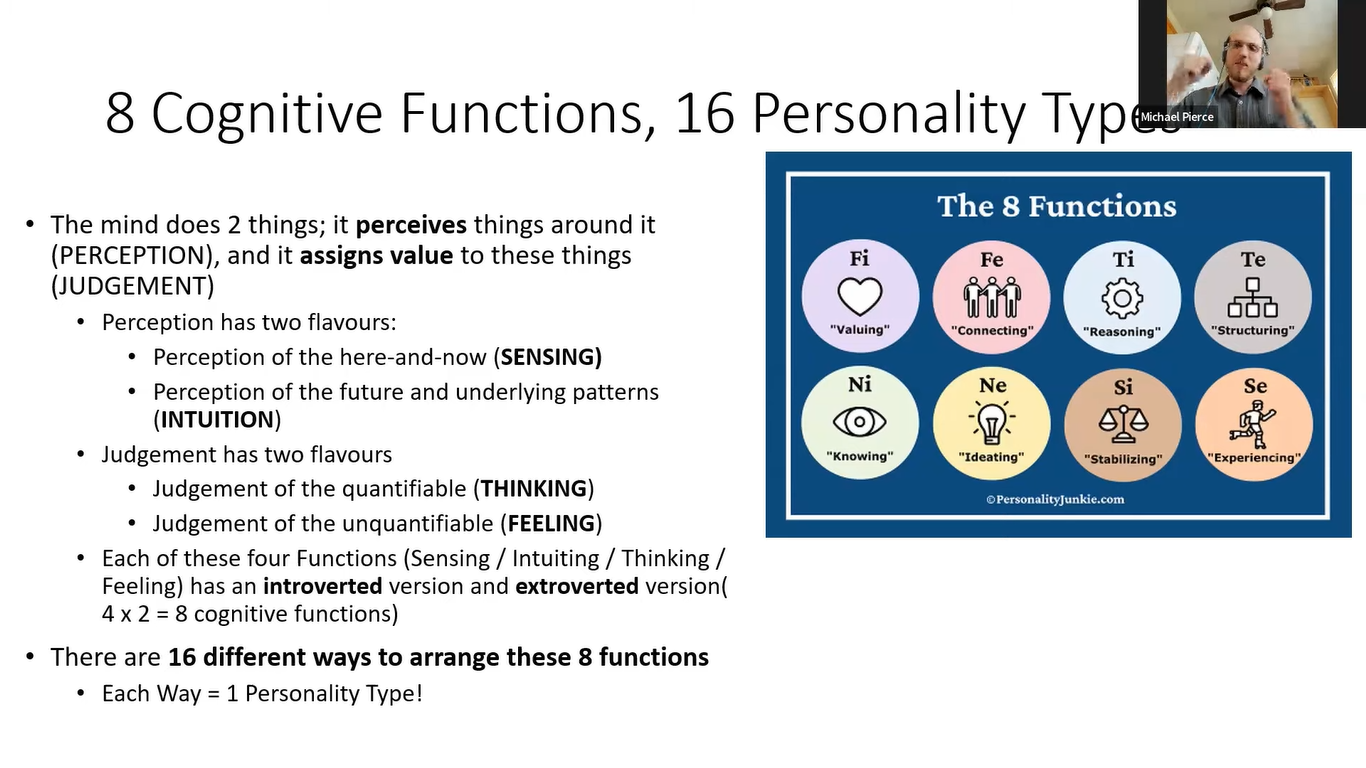
Michael: “You’re about to join me down the rabbit hole of this more complex, advanced system known as Cognitive Function Theory or Jungian Theory. So, we begin with Perception and Judgment. These appear in the MBTI test as a dichotomy pair. In Jung’s Theory, they serve a bit of a different role. Perception simply refers to how you perceive the world. It takes in information and it doesn’t categorize it, it doesn’t make any judgments about it. It is only interested in what the things are that are being perceived and are coming into the personality, into your mind. Judgment, as it’s been laid out here, assigns some sort of value to these things. It categorizes them, it judges them. So these two are opposites, but they’re complimentary. Perception has two flavors, or there are two kinds of perception, and in the same way, there are two kinds of Judgment. There are slightly different theories about precisely the correct way to justify splitting them into two flavors, but for our purposes, we’ll just take it for granted and say Perception has two flavors. One is Sensing or Sensation. That’s the perception of what is actually there, the here and now. It has to do with the present, and it also has to do with concrete objects, a lot of the time. Whereas Intuition is a perception of the future, of underlying patterns, of the possibilities of things. That’s how I often try to refer to it. So Sensation is almost like a more direct line to the object, whereas Intuition tends to go around it to things that are implied by the object. So, Sensation is generally very concrete, down to earth. Intuition is very creative but can also be very head in the clouds about things. Those are two ways of just perceiving the object. Judgment also has two kinds: Thinking and Feeling. It’s important to note that we use the terms Thinking and Feeling in a very different way from how they are more precisely used in Jung’s Theory. But as Ching has laid it out nicely here, Thinking is judgment of the quantifiable, and Feeling is judgment of the unquantifiable. There’s a correspondence, at least in my theory, my approach to it, between Thinking and Sensation and Feeling and Intuition. Thinking has to do with judging things in terms of rigid categories and logic, whereas Feeling has more to do with values, ethics, how you and other people are feeling. So that’s sort of the distinction. Okay, so now we have four functions, and note we’ve just sort of built them beginning from Perception and Judgment, and we’ve built our way up to Sensation, Intuition, Thinking, and Feeling, which again you would recognize those from the MBTI, the Myers-Briggs test, and other tests online.”
The Dichotomy of Extraversion and Introversion
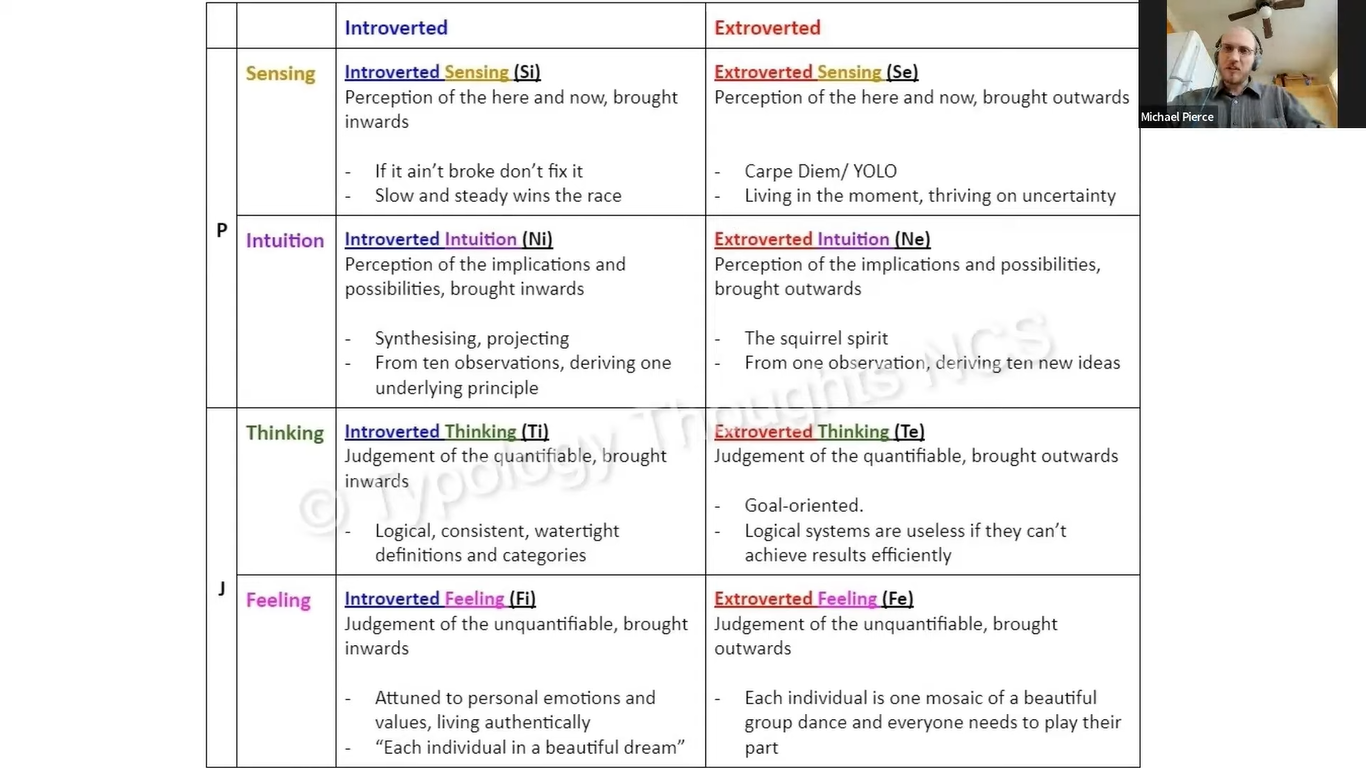
Michael: “So now we’re going to do the division game again. We’re going to introduce a new dichotomy, Introversion and Extraversion, and by doing that, we will multiply the four functions into eight cognitive functions. Extroversion is an attitude. It’s a focus on what we call ‘the object’. So I perhaps should have started with this, but just so you understand the terminology, the object is anything that is not you. It is the thing that you are focusing on, in order for anything to happen in psychology, you have to have an object and you have to have a subject. The subject is the mind, the subject is the person or the being that has the psychology going on inside them, as it were. And for every subject, there needs to be objects that that subject can think about and can focus on. For Extroversion, there is this, as it were, outward turning and outward focus towards the objects that are out there in the world. And Introversion is a turning inwards to the way that your own subject is. So in some sense, Introversion, you could say, is making an object of your own subject. But I don’t want to start getting into loops of language and so forth. The more important thing is the outward motion versus this inward motion. And so we can split up Sensation and Thinking, and Feeling and Intuition via Extroversion and Introversion. So we would get extroverted sensation, introverted sensation, extroverted thinking, introverted thinking, so forth.
You’ll notice in the little chart up here, they are abbreviations. So Fi would be Introverted Feeling. So the F is for Feeling, the T is for thinking, the S is for Sensation, and the N is for Intuition. Even though intuition starts with an I, it’s abbreviated with an N so it doesn’t get mixed up with Introversion. And then each of those has a little I for Introversion after it or a little E for Extraversion after it. So that’s the notation and how that works. It’s a lot faster to just write, say, Fe rather than Extroverted Feeling because that would get a lot of letters on the page. So finally, we have eight cognitive functions. And now what we’re going to do is we’re going to arrange these functions in order to get 16 different personality types. Let’s just run over what these cognitive functions are and how they work.”
What is “Sensation”?
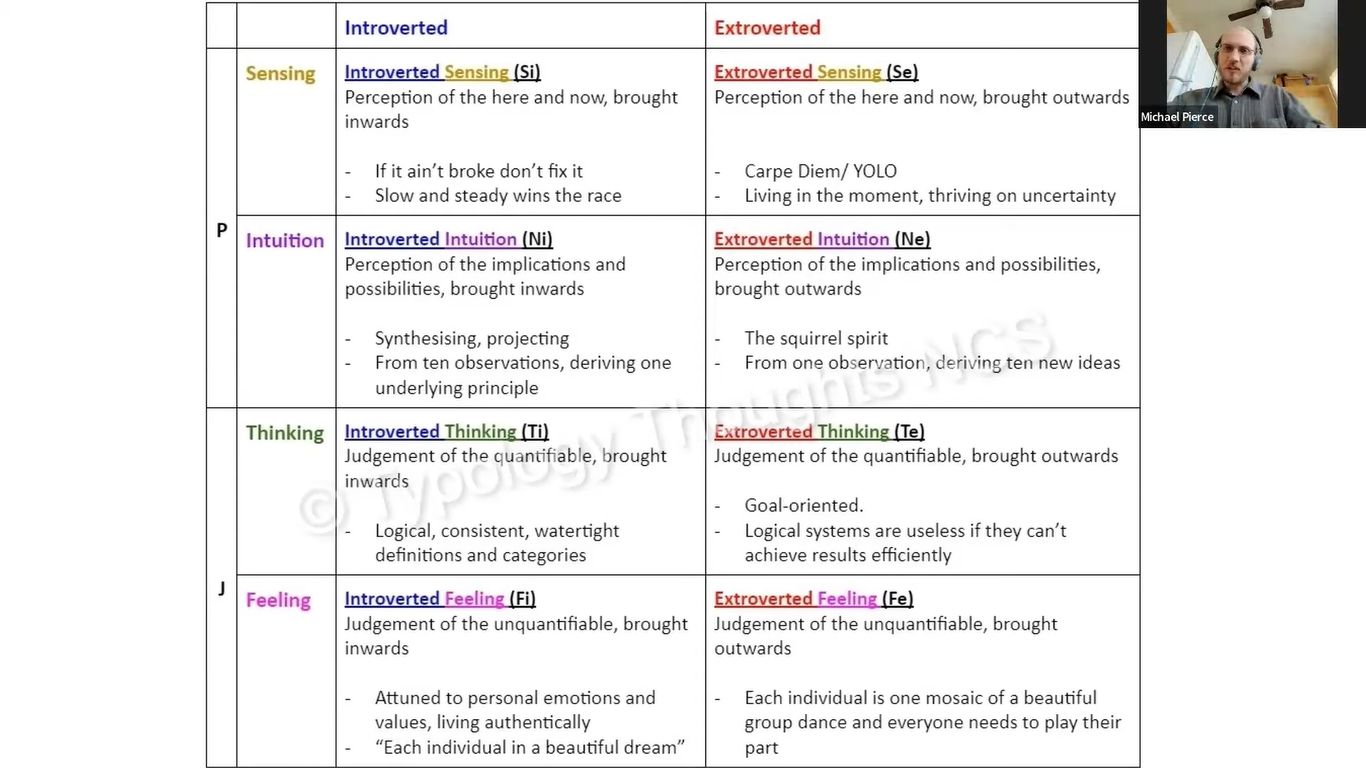
Michael: “There are two kinds of Sensation: Introverted and Extroverted. I’ll start with Extroverted Sensation. Going by our definitions, Extroverted Sensation would be sensation but directed outward, as it were. It is directed to objects in the here and now. Somebody who is using Extroverted Sensation is someone for whom that is the dominant function they prefer to use. There tends to be a very, as it were, carpe diem, YOLO, living in the moment, thriving on uncertainty. People who are Extroverted Sensing types in my experience thrive in situations where there’s a bit of chaos, and it can stress them out as well, but they’re often much better than introverted types at dealing with that because they’re just going moment by moment. They see what concretely is happening around them, and they just keep track of everything and flow in order to adapt to what is happening in the moment. So, you know, emergency workers, firefighters, police, a lot of people who have to deal with emergency situations. It doesn’t just have to be that. You can still find them in more academic disciplines at times, though that is usually through focus on other functions. So that’s Extroverted Sensation, very in the moment. Introverted Sensation reverses that in an interesting way, because the sensation is directed inwards. So Introverted Sensation people, not in a political sense at all, per se, but there’s a kind of conservatism, they’re much slower and more removed from the outside world, as compared to the extroverted sensor. It is perception of the here and now but brought inwards.
My mother, for example, is a dominant Introverted Sensation type, and she has a very sensitive palate. She usually does a lot of the cooking. She prefers to do the cooking because she can cook the things right. And every time we sit down to dinner, she will eat the food and she will be comparing what she is tasting here and now with these sort of ideal sensations that she has in her own mind. And she compares those sensations to that ideal sensation, and it’s that ideal sensation which is more real for her than the sensations in the here and now. And so she will taste and say, “This tastes like it has too much salt. This shouldn’t have as much salt as it does at the moment,” whereas I’m sitting there, and I’m like, “Oh, this is a salty dish“. But for her, it’s like, “No, it’s more salty than the way it should have salt”. And if you’re clever, you might notice there’s some relation with judgment, which I don’t really have time to get into that right now, but it’s a valid observation. So anyway, you get a conservatism there. It’s not “live-in-the-moment”. One of the other things my mother would do is when something flashy or wild or very quick would happen, she would take a moment and she would just say, “I’m just processing what just happened”. And she’s processing the sensory aspect of it. So they all also will often be very good journal keepers, very meticulous, able to remember all of the details and repeat those back.
What is “Intuition”?
Michael: “So now we move on to Intuition. We have Extroverted Intuition, which is a perception of implications and possibilities brought outwards. It is a focus on ideas and possibilities. Almost like they’re juggling a lot of different ideas at one time. But more importantly, it’s the fact that those ideas are out there. A better way of putting it is it’s almost like ideas are actual objects for them that exist outside of themselves and exist on their own. So the result of this is that ideas tend to diverge for them. From one observation, you can derive ten new and distinct ideas from it. So there’s this branching out, and it very quickly can turn into a kind of chaos for them. But it’s very, very fruitful because they will see all of the ways you can split up one topic into different topics.
Introverted Intuition does sort of the opposite. Introverted intuition, because it turns inwards, has a tendency to see similarities between things to a certain extent and to say, “This idea is really just this idea if you put them next to each other.” You can sort of collapse things into each other. From 10 observations, you derive one sort of vision or one underlying principle. Extroverted Intuition is almost like, you have one point, and then you draw an infinite number of lines through that one point to show all of the different ways you can diverge from that one point. Whereas intuition or introverted intuition, you have say 10 points, and then you try to draw a line of best fit, if you know that from algebra, you try to draw a single line that sort of averages out all of those individual observations, and that is the single idea which is then kept in Introverted Intuition. So kind of like with Introverted Sensation where I mentioned this notion of having ideal sensations that you kind of use to organize the sensations in the outside world, similar idea with Introverted Intuition, but with ideas, you have sort of a single idea that you are relating things back to. So Extroverted Intuition is stereotypically… it doesn’t necessarily look like this, but stereotypically, lots of different ideas. Very kind of scattered brains, running all over the place, whereas introverted intuition is like, “I have the eyes that stare into your soul,” you know, kind of like the chess grandmaster or something like that.”
What is “Thinking”?
Michael: “Thinking is judgment that is based on logic and facts, and it’s broader than that, but that’s the quickest way to explain it. So Extroverted Thinking is very goal-oriented. It’s very, “I want to accomplish things out there in the world. I want to organize the actual materials or people or resources that I see outside of me. I want to work with the external facts of a situation. Here’s where we should go with something. Here’s how we make things more efficient.’” Ching: “Everyone always has this mindset that Extraversion means party animal, you know? So when I meet someone and I say, ‘Oh, I think you have a very strong Extraverted Thinking,’ they often say, ‘Oh, I’m not an extrovert. I’m just doing all the work in the background,’ but it is precisely the fact that they are doing all the work that is the Extroversion, and that is the Jungian definition of Extroversion that is that we don’t really use nowadays.” Michael: “Thank you, Ching. Yes, that’s a very good point. It’s important to leave aside some of your preconceptions about what Extroversion and Introversion mean in order to properly understand these. You can get people who will seem very introverted in a colloquial sense, in an everyday sense, but the way that their mind actually functions would be described better by one of the extroverted functions. Perhaps, and as we shall see soon, everybody has extroverted sides and introverted sides. It’s just a matter of how they are arranged in relation to each other. So it’s never as simple as whether you’re a party animal or you want to stay home and read books.
So that’s Extroverted thinking, very pragmatic. Introverted Thinking, again, we have this idea where it’s almost the thinking idea inside of one’s own subject which takes precedence over the facts out there. So there’s a focus on refining logical ideas, refining and making those ideas perfectly precise, pure mathematics almost all the time. That’s where you’re going to find more Introverted Thinking types. But they’re much more interested in the theory and in making things logical and consistent, and then taking that theory and then after the fact applying it to what’s going on out there. They’re always much more interested in making the definitions and ideas more precise. Rene Descartes, a French philosopher, he’s famous for saying, “I think, therefore, I am”. That is very introverted thinking because what he literally did was said, “I can’t trust any of my external knowledge of the outside world because, you know, it’s possible that I am deceived or I’m hallucinating or I’m dreaming or something. All I can trust, and what is more real for me, is my own thoughts, my own principles that I’ve developed.” This is very introverted thinking. So that’s how those two go. You kind of have this difference between theory and practice, which would be a very general way of differentiating them.”
What is “Feeling”?
Michael: “Finally, we have Feeling. Extroverted Feeling is a feeling which is sort of directed outwards. It is objectified. Extroverted Feeling will generally be much more naturally outwardly expressive. It will be in tune with what expressions are the most socially acceptable or most harmonious to the needs of the group. Ching wrote a nice little thing, actually, a very nice little description here: “Each individual is one Mosaic of a beautiful group dance, and everyone needs to play their part.” That’s great. The dance especially is a great way of putting it because you have this notion of the need to not focus on how you’re feeling or your own feelings, but to harmonize with the group and to try to promote the feelings of the group as a whole. So you see there’s this movement outwards in terms of one’s ethics. When someone has dominated Extroverted Feeling, there will often be this sort of blurring of the line where they will be literally feeling what they think should be felt. And if they’re not feeling what should be felt, then they’re like, “Something’s wrong. If I’m not crying at a funeral, something’s probably wrong. This isn’t how you’re supposed to feel objectively in this situation”. They also don’t say certain things to certain people because they think they’re just going to screw everything up.
Introverted Feeling is where the feeling is directed inwards. You have to get past some of the connotations of the language because when I say they’re much more focused on how they are feeling, it sounds as though they’re self-absorbed and selfish. And from the Extroverted Feeling perspective, they are. From that perspective, that’s what’s going on. But then that gets challenged when you find that some of the most empathetic and self-sacrificing people I’ve met have been Introverted Feeling types. And that’s because it sort of messes with the selfishness-selflessness division. Introverted feeling is that feeling which is internal or individual to you. If you’re crying at a funeral because you knew the person and you had a personal connection with them and you are genuinely, like, this is how I feel regardless of how everybody else is feeling, that’s good because that indicates that you are more in alignment with your own feelings and your own soul. But if you’re just crying at the funeral because that’s what you’re supposed to do, then that’s like, who are you? You’re like an empty shell. I once had an argument with a friend of mine who wasn’t a dominant Introverted Feeling, but they had that in there as one of their major functions, and they were always asking me, like, “So, how do you feel about this or that controversial issue?” And I, being more Extroverted Feeling, was always like, “I don’t really want to answer that .. What’s more important is how are you going to react to how I feel about such and such”. As far as my feelings go, those just seem so ephemeral and so kind of unrelated to the topic… and it would turn into just us arguing over whose feelings are right, and that wasn’t useful. But that wasn’t how she thought about the things. So, that’s your crash course in the eight functions.“
How are cognitive functions organized to form personality types?
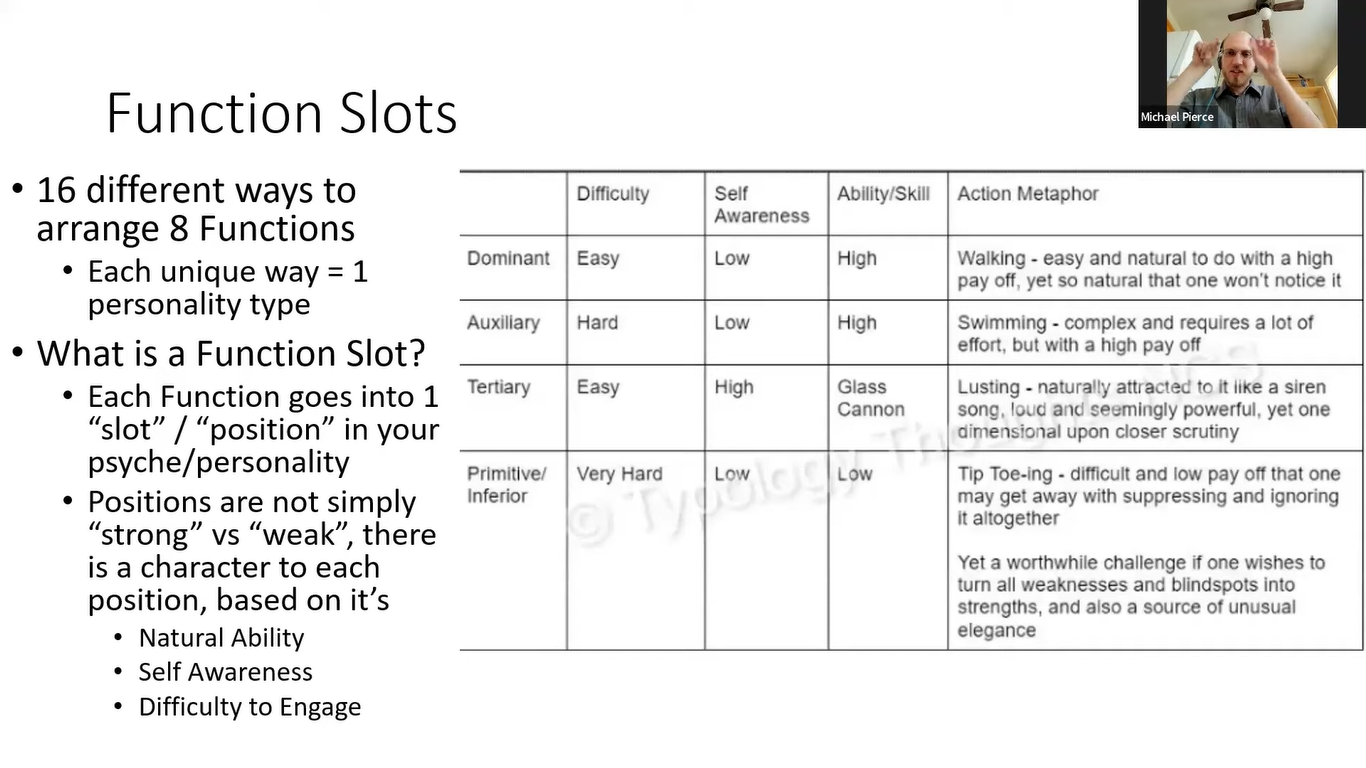
Michael:“The way that the functions are organized in a personality is that you have four function slots. You have the dominant function, you have the auxiliary function, the tertiary function, and the primitive or inferior function. We’ll start with the dominant.
The dominant function is the one that most defines you and the way that you tend to think. It’s the one that you use the most. Nicely compared with walking here, which I know is drawn from the book. Thank you, Ching. Yes, it’s the most easy and natural thing for you to do. In some cases, it can be so natural that the person will not even notice that that is definitely their mode of thinking, and that can actually sometimes be a bit of a challenge in typing people or at least in self-typing. But in any case, that’s sort of the easiest one to understand in a lot of ways. But in order to function as a person in general, you can’t just have one function, because you need multiple ways to see and to situate yourself in reality. So you have to start off with the auxiliary function, which compensates for your dominant function. So there’s always a bit of opposition there. The auxiliary function nicely compares to swimming; it requires more effort to do it, but you can do it, and it’s very useful for you to orient yourself in society. For example, I believe my dominant function is introverted intuition, so that’s what I sort of just do in the background all the time naturally. My auxiliary function is Extroverted Feeling. That is what helps compensate for my Introverted Intuition so that I’m not just sitting in my room, staring, and reading a text and trying to understand the secrets of the universe. I can actually go out and buy food and act like a normal human being. That’s a silly way of putting it, but more importantly, I associate it with my ability to situate myself in relation to other people and also a concern with social harmony.” Ching: “The Fe auxiliary really helps you in a teaching role because you’re always focused on translating that vision to something that’s palatable to the people we are speaking to, or tailoring it specifically to the people you are talking to.” Michael: “Exactly, yes. It’s not the thing that you’re naturally doing; it’s something that assists your dominant function with what it wants to do. Then you get the tertiary function. The tertiary function is something that you are very interested in, but you may not realize that you’re not actually the best there ever was at it. There can often be a bit of overestimation of one’s abilities with the tertiary function. It’s like the term here, the action metaphor, is lusting. Though you might associate it more with infatuation or fascination, you’re attracted to it, and yet it’s one-dimensional in your understanding of it, which sometimes can be a benefit. But you’re not actually, if you go up against somebody who is dominant in that function, it often becomes clear where the weaknesses lie or where the naivete lies, where the lack of cultivation there lies. So my tertiary function is Introverted Thinking, and you can see this, say, in my book where I’m creating these strict structures that are very Introverted Thinking, very logical, and they build one thing after the other. So my natural tendency would be to say, “Wow, it’s like I’m an Introverted Thinking type. I’m the master at ‘logic’ and figuring things out.” And then you compare it with my father, who is an Introverted Thinking dominant type, and he is an actual mathematician, and he can manipulate concepts and logical concepts in a way that is just completely out of my league. But in a way, he’s much more… he would not make some of the bold leaps that I make in Introverted Thinking precisely because he’s more of a veteran with it. So there’s a trade-off there. So that’s sort of scratching the surface of auxiliary and tertiary. I hope that maybe helps to differentiate them a bit.” Ching: “Oh, maybe just one point I can add to that. So, in Chinese, there is a phrase that goes “showing off in front of a master”. I use this phrase to help people differentiate between dominant and tertiary because basically when the first person, you know, who uses the tertiary function meets someone who is using it in a dominant way, they would be exactly that phrase where you are showing off in front of this master.” Michael: “Yeah, I really like that because that’s exactly what happens, that’s actually a very good phrase.” Ching: “And also, I can think of some examples. For instance, there’s a friend of mine who is an ENFJ, and she said her boyfriend is an ESTP. The ESTP’s tertiary function is extroverted feeling, making him a super party animal and a social butterfly. He’s always friendly, saying “Hey, what’s up?” to everyone and making everyone laugh. My ENFJ friend feels that he doesn’t need to be that friendly to everyone. In fact, she believes he may encourage inappropriate behaviors or enable the wrong people to become popular by focusing on only one aspect of the tertiary function.” Michael: “Yes, that’s very good, and in some sense, there is a descending order of maturity to the functions, is another way of characterizing it. The dominant function is your most mature function, the auxiliary function is pretty mature, but it’s almost like the assistant to the hero. The tertiary is much younger, much less experienced, and finally, you get the inferior function, which is the least experienced and often the most… all-or-nothing, in a lot of ways. You compared it to tiptoeing, which is very nice, difficult, and low payoff. One may get away with suppressing and ignoring it altogether. It can be a worthwhile challenge if one wishes to turn all weaknesses and blind spots into strengths and also a source of unusual elegance. So all of the functions have a function, which is the most directly opposite to it. The dominant function represses its opposite function, and its opposite function thereby becomes the inferior function. So introverted intuition is opposed to extroverted sensation, because extroverted sensation has to do with the actual objects outside of me, whereas introverted intuition has to do with the ideas inside of me. So you have this repression between the two of them, and yet it’s sort of a yin-yang, complementary association between them because you can’t have one without the other. You get a similar opposition between the auxiliary and the tertiary, where you’ll have somebody who, say, with the ESTP example that Ching gave, the ESTP is much better with Introverted Thinking, and they’ll use that in order to organize their life and give themselves principles of action. But especially as they get older, they’ll become more infatuated with Extroverted Feeling and almost think that is more important and want to associate more with that than with the introverted thinking, which they’re much better at. So, there’s this element of natural ability, self-awareness, engagement. That’s sort of the organization for the different types. So you get 16 types, in which each type has four functions, and these different slots. The reason that there are only 16 types built from eight functions is because of the natural oppositions I mentioned, where if you have Ni as your dominant function, you must have Se as your inferior function. That’s just they always go together in that way. And you can… if you have a perceiving function as your dominant, then you have to have a judging function as your auxiliary. So you get these natural oppositions, and in this almost very geometrical, mathematical way, it works out, so you only end up getting 16 distinct types.”