Intuition vs Sensing: Two Distinct Ways Our Mind Takes In Information

The Myers Briggs Type Indicator (MBTI) personality test and framework have popularized the concepts of extroversion, introversions and the cognitive processes that you probably have heard of: Thinking vs Feeling, Intuition vs Sensing. However, these concepts were first introduced in the early 20th century by Carl Gustav Jung (1875 – 1961), a famous Swiss psychiatrist who founded analytical psychology.

Understand the fundamentals of these processes is crucial for any further learning and reading of MBTI-related theories and Jungian psychology. At the very least, you will be able to decipher the various functions that make up your personality type and how they interact together to form your unique cognitive patterns.

So let’s dive in to the first pairs of two opposite processes: Intuition and Sensing! If you prefer to watch instead of reading, below is a detailed video explanation I have made on the same topic:

The Definitions

This dichotomy is how we perceive and make sense of information, either in a dominantly concrete or abstract manner.

Concrete information is tangible sensory information, something that you can feel, see, taste, hear. With regards to time, it’s also related to what is here and now, what’s currently going on in society and most immediate environment. Jung termed this process of accessing concrete information: sensing and those with this preference are called sensors

Abstract information is intangible conceptual information, such as reading between the lines, metaphors, meaning behind things, future possibilities … The person likes to think far ahead, using past data to foresee future outcomes and behaviors. The process of using abstract perception is termed Intuition and the people who prefer it over sensing are called intuitives.

We both can use sensing and intuition at will, we have preference to prioritize one over the other. Our preferred side is more dominant, natural, and more developed like the left and right hand. Sensors are generally better at noticing and remembering details of a discussion while intuitives often only remember the key points or vibe. 

 Intuition dominantSensing dominant
How an intuitive and sensor notice a book in bookshop differently (in order
of what the person see first)
Essence of what’s it about
Relevance to me
Seem a bit worn out
Eww one corner is torn off!
The cover design is corny
What is it about?
Example of how an intuitive and sensing person would notice an object differently

According to statistical studies, Sensors significantly outnumber Intuitives in the general population.(70-75% of the population are sensors). It is a big advantage if you are aware of the sensing-intuitive difference because this dichotomy is often a common source of misunderstanding in work and personal relationships.

Sensors look for concrete facts and details and take things as they are and work with them. Intuitives look for abstract patterns and connections because they prefer to deal with the potential of objects, believing that reality can be different or changed, with a hopeful lens for the future. Sensors are more realistic and grounded while intuitives are more idealistic.

When Sensors intuit for too long, they feel impatient with too much theory and abstract thoughts. Meanwhile, intuitives can easily be put off by feeling forced to explain or sequence “every little detail” and would rather get back to entertaining new or interesting possibilities to restore equilibrium to their personality.

Evolutionary and social roles

Many would think that Intuition – the ability for more abstract thinking should exist only in humans or modern humans but the truth is both Intuition and Sensing exist in animals too. A lot of animals are known for their gut feeling or ability to memorise patterns (like salmon or birds that migrate thousands of miles to the places they are born). Of course, abstract thinking is more pronounced in humans because we have developed tools like languages and the concept of time, which significantly boosts our capacity for abstract thinking.

Any MBTI types are capable of both, as mentioned above. The average humans, regardless of types, are capable of comprehending and using way more abstraction than any other species on planet earth. I suspect that the part of Intuition and Sensing in our brains are pretty distinctive and mutually exclusive. However, why don’t we all evolve to become abstract thinkers? 

Because both ways of thinking are important to get any society or any project to function. It is a matter of spectrum. For example, Einstein came up with the E=MC2 formula, which is an example of highly abstract work! But society don’t just exist out of a formula! We need to further “concretize” the abstraction into practical and applicable tasks – the realm of Sensing. We further apply it to build space craft, atomic bomb… then we need people who like to take specific instruction on how to make that part of the space craft, what color is the craft, what materials is it made of… down to the smallest details!

What does it mean for you?

I hope the overview above gives you a more accurate and objective view of the two primary modes of information perception in the population. Keep it in mind when you interact next with other people and see if you can tell if they are sensors or intuitives. Two people of the same types will have an easier time communicating while you should be a bit more mindful of people who do not share the same preference. In essence, intuitive people love abstract and somewhat theoretical discussion while sensing-dominant people want to know the details and concrete steps.

No preference is better than the others. We have our respective social roles and strengths and weaknesses. In particular, if you are an intuitive, you might be the minority but with great potential for big-pictured thoughts and acquisition of abstract and innovative information. If you ever feel misunderstood or broken in some ways cause you are not in tune or don’t care about the latest social trends or norms, it’s ok. There are other people like you and there are exciting discovery ahead when things start to make sense and you will finally discover your true identity and purpose, even if it takes slightly longer than usual.

Why Does Your MBTI Make You A Late Bloomer

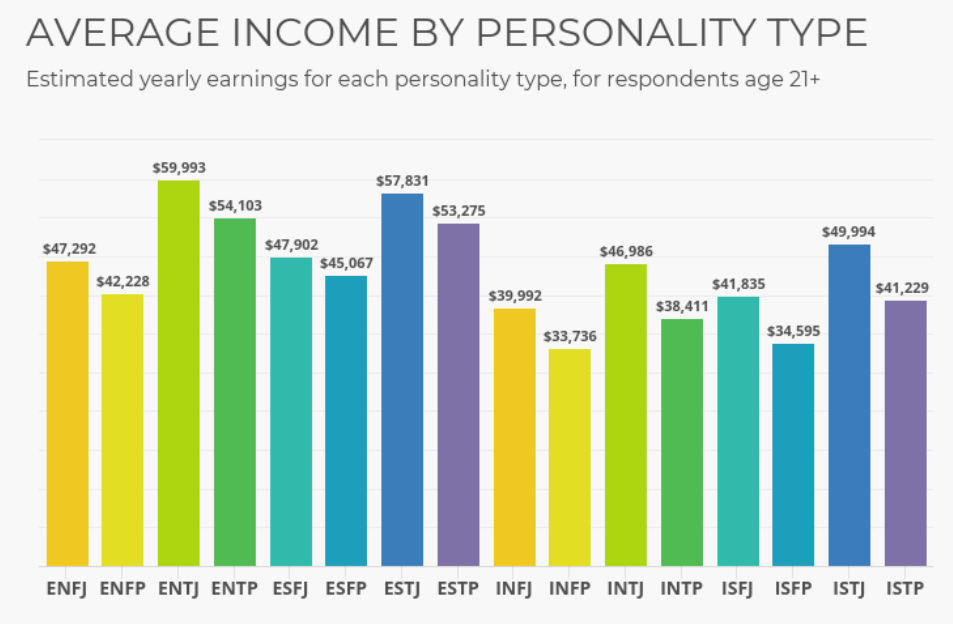
Source: truity.com

Let’s face it, even in the 21st century, what society defines as success is still very much materialistic. Whether someone is considered to do well in life depends on how high is his or her earning, his material possession and other status symbols including having (attractive) romantic partners.

The average income chart above by MBTI types portray a perspective of success. The highest earners on average are ENTJ and ESTJ while the lowest earners are INFP and ISFP. Overall, higher scores on extraversion (E), thinking (T), sensing (S) and judging (J) better predict financial success.

The reason that I phrase this article as “late bloomer” is because even though there is no survey that I know of, I do believe the material gap between types will lessen as people become more mature and balanced. The second reason is that even if the gap is still there, you will better accept who you are and the non-material and non-traditional sense of success that you create, which will give you better self-confidence and happiness down the road.

Introversion

There has been a rising support for the power of the introvert in the past decades with many books and articles that talk about the hidden advantage of being an introvert. They might be stereotyped as wallflowers who are meek and easily pushed over.

The truth is that introverts are not the minority. They are almost equal in the share of population as extroverts and introversion and shyness are not the same, though they can be easily mistaken. Introversion simply means the information processing pathway is longer and consumes more energy. Hence, introverts tend to think more and are easily overwhelmed by external stimuli.

It’s easy to see how introversion leads you to become a late bloomer. Life is tough and complicated at the start. You can be overwhelmed by the world when younger and it will take longer for introverts to consolidate and master this wave of insights and nuances in their brilliant but overwhelming minds. 

Not only can introverts catch up with extroverts later in life in material success, their insightful minds allow them to excel in highly skilled and specialized careers such as writer, scientist and philosopher. These careers might not be the best paid, but they have the potential to be highly celebrated and to propel society forward.

FEELING

If your type has letter F instead of T, you lean more towards feeling, which has to do with either intrapersonal or interpersonal relationships than efficiency and logic (T).

Feeling can either be introverted or so-called intrapersonal (Fi) (most dominant in INFP and ISFP) or extraverted/interpersonal (Fe) (which is dominant in ENFJ and ESFJ). Introverted feeling will likely have it the hardest at younger age because it is very hard to express and easily misunderstood. It is primarily concerned with moral right and wrong, living authentically and freely according to their inner compass of beauty.

This inward feeling may make you artistic yet impractical because deep down you yearn to express something of profound beauty but also makes you unable to take on more practical tasks and jobs, which feels inauthentic to your being. It will take time and sometimes luck to find a path that is both spiritually fulfilling yet lucrative. Introverted feelers like ISFP and INFP make the best artists and poets but their path will be long and rocky.

Extraverted feeling users, especially introverted ones (INFJ and ISFJ) would also feel under par because they find it hard to assert themselves and risk upsetting others. This function chiefly concerns maintaining a harmonious social atmosphere, causing you to feel it hard to just simply put people aside to get what you want. But humans are ultimately social creatures and being able to get on the good sides of the group often can take you far ahead, including in your finance and career.

INTUITION

I believe the Intuitive (N) – Sensing (S) dimension is the most interesting yet often overlooked in MBTI. Only about 25-30% of the population are intuitive, so they are way more rare than introverts! You can think of the intuitive-oriented person simply as a nerdy book-smart kind of person who is more interested in philosophy and theories than concrete facts and actions.

Intuitives, especially INFP, INTP, ENFP and ENTP (extraverted intuition) are often scattered-brain big-pictured people who have a hard time being decisive. To them the world is full of possibilities where traditional and well-accepted concepts like marriage, houses, children and even money should be questioned and explored.

With so much information and so many questions being shifted and synthesized, no wonder it takes longer for them to reach a stable stage in life. They make for smart students but somewhat clueless and restless young or even middle-aged adults while their sensing-dominant peers have happily accepted and settled into more traditional paths and roles.

However, the gift of this unconventional and big-picture mindset is the potential for paradigm shifting and holistic perspectives. Survey might suggest that intuitives earn slightly less than sensors but one reason is because the former takes longer to synthesize their perspectives, which can go beyond the immediate needs of themselves and families to challenge the status quo and propel society’s understanding forward. They make for wise and profound innovators and teachers of arts, philosophy and sciences.

So in conclusion, even if you are at the receiving end of all the disadvantaged factors above, like even in the case of INFP and ISFP, don’t be discouraged. Your mind is uniquely created for a special purpose with unique strengths and values. Of course life is tough for everyone and everyone needs a certain degree of material and practical success, but social contribution and your path to success are just not in a traditional sense. Your life purpose might be more towards helping others or helping society make new breakthroughs or to find the secrets of the universe, at the expense of the practical aspects – and that is ok!

Overview of MBTI Dimensions: Introversion, Intuition, Thinking, Judging

If you do not know or remember your Myers Briggs Type Indicator (MBTI) results, you can take one of the many free tests available such as 16personalities.com or http://www.truity.com/test/ or http://www.humanmetrics.com

Your result is a personality type with a corresponding 4-letter combo such as INFP (The Mediator) or ENTJ (The Commander). The 4 letters come from 4 dichotomies: Introversion (I)-Extroversion (E), Intuition (N) – Sensing (S), Thinking (T) – Feeling (F), and Perceiving (P) – Judging (J).

What do these letter and dichotomies mean? Those free online tests often come with a general description of your type and functions. You can read them on your own. Below is my own brief but somewhat more advanced description of the functions in these 4 dichotomies that might be worth learning.

1. Introversion vs Extroversion

introvert-or-extrovert

An extroverted behavior is one where objective (environmental) data contributes more weight than subjective input in decision making. If extroverted behaviors become habitual, then such individual is considered an extroverted type. Conversely, if a person spends more energy staying detached from objective data to listen to their own mind, he or she is considered introverted.

A very important point put forth by Jung is that introversion and extroversion are not mere deliberate choices that can be easily changed.  They are more likely to be assigned by birth randomly in the population, representing two distinct yet balancing survival strategies in organisms. An organism can be greedy and aggressively grab food and mate around to maximize successful reproduction. While another is more selective to conserve energy, strike only when absolutely necessary. Basically, introverts prefer to conserve energy while extrovers expand.

Projecting the above strategies further into humans, Jung further points out that extroverts are more likely to adjust their behaviors faster to objective data and immediate surroundings. They are more driven by short-term immediate gains, be it business opportunities or valuable things. Their morals are heavily dictated by the prevailing demand from the society at the moment.

Extroverted behaviors may allow for quick adjustments and gains to a change in environment, but can be at odds with the universal trends or laws. This is where the introverts step in to gain advantage. They listen deeper within themselves and abide by the more universal, but often misunderstood rules coded in their genes and minds since birth.

Can one really change his attitude from introvert to extrovert and vice versa? According to Jung, it could happen, but with significant resulted psychological strains and disorders. For example, a kid having to suppress his natural attitude due to unfavorable parental influence will develop neuroticism  when grow up, which can only be remedied by allowing his natural tendency to redevelop.

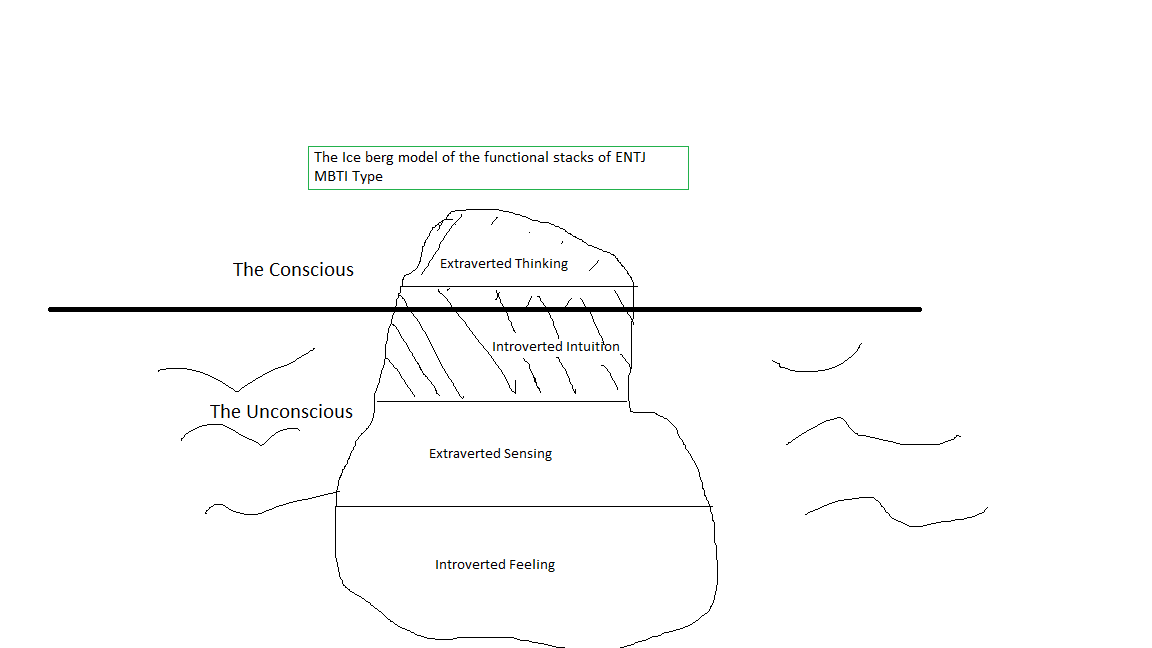
Another essential model to keep in mind as proposed by Jung is the insidious influence of the unconscious to the other functions which received less conscious energy from the subject.  He emphasized the importance of the unconscious in balancing the conscious, which is most evident in the case of dreams. Dreams often have prophetic qualities in response to anything done excessive in a person’s waking moments.

According to Jung, no function will be entirely eliminated, it can only be greatly distorted. The suppressed functions become merged with unconscious content and become bizarre in character, though one of great importance to the overall psychological well-being.

Illustration of the functional stack of ENTJ type

 2. Thinking vs Feeling

photo of two women lying on grass

At the most basic level, thinking and feeling point to 2 contrasting approaches of survival for human beings as rational yet social creatures. On one hand, one may prefer collaboration and building relationships as a survival strategy. On the other hand, some choose a more independent approach with the aim of accumulating resources for oneself and devise plans to better compete with others. Of course anyone would need some mixture of these 2 strategies to navigate human’s complex social structures.

At individual level, thinking and feeling are somewhat more visible  and easier to understand than the other dichotomies, especially in the case of extroverts. I find Socionic offered more detailed and interesting description to contrast this dichotomy (Note that they are often referred to as logic versus ethic in socionic, which I find less misleading than the term thinking and feeling): https://www.the16types.info/vbulletin/content.php/429

By Socionic models, thinking individuals are more energized by changes in the “logical world”, which are rules, systems, logical criteria and measurable results. They pay more attention to the demand of the material worlds, and are more black-and-white in terms of statement of facts being correct or incorrect etc. Feeling individuals, on the other hand, are often more expressive and energized by the “ethical world”, which ranges from overall momentary atmosphere to deeply held individual values.

3. Intuition vs Sensing

intuition-versus-sensing

Intuition and sensing are often harder to understand and very often mis-typed in my experience. People would often prefer to be viewed as intuitive than sensing-dominant. Because if thinking is considered a more advanced function which develops later in human’s evolution, the same thing can be said about intuition. Another term for intuition is abstraction, the ability to perceive beyond immediate sensory data to see the hidden patterns and concepts. Intuitive people are big-picture oriented and energized more by abstract parameters such as timing, potential, expectations, meaning etc. 

The rest of the animal kingdom is mostly unable to perform any intuitive task. Everything to them is immediate sensory input and responses. They live in the moment with no concept of time, let alone higher abstract thoughts such as the meaning of life.

Sensor is the term often used to refer to individuals dominant in sensing perception. They are often quicker in noticing surrounding movements and superficial impression: aesthetic beauty, vibe, concrete results and actions. They are often more attuned with pop culture and have highly-discriminated aesthetic tastes, making for great athletes, cooks, singers and artists. They prefer quick and concrete results and action, with little patience for theories or abstract discussions.

With that being said, there are pros and cons in being intuitive or sensing dominant. Intuitive people are stereotyped as being absent-minded professors, bland in taste and impractical. Meanwhile, sensors often have a bad reputation, especially on personality forums, as shallow, conformist, superficial, impulsive and lacking in foresight. Sensors may be the majority in the general population, but they are probably too bored to discuss personality theories online, thus being the minority here.

4. Judging vs Perceiving

This last dichotomy is probably the biggest pain point for many MBTI and Jungian purists. Judging and Perceiving are actually NOT psychological functions. They simply point out how your other two dichotomies, thinking-feeling and intuitive-sensing, orientate. If you are a P, your Dominant Extraverted function is an Perceiving function. Similarly, if you are J, your Dominant Extraverted function is a Judging function.

This is extremely confusing, I know. Perceiving functions are Intuitive or Sensing, while Rational functions refer to either Thinking or Feeling. I will have to explain the difference another time, but in short, jugding functions prioritize the perception of the objects, result or expectations of results while perceiving ones are process-oriented. If you are an INFP, your dominant extraverted function is Extraverted Intuition as compared to an INFJ who possesses a Judging extraverted function of Extraverted Feeling. 

Even though they are important, (INFJ and INFP actually have no function in common), beginners of MBTI should be more comfortable to regard the J and P letter as functions denoting abstract concepts of Being Organized versus Being Impulsive. 

It is important to remember to take them at face value, especially in the case of introverts, because they only denote the outward behaviours. An INFP is actually a Judger at heart because their dominant function is Introverted Feeling, a judging function. They would prefer to start the day with a goal and plan in mind, while an INFJ would actually go with the flow despite their outward quality of being more organized.

Jung, C. G. (2017). Psychological types. Abingdon, Oxon: Routledge.