The key to a fulfilling career is knowing yourself. This guide to MBTI temperaments reveals your natural strengths, weaknesses, and career paths that truly fit.
In this insightful video, our Human Minds founder and personality coach, Tuan Le, will quickly walk you through the enlightening work by David Kiersey built upon the MBTI frameworks to uncover the 4 main personality groups in our society. Learn what is your best-fit temperament and the corresponding strengths, weaknesses and ideal career paths.
Video timeline:
00:00 – 02:44 – Introduction of the theory 02:44 – 05:22 – The Idealist Temperament 05:22 – 09:25 – The Rational Temperament 09:25 – 11:25 – The Artisan Temperament 11:25 – 14:35 – The Guardian Temperament 14:35 – 17:10 – Reflection exercise
Are you tired of wasting time on bad dates that lead nowhere or result in a downward spiral of disappointment every time? Maybe the key here is to take a step back and reflect on the more fundamental questions of what are the signs of love? What is truly important in a relationship? And How to quickly find people with similar values?
It’s certainly a big topic but given the spirit of Valentine’s day, Our Human Minds founder and personality coach Tuan Le will share his passion on this topic. This concise yet enlightening video will hopefully give you a bigger perspective on the nature of love and long-term compatibility with personality science.
Remember to pause the video and reflect (preferably with a pen and paper ) as you go along this facilitated reflection video.
Video outline:
00:00 – 02:52 Discover the components of true love with the Triangular theory of love 02:52 – 06:25 Understand the role of personalities in both short-term attraction and long-term compatibility 06:25 – 15:15 Explore the 4 group of temperaments and their core values 15:15 – 20:28 Statistics and discussion on the temperaments’ compatibilities and chemistry
Introversion is often misunderstood term. Forget the stereotype of the shy recluse who dreads social interaction. Introversion and extroversion are not about how much you like people or how outgoing you are. Instead, they’re about where you direct your attention and energy.
Proposed by Swiss psychologist Carl Jung, the concept of introversion and extraversion illustrates two worlds wherein an individual exists on: an inner world and an outer world. Your inner world encompasses your thoughts, feelings, memories, and subjective experiences. It’s the landscape of your imagination and self-reflection. The outer world consists of everything external to you – people, places, objects, and the constant flow of information and interaction. Extroverts find their energy in the outer world. They thrive on social interaction, external feedback, and actively connecting with others.
Introverts, on the other hand, gain their energy and actually prioritize listening to their inner world first. They enjoy spending time alone, processing information internally, and engaging in deep reflection. This inward focus allows them to develop rich inner landscapes, become strong observers of the external world, and excel at activities that require concentration and thoughtful analysis. Introverts are often excellent listeners, as their focus on their inner world translates to a genuine interest in understanding the thoughts and feelings of others.
A Look At The Four Types
With a clearer understanding of what is an introvert in mind, and if you are fairly sure you are an introvert, you might be wondering if there is any specific “flavor” of an introvert that can better explain your uniqueness.
Intuition vs. Sensing: Perceiving the World Through Different Lenses
The way we take in and process information about the world can be categorized as either Intuitive or Sensing. Intuitives are drawn to the abstract and the unseen. They excel at pattern recognition, readily grasping underlying connections and future possibilities. Big-picture thinking comes naturally to them, and they are often brimming with innovative ideas. They might struggle with mundane details, preferring to focus on the broader implications and potential outcomes.
What do you see? Intuition and Sensing can often be simplified as seeing the forest first or the tree first?
Sensors, in contrast, find comfort in the concrete and the present. They are detail-oriented observers, meticulously collecting and analyzing sensory information. Their strength lies in their ability to focus on the here and now, ensuring accuracy and practicality. They excel at creating and maintaining routines, finding comfort in the familiar. While not dismissive of future possibilities, Sensors prioritize the tangible world and the information readily available to their senses.
Combining Sensing & Intuition and Introversion, we have two introverted functions that correspond to two types of introverts:
The Traditionalist, Introverted Sensor (Si): Si-dominant individuals find comfort in familiarity and tradition. They excel at observing details and preserving past experiences. However, they can also be too stubborn and stay in their sensory “comfort zone” and not be adaptable and miss out on new trends or opportunities.
The Visionary, Introverted Intuitive (Ni): With Ni at the forefront, these individuals perceive the world through a lens of possibilities and hidden meanings. They possess a strong foresight and can readily grasp the essence of situations. However, once their vision is formed, they often stick to it stubbornly without willing to take feedback or adjust to the reality of the situation.
Thinking vs. Feeling: Navigating the Decision-Making Landscape
Thinkers and Feelers represent two distinct approaches to decision-making. Thinkers, as the term suggests, prioritize logic and objectivity. When faced with a choice, they meticulously analyze information, weigh pros and cons, and strive for solutions that are fair and consistent. They are drawn to clear-cut principles and frameworks, often employing a step-by-step approach to reach a conclusion. Emotions might play a role in the initial consideration, but ultimately, logic reigns supreme for Thinkers.
Feelers, on the other hand, make decisions with a heart-centered approach. They place significant value on emotions, both their own and those of others. When evaluating a situation, they consider how the decision will impact people involved and how it aligns with their personal values. Empathy is a cornerstone of their decision-making process. While Feelers can be logical, their emotions often hold significant weight in the final verdict.
Combining Thinking and Feeling with Introversion, and we have two introverted functions that correspond to two types of introverts:
The Empathetic Individualist, Introverted Feeler (Fi): Driven by their strong moral compass, Fi-dominant introverts are authentic and compassionate. They excel at understanding the emotions of others and championing causes they believe in. However, their strong convictions can sometimes make them judgmental of those with differing viewpoints.
The Analytical Mind, Introverted Thinker (Ti):Fueled by a thirst for knowledge, Ti-dominant introverts are analytical and systematic thinkers. They enjoy constructing logical frameworks and solving problems efficiently. However, their focus on logic can sometimes make them seem detached or insensitive to the emotions of others.
A Spectrum of Strengths
As you can see, each introverted type brings valuable strengths to the table as well as corresponding weaknesses. Traditionalists provide stability and preserve valuable traditions, visionaries inspire with their foresight and ability to see the bigger picture, empathetic individualists champion what’s right and foster strong connections, and analytical minds bring order and logic to complex situations.
Regardless, a common pitfall (as well as strength) for anyone leading with an introverted function is their stubbornness and single-mindedness that may benefit from being more open to external data and input.
So, which type of introvert do you resonate more with? Share your thoughts and experiences in the comments below!
Webinar timing: 18 Mar (Mon), 9pm-10pm Singapore time (9am EST)
Do self-limiting beliefs hold you back from unleashing your full potential? Ambitious managers and professionals, known for being hard on themselves, often struggle with these negative self-beliefs which can reinforce a cycle of low self-esteem, weak boundaries and burnout.
The key to breaking this cycle lies in objective self-awareness: firmly recognizing your strengths, and acknowledging the accompanying weaknesses. While various tools frameworks are available to aid in your self-awareness journey, the Myers Briggs Type Indicator (MBTI) stands out as a highly comprehensive and popular modern self-discovery framework. It’s widely used by millions of individuals and many Fortune 500 companies to enhance workplace relationships and leadership coaching.
Join our community for this exclusive crash course aimed at helping you conquer your negative self-beliefs and transform them into strengths and confidence through the secrets of the less well-known 8 Cognitive Functions.
Introduction to MBTI and Jungian cognitive functions
A quick crash course on cognitive function definitions
Reflection on how your dominant functions reveal your strengths and corresponding weaknesses
Explore practical strategies for developing your weaker functions
Q&A
The most helpful aspect is I could again a level of self-awareness and how this impacts how I engage with others and what works for me , but also a good list of tips that I can share with others who engage with me often so that they can understand how I work/think.
Denise, English instructor
Guided by a certified Type Coach Tuan Le with over 8 years of experience in personality psychology, participants will engage in lively yet intimate discussions focused on self-healing and self-exploration, emerging with deeper insights and increased self-confidence. Secure your spot now and be part of this enlightening experience.
Note: This form will close 1 day before the event or when the participant limit have been reached.
Registration has now been closed. You may check out the next training here.
This is a recorded webinar, please request for the link via the registration form below.
If you’re feeling frustrated with the dating scene, you’re not alone. Trying to find the right partner can be both fulfilling and dating experience. There’s no easy formula, just like anything worthwhile in life, but there is a way to equip yourself with the right mindset so you can select better as well as be much more understanding with your partners & special people in your life..
Typology or personality science is a powerful tool that categorizes people into personality patterns, allowing you to overcome psychological biases and lack of information to see the core of another person. In this expert-led session, we will learn and discuss:
Agenda:
Introduction: the role of personality in relationship compatibility
Compatibility vs acceptance, what’s more important?
The biggest hindrance to understanding: ego and naive realism
Introduction to Jungian Function & Temperaments as essential tools for people reading
Statistics and discussion of different temperament pairing and happiness
Q&A and sharing
About the trainer: Tuan Le is a passionate veteran in personality psychology. A certified typology coach, he has spent over 8 years learning and later training the public in the psychological frameworks such as MBTI, Enneagram, Socionics…. He is passionate about fostering better self-awareness and interpersonal understanding through objective and deeper understanding of personalities. Read more
Submit the registration form below to receive your link:
Hello personality enthusiasts! We had the honor to be able to have Michael Pierce to do a public session for the Singapore Typology Community. Michael Pierce is a Jungian researcher and well-known figure online with his substantial work published under the book “Motes and Beams”. I hope his beautiful analogies and philosophical analysis can help many beginners to move from simple personality quizzes to the beautifully nuanced world of Jungian Typology.
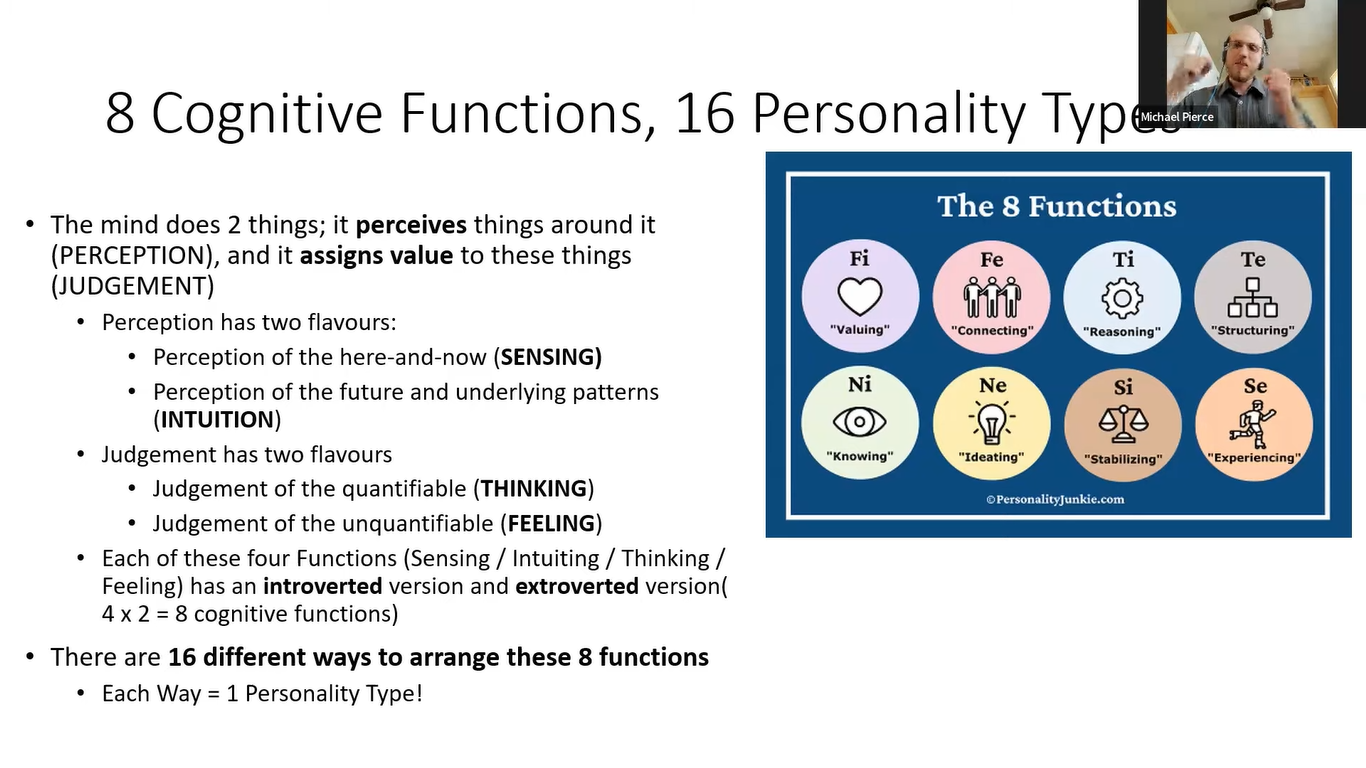
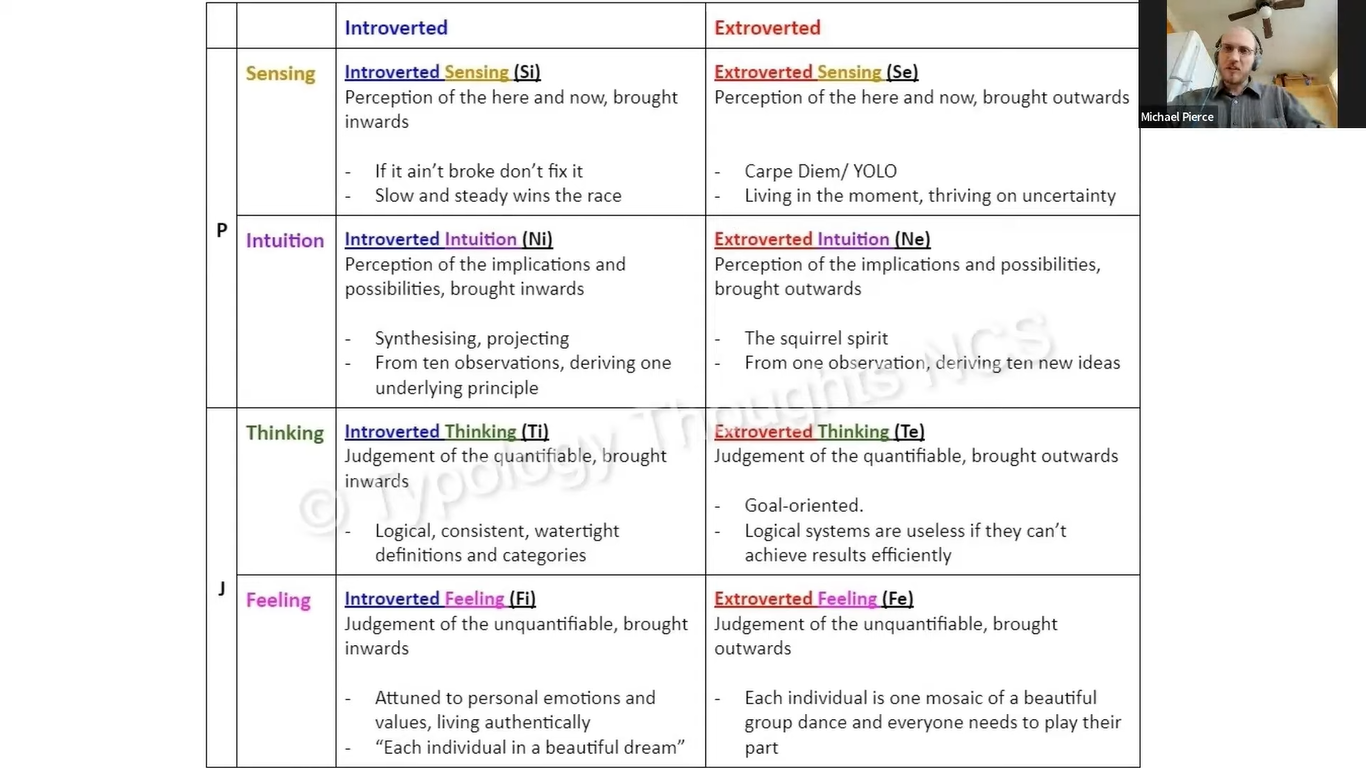
Michael: “You’re about to join me down the rabbit hole of this more complex, advanced system known as Cognitive Function Theory or Jungian Theory. So, we begin with Perception and Judgment. These appear in the MBTI test as a dichotomy pair. In Jung’s Theory, they serve a bit of a different role. Perception simply refers to how you perceive the world. It takes in information and it doesn’t categorize it, it doesn’t make any judgments about it. It is only interested in what the things are that are being perceived and are coming into the personality, into your mind. Judgment, as it’s been laid out here, assigns some sort of value to these things. It categorizes them, it judges them. So these two are opposites, but they’re complimentary. Perception has two flavors, or there are two kinds of perception, and in the same way, there are two kinds of Judgment. There are slightly different theories about precisely the correct way to justify splitting them into two flavors, but for our purposes, we’ll just take it for granted and say Perception has two flavors. One is Sensing or Sensation. That’s the perception of what is actually there, the here and now. It has to do with the present, and it also has to do with concrete objects, a lot of the time. Whereas Intuition is a perception of the future, of underlying patterns, of the possibilities of things. That’s how I often try to refer to it. So Sensation is almost like a more direct line to the object, whereas Intuition tends to go around it to things that are implied by the object. So, Sensation is generally very concrete, down to earth. Intuition is very creative but can also be very head in the clouds about things. Those are two ways of just perceiving the object. Judgment also has two kinds: Thinking and Feeling. It’s important to note that we use the terms Thinking and Feeling in a very different way from how they are more precisely used in Jung’s Theory. But as Ching has laid it out nicely here, Thinking is judgment of the quantifiable, and Feeling is judgment of the unquantifiable. There’s a correspondence, at least in my theory, my approach to it, between Thinking and Sensation and Feeling and Intuition. Thinking has to do with judging things in terms of rigid categories and logic, whereas Feeling has more to do with values, ethics, how you and other people are feeling. So that’s sort of the distinction. Okay, so now we have four functions, and note we’ve just sort of built them beginning from Perception and Judgment, and we’ve built our way up to Sensation, Intuition, Thinking, and Feeling, which again you would recognize those from the MBTI, the Myers-Briggs test, and other tests online.”
The Dichotomy of Extraversion and Introversion
Michael: “So now we’re going to do the division game again. We’re going to introduce a new dichotomy, Introversion and Extraversion, and by doing that, we will multiply the four functions into eight cognitive functions. Extroversion is an attitude. It’s a focus on what we call ‘the object’. So I perhaps should have started with this, but just so you understand the terminology, the object is anything that is not you. It is the thing that you are focusing on, in order for anything to happen in psychology, you have to have an object and you have to have a subject. The subject is the mind, the subject is the person or the being that has the psychology going on inside them, as it were. And for every subject, there needs to be objects that that subject can think about and can focus on. For Extroversion, there is this, as it were, outward turning and outward focus towards the objects that are out there in the world. And Introversion is a turning inwards to the way that your own subject is. So in some sense, Introversion, you could say, is making an object of your own subject. But I don’t want to start getting into loops of language and so forth. The more important thing is the outward motion versus this inward motion. And so we can split up Sensation and Thinking, and Feeling and Intuition via Extroversion and Introversion. So we would get extroverted sensation, introverted sensation, extroverted thinking, introverted thinking, so forth.
You’ll notice in the little chart up here, they are abbreviations. So Fi would be Introverted Feeling. So the F is for Feeling, the T is for thinking, the S is for Sensation, and the N is for Intuition. Even though intuition starts with an I, it’s abbreviated with an N so it doesn’t get mixed up with Introversion. And then each of those has a little I for Introversion after it or a little E for Extraversion after it. So that’s the notation and how that works. It’s a lot faster to just write, say, Fe rather than Extroverted Feeling because that would get a lot of letters on the page. So finally, we have eight cognitive functions. And now what we’re going to do is we’re going to arrange these functions in order to get 16 different personality types. Let’s just run over what these cognitive functions are and how they work.”
What is “Sensation”?
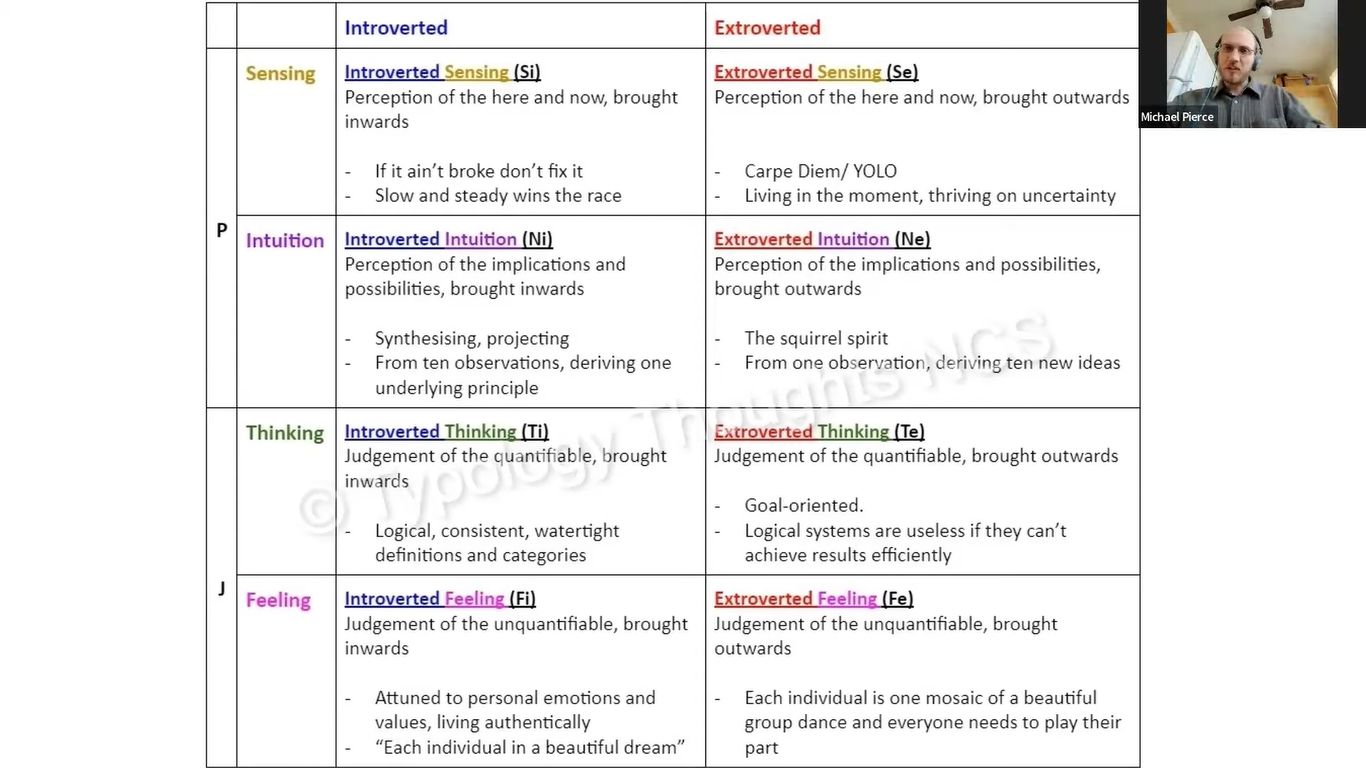
Michael: “There are two kinds of Sensation: Introverted and Extroverted. I’ll start with Extroverted Sensation. Going by our definitions, Extroverted Sensation would be sensation but directed outward, as it were. It is directed to objects in the here and now. Somebody who is using Extroverted Sensation is someone for whom that is the dominant function they prefer to use. There tends to be a very, as it were, carpe diem, YOLO, living in the moment, thriving on uncertainty. People who are Extroverted Sensing types in my experience thrive in situations where there’s a bit of chaos, and it can stress them out as well, but they’re often much better than introverted types at dealing with that because they’re just going moment by moment. They see what concretely is happening around them, and they just keep track of everything and flow in order to adapt to what is happening in the moment. So, you know, emergency workers, firefighters, police, a lot of people who have to deal with emergency situations. It doesn’t just have to be that. You can still find them in more academic disciplines at times, though that is usually through focus on other functions. So that’s Extroverted Sensation, very in the moment. Introverted Sensation reverses that in an interesting way, because the sensation is directed inwards. So Introverted Sensation people, not in a political sense at all, per se, but there’s a kind of conservatism, they’re much slower and more removed from the outside world, as compared to the extroverted sensor. It is perception of the here and now but brought inwards.
My mother, for example, is a dominant Introverted Sensation type, and she has a very sensitive palate. She usually does a lot of the cooking. She prefers to do the cooking because she can cook the things right. And every time we sit down to dinner, she will eat the food and she will be comparing what she is tasting here and now with these sort of ideal sensations that she has in her own mind. And she compares those sensations to that ideal sensation, and it’s that ideal sensation which is more real for her than the sensations in the here and now. And so she will taste and say, “This tastes like it has too much salt. This shouldn’t have as much salt as it does at the moment,” whereas I’m sitting there, and I’m like, “Oh, this is a salty dish“. But for her, it’s like, “No, it’s more salty than the way it should have salt”. And if you’re clever, you might notice there’s some relation with judgment, which I don’t really have time to get into that right now, but it’s a valid observation. So anyway, you get a conservatism there. It’s not “live-in-the-moment”. One of the other things my mother would do is when something flashy or wild or very quick would happen, she would take a moment and she would just say, “I’m just processing what just happened”. And she’s processing the sensory aspect of it. So they all also will often be very good journal keepers, very meticulous, able to remember all of the details and repeat those back.
What is “Intuition”?
Michael: “So now we move on to Intuition. We have Extroverted Intuition, which is a perception of implications and possibilities brought outwards. It is a focus on ideas and possibilities. Almost like they’re juggling a lot of different ideas at one time. But more importantly, it’s the fact that those ideas are out there. A better way of putting it is it’s almost like ideas are actual objects for them that exist outside of themselves and exist on their own. So the result of this is that ideas tend to diverge for them. From one observation, you can derive ten new and distinct ideas from it. So there’s this branching out, and it very quickly can turn into a kind of chaos for them. But it’s very, very fruitful because they will see all of the ways you can split up one topic into different topics.
Introverted Intuition does sort of the opposite. Introverted intuition, because it turns inwards, has a tendency to see similarities between things to a certain extent and to say, “This idea is really just this idea if you put them next to each other.” You can sort of collapse things into each other. From 10 observations, you derive one sort of vision or one underlying principle. Extroverted Intuition is almost like, you have one point, and then you draw an infinite number of lines through that one point to show all of the different ways you can diverge from that one point. Whereas intuition or introverted intuition, you have say 10 points, and then you try to draw a line of best fit, if you know that from algebra, you try to draw a single line that sort of averages out all of those individual observations, and that is the single idea which is then kept in Introverted Intuition. So kind of like with Introverted Sensation where I mentioned this notion of having ideal sensations that you kind of use to organize the sensations in the outside world, similar idea with Introverted Intuition, but with ideas, you have sort of a single idea that you are relating things back to. So Extroverted Intuition is stereotypically… it doesn’t necessarily look like this, but stereotypically, lots of different ideas. Very kind of scattered brains, running all over the place, whereas introverted intuition is like, “I have the eyes that stare into your soul,” you know, kind of like the chess grandmaster or something like that.”
What is “Thinking”?
Michael: “Thinking is judgment that is based on logic and facts, and it’s broader than that, but that’s the quickest way to explain it. So Extroverted Thinking is very goal-oriented. It’s very, “I want to accomplish things out there in the world. I want to organize the actual materials or people or resources that I see outside of me. I want to work with the external facts of a situation. Here’s where we should go with something. Here’s how we make things more efficient.’” Ching: “Everyone always has this mindset that Extraversion means party animal, you know? So when I meet someone and I say, ‘Oh, I think you have a very strong Extraverted Thinking,’ they often say, ‘Oh, I’m not an extrovert. I’m just doing all the work in the background,’ but it is precisely the fact that they are doing all the work that is the Extroversion, and that is the Jungian definition of Extroversion that is that we don’t really use nowadays.” Michael: “Thank you, Ching. Yes, that’s a very good point. It’s important to leave aside some of your preconceptions about what Extroversion and Introversion mean in order to properly understand these. You can get people who will seem very introverted in a colloquial sense, in an everyday sense, but the way that their mind actually functions would be described better by one of the extroverted functions. Perhaps, and as we shall see soon, everybody has extroverted sides and introverted sides. It’s just a matter of how they are arranged in relation to each other. So it’s never as simple as whether you’re a party animal or you want to stay home and read books.
So that’s Extroverted thinking, very pragmatic. Introverted Thinking, again, we have this idea where it’s almost the thinking idea inside of one’s own subject which takes precedence over the facts out there. So there’s a focus on refining logical ideas, refining and making those ideas perfectly precise, pure mathematics almost all the time. That’s where you’re going to find more Introverted Thinking types. But they’re much more interested in the theory and in making things logical and consistent, and then taking that theory and then after the fact applying it to what’s going on out there. They’re always much more interested in making the definitions and ideas more precise. Rene Descartes, a French philosopher, he’s famous for saying, “I think, therefore, I am”. That is very introverted thinking because what he literally did was said, “I can’t trust any of my external knowledge of the outside world because, you know, it’s possible that I am deceived or I’m hallucinating or I’m dreaming or something. All I can trust, and what is more real for me, is my own thoughts, my own principles that I’ve developed.” This is very introverted thinking. So that’s how those two go. You kind of have this difference between theory and practice, which would be a very general way of differentiating them.”
What is “Feeling”?
Michael: “Finally, we have Feeling. Extroverted Feeling is a feeling which is sort of directed outwards. It is objectified. Extroverted Feeling will generally be much more naturally outwardly expressive. It will be in tune with what expressions are the most socially acceptable or most harmonious to the needs of the group. Ching wrote a nice little thing, actually, a very nice little description here: “Each individual is one Mosaic of a beautiful group dance, and everyone needs to play their part.” That’s great. The dance especially is a great way of putting it because you have this notion of the need to not focus on how you’re feeling or your own feelings, but to harmonize with the group and to try to promote the feelings of the group as a whole. So you see there’s this movement outwards in terms of one’s ethics. When someone has dominated Extroverted Feeling, there will often be this sort of blurring of the line where they will be literally feeling what they think should be felt. And if they’re not feeling what should be felt, then they’re like, “Something’s wrong. If I’m not crying at a funeral, something’s probably wrong. This isn’t how you’re supposed to feel objectively in this situation”. They also don’t say certain things to certain people because they think they’re just going to screw everything up.
Introverted Feeling is where the feeling is directed inwards. You have to get past some of the connotations of the language because when I say they’re much more focused on how they are feeling, it sounds as though they’re self-absorbed and selfish. And from the Extroverted Feeling perspective, they are. From that perspective, that’s what’s going on. But then that gets challenged when you find that some of the most empathetic and self-sacrificing people I’ve met have been Introverted Feeling types. And that’s because it sort of messes with the selfishness-selflessness division. Introverted feeling is that feeling which is internal or individual to you. If you’re crying at a funeral because you knew the person and you had a personal connection with them and you are genuinely, like, this is how I feel regardless of how everybody else is feeling, that’s good because that indicates that you are more in alignment with your own feelings and your own soul. But if you’re just crying at the funeral because that’s what you’re supposed to do, then that’s like, who are you? You’re like an empty shell. I once had an argument with a friend of mine who wasn’t a dominant Introverted Feeling, but they had that in there as one of their major functions, and they were always asking me, like, “So, how do you feel about this or that controversial issue?” And I, being more Extroverted Feeling, was always like, “I don’t really want to answer that .. What’s more important is how are you going to react to how I feel about such and such”. As far as my feelings go, those just seem so ephemeral and so kind of unrelated to the topic… and it would turn into just us arguing over whose feelings are right, and that wasn’t useful. But that wasn’t how she thought about the things. So, that’s your crash course in the eight functions.“
How are cognitive functions organized to form personality types?
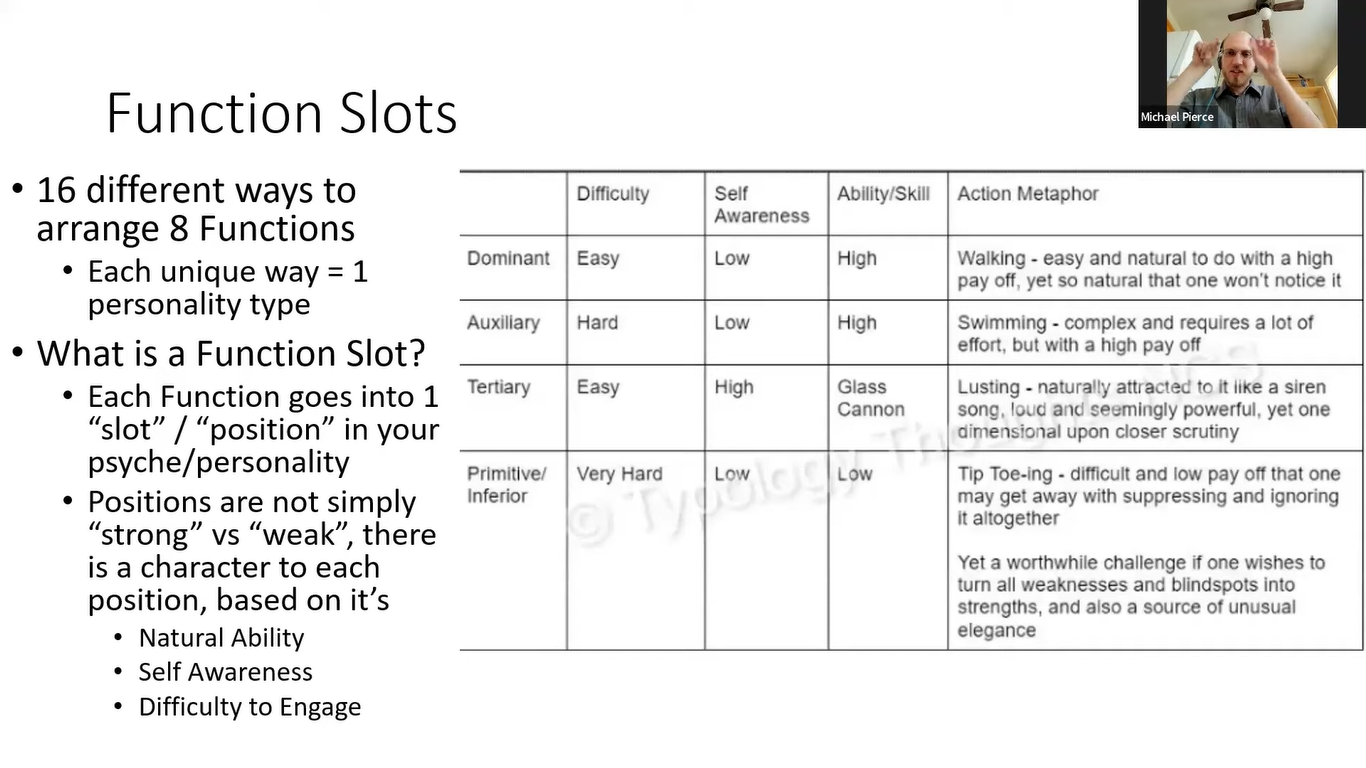
Michael:“The way that the functions are organized in a personality is that you have four function slots. You have the dominant function, you have the auxiliary function, the tertiary function, and the primitive or inferior function. We’ll start with the dominant.
The dominant function is the one that most defines you and the way that you tend to think. It’s the one that you use the most. Nicely compared with walking here, which I know is drawn from the book. Thank you, Ching. Yes, it’s the most easy and natural thing for you to do. In some cases, it can be so natural that the person will not even notice that that is definitely their mode of thinking, and that can actually sometimes be a bit of a challenge in typing people or at least in self-typing. But in any case, that’s sort of the easiest one to understand in a lot of ways. But in order to function as a person in general, you can’t just have one function, because you need multiple ways to see and to situate yourself in reality. So you have to start off with the auxiliary function, which compensates for your dominant function. So there’s always a bit of opposition there. The auxiliary function nicely compares to swimming; it requires more effort to do it, but you can do it, and it’s very useful for you to orient yourself in society. For example, I believe my dominant function is introverted intuition, so that’s what I sort of just do in the background all the time naturally. My auxiliary function is Extroverted Feeling. That is what helps compensate for my Introverted Intuition so that I’m not just sitting in my room, staring, and reading a text and trying to understand the secrets of the universe. I can actually go out and buy food and act like a normal human being. That’s a silly way of putting it, but more importantly, I associate it with my ability to situate myself in relation to other people and also a concern with social harmony.” Ching: “The Fe auxiliary really helps you in a teaching role because you’re always focused on translating that vision to something that’s palatable to the people we are speaking to, or tailoring it specifically to the people you are talking to.” Michael: “Exactly, yes. It’s not the thing that you’re naturally doing; it’s something that assists your dominant function with what it wants to do. Then you get the tertiary function. The tertiary function is something that you are very interested in, but you may not realize that you’re not actually the best there ever was at it. There can often be a bit of overestimation of one’s abilities with the tertiary function. It’s like the term here, the action metaphor, is lusting. Though you might associate it more with infatuation or fascination, you’re attracted to it, and yet it’s one-dimensional in your understanding of it, which sometimes can be a benefit. But you’re not actually, if you go up against somebody who is dominant in that function, it often becomes clear where the weaknesses lie or where the naivete lies, where the lack of cultivation there lies. So my tertiary function is Introverted Thinking, and you can see this, say, in my book where I’m creating these strict structures that are very Introverted Thinking, very logical, and they build one thing after the other. So my natural tendency would be to say, “Wow, it’s like I’m an Introverted Thinking type. I’m the master at ‘logic’ and figuring things out.” And then you compare it with my father, who is an Introverted Thinking dominant type, and he is an actual mathematician, and he can manipulate concepts and logical concepts in a way that is just completely out of my league. But in a way, he’s much more… he would not make some of the bold leaps that I make in Introverted Thinking precisely because he’s more of a veteran with it. So there’s a trade-off there. So that’s sort of scratching the surface of auxiliary and tertiary. I hope that maybe helps to differentiate them a bit.” Ching: “Oh, maybe just one point I can add to that. So, in Chinese, there is a phrase that goes “showing off in front of a master”. I use this phrase to help people differentiate between dominant and tertiary because basically when the first person, you know, who uses the tertiary function meets someone who is using it in a dominant way, they would be exactly that phrase where you are showing off in front of this master.” Michael: “Yeah, I really like that because that’s exactly what happens, that’s actually a very good phrase.” Ching: “And also, I can think of some examples. For instance, there’s a friend of mine who is an ENFJ, and she said her boyfriend is an ESTP. The ESTP’s tertiary function is extroverted feeling, making him a super party animal and a social butterfly. He’s always friendly, saying “Hey, what’s up?” to everyone and making everyone laugh. My ENFJ friend feels that he doesn’t need to be that friendly to everyone. In fact, she believes he may encourage inappropriate behaviors or enable the wrong people to become popular by focusing on only one aspect of the tertiary function.” Michael: “Yes, that’s very good, and in some sense, there is a descending order of maturity to the functions, is another way of characterizing it. The dominant function is your most mature function, the auxiliary function is pretty mature, but it’s almost like the assistant to the hero. The tertiary is much younger, much less experienced, and finally, you get the inferior function, which is the least experienced and often the most… all-or-nothing, in a lot of ways. You compared it to tiptoeing, which is very nice, difficult, and low payoff. One may get away with suppressing and ignoring it altogether. It can be a worthwhile challenge if one wishes to turn all weaknesses and blind spots into strengths and also a source of unusual elegance. So all of the functions have a function, which is the most directly opposite to it. The dominant function represses its opposite function, and its opposite function thereby becomes the inferior function. So introverted intuition is opposed to extroverted sensation, because extroverted sensation has to do with the actual objects outside of me, whereas introverted intuition has to do with the ideas inside of me. So you have this repression between the two of them, and yet it’s sort of a yin-yang, complementary association between them because you can’t have one without the other. You get a similar opposition between the auxiliary and the tertiary, where you’ll have somebody who, say, with the ESTP example that Ching gave, the ESTP is much better with Introverted Thinking, and they’ll use that in order to organize their life and give themselves principles of action. But especially as they get older, they’ll become more infatuated with Extroverted Feeling and almost think that is more important and want to associate more with that than with the introverted thinking, which they’re much better at. So, there’s this element of natural ability, self-awareness, engagement. That’s sort of the organization for the different types. So you get 16 types, in which each type has four functions, and these different slots. The reason that there are only 16 types built from eight functions is because of the natural oppositions I mentioned, where if you have Ni as your dominant function, you must have Se as your inferior function. That’s just they always go together in that way. And you can… if you have a perceiving function as your dominant, then you have to have a judging function as your auxiliary. So you get these natural oppositions, and in this almost very geometrical, mathematical way, it works out, so you only end up getting 16 distinct types.”
Have you ever met someone who seemed to just “get” you from the very beginning? For INFPs and INFJs, that connection can feel almost magical. Both types are deeply empathetic, introspective, and committed to personal growth. It’s easy to imagine that these two personalities would be the perfect match. However, like any other pairing, there are several differences between them, leading to unique challenges that they have to navigate. How do these similarities and differences play out in real-life relationships? Let’s take a closer look.
But first, let’s have a quick overview of INFJs’ and INFPs’ cognitive functions, which will serve as a reference throughout the article. Cognitive functions are the mental processes- the bricks that build the house which is your personality! Even though they have only one letter different, INFJ and INFP actually share zero common cognitive functions (in the top 4)! There are a total of eight cognitive functions with each MBTI personality type having a unique sequence of the functions. Simply put, the top or dominant function has the strongest influence on our thoughts and behaviors followed by auxiliary, tertiary…. The top-four cognitive functions of INFJs and INFPs are:
INFJ
INFP
Dominant
Introverted Intuition (Ni) – relies on abstract connections, speculates about potential and potential implications.
Introverted Feeling (Fi) – relies on value judgment – a deep understanding of personal values and beliefs, and a desire to live in congruence with them.
Auxiliary
Extraverted Feeling (Fe) – relies on sensitivity to the emotional states of others and feelings of harmony with the world.
Extraverted Intuition (Ne) – relies on abstract possibilities, generates novel ideas about what things can be.
Tertiary
Introverted Thinking (Ti) – uses personal framework of technical knowledge and skill to prevent/avoid/solve problems
Introverted Sensing (Si) – relies on sensory details, processes concrete details via comparing/contrasting with past experiences.
Inferior
Extraverted Sensing (Se) – maintains direct relationship to the world via physical sensations.
Extraverted Thinking (Te) – relies on knowledge of external systems, uses empirical data to make effective decisions
For a more detailed explanation and examples for each cognitive function, click here.
Now that we have a better understanding of their cognitive functions, we can examine how these functions interact to create the foundation of great INFJ-INFP relationships.
What draws INFJ and INFP to each other?
INFJs and INFPs share a lot of similarities, which is why they are often considered to be highly compatible. Some of them include:
Emotional compatibility
INFJs and INFPs are highly compatible due to their shared capacity for experiencing emotions on a deep and meaningful level. Both types possess a strong sense of empathy and prioritize emotional connection in their relationships. INFJs utilize their Extraverted Feeling (Fe) function to intuitively understand the emotions and needs of their partner. They often place their partner’s feelings above their own, striving to maintain peace and harmony in the relationship.
Meanwhile, INFPs use their dominant Introverted Feeling (Fi) function to remain true to their own emotions while simultaneously empathizing with their partner by understanding their emotions. Since INFJs’ Feeling function is directed outwards, they can quickly realize how others are feeling but often have trouble identifying their own emotions. INFPs help them explore their feelings by mirroring them, and provide them a safe space to express themselves without any fear of judgment.
Intuitive connection
Both INFJs and INFPs share a deep connection through their intuitive nature. INFJs have dominant Introverted Intuition (Ni), which provides them with sudden flashes of insight into the meaning of things, sometimes in the form of images, words, or even symbols. This can be perceived as strange or confusing by other personality types, but INFPs can easily understand and appreciate their thought process, and don’t ask for logical justifications for their insights. INFPs’ auxiliary function, Extraverted Intuition (Ne), allows them to make connections between different ideas and things in their environment and make predictions. Although their Intuition is directed outwards, they can still relate to the unexplainable sense of just “knowing” about something.
This mutual understanding of intuition creates a profound level of communication and empathy between INFJs and INFPs. They are able to pick up on subtle cues and unspoken feelings, allowing them to connect on a deeper level than many other personality types. This makes them highly compatible in both friendships and romantic relationships.
A shared disdain for shallow relationships
INFJs and INFPs share a strong aversion to shallow relationships. They prioritize deep and meaningful connections and are often dissatisfied with superficial interactions. As intuitive feelers, they crave authenticity and are drawn to others who share their values. This shared disdain for superficial relationships creates a strong bond between these two personality types, allowing them to build a relationship based on trust, emotional depth, and a mutual desire for genuine connection.
Balanced planning and exploration:
INFJs and INFPs complement each other’s tendencies towards action and contemplation. INFPs inspire INFJs to take a more relaxed approach to their day-to-day life and enjoy the journey rather than focusing solely on the destination. On the other hand, INFJs motivate INFPs to come up with concrete plans and take action towards achieving their ideas. Together, they can strike a balance between dreaming and doing, creating a harmonious partnership.
INFJs, being a “J” type, are naturally inclined towards closure, planning, and getting things done. They tend to be perfectionists, always striving for the best solution to a problem, and often stressing about getting everything done on time. In contrast, INFPs, being a “P” type, are more focused on exploration and trying out different options. They enjoy seeing where the plan takes them, and are not as worried about sticking to a strict schedule. This is where they balance each other out. INFJs help INFPs pare down their ideas and options to the most suitable ones (using their Ni), and INFPs prevent INFJs from getting caught up in planning and overlooking opportunities for exploration (using their Ne).
Respect for boundaries
INFJs and INFPs both have introverted personalities, and they understand the value of space and alone time. They understand that personal space is not a sign of disinterest or dislike, but a necessary part of recharging and reflecting. They appreciate each other’s need for solitude and respect it, without feeling neglected or hurt. They can match each other’s energy and wavelength, creating a harmonious balance in the relationship. Being introverts, they also prefer meaningful conversations over small talk, which deepens their emotional connection.
Shared interests and preferences
INFJs and INFPs share a lot of common interests and values, which makes them compatible partners. They both tend to have hobbies that involve creativity and introspection, such as reading, writing, painting, or playing music. They also share a preference for people who are thoughtful and empathetic, and both tend to value deep and meaningful connections with others over superficial ones. In terms of their social lives, both INFJs and INFPs tend to prefer a small circle of close friends rather than a large group of acquaintances, and they generally prefer quieter, more low-key activities over loud, crowded events.
Additionally, both types have deep appreciation for art and the meaning it brings to life. Last but not least, they both tend to be non-materialistic, valuing meaning and depth over material possessions and superficial glamor. These shared values and interests create a strong bond between INFJs and INFPs, making them a natural match for one another.
Potential conflicts in INFJ-INFP relationships
While INFJs and INFPs share many similarities that make them compatible, their different approaches to processing and expressing emotions can create potential areas of conflict, such as below.
Prioritization of values
While both INFJs and INFPs prioritize values, they differ in their focus. INFJs tend to prioritize social values and harmony (Fe) while INFPs prioritize their individual values and feelings (Fi). This difference in focus can lead to conflicts, especially when it comes to decision-making as a couple. Conflict can also arise when it comes to issues that affect the broader society. INFJs may be more willing to compromise their individual values in the interest of social harmony, while INFPs may get defensive and feel more strongly about sticking to their personal values, even if it means going against the norm. These differences in prioritization can lead to misunderstandings and disagreements between the two types.
Communication challenges
Both INFJs and INFPs struggle with expressing their own needs and emotions in a clear and direct manner. INFJs may expect their partners to anticipate their emotions as they do for their partners, leading to unrealistic expectations and potential conflict. On the other hand, INFPs may become defensive and withdraw from conflict, leading to unresolved resentment. These communication challenges can put a strain on the relationship and make it difficult to maintain a healthy and fulfilling partnership.
Pursuit of knowledge
Another potential area of conflict between INFJs and INFPs stems from their different approaches to seeking knowledge. While both types are idealistic and passionate about their beliefs, INFPs tend to have a more free-form approach to intellectual exploration, following their hunches (Ne) without worrying too much about confirmation. In contrast, INFJs are highly focused on testing and confirming their ideas and theories (due to their Ni). This divergence in approach can lead to misunderstandings, with INFPs potentially seeing INFJs as rigid and unyielding, and INFJs seeing INFPs as impractical or lost in a dream world.
Stress Responses
Both INFJs and INFPs have different stress responses, which can cause conflict in their relationship. INFJs tend to resort to their inferior function Extraverted Sensing (Se) under stress, leading to self-indulgence in sensory pleasures like binge-eating, smoking, drinking, or watching TV for hours, while ignoring their responsibilities. On the other hand, INFPs under stress tend to resort to their inferior function, Extraverted Thinking (Te), overwhelmed by an urge to organize their surroundings and frantically “fix” things.
This can cause conflict between them when INFJs give in to their desires and engage in sensory activities. As a result, INFPs may perceive them as irresponsible or selfish, which could lead to resentment. In the same way, when INFPs become critical, extremely focused, and tend to blame others, INFJs may view them as overpowering or harsh, which can cause tension and disagreements in their relationship.
Keeping the spark alive: Tips for a healthy INFJ-INFP relationship
To improve your relationship, it’s important for both INFPs and INFJs to remember that the other person is sensitive and has their own unique needs. INFPs should be willing to open up about their thoughts and feelings, which will help INFJs feel that the relationship is healthy and intimate. INFJs should be mindful of INFPs’ strong values and avoid pressuring them to conform to their own beliefs. Instead, they should approach inquiries with a non-judgmental tone.
When problems arise, it’s important for both INFJs and INFPs to communicate openly and calmly, focusing on the behavior or action rather than attacking the person. They should avoid letting problems fester and seek to resolve them together, with empathy and understanding.
Finally, it’s important to have interests outside of the relationship, to avoid becoming overly focused or dependent on each other.
Conclusion
In conclusion, the INFJ-INFP pairing is a truly fascinating and harmonious relationship dynamic. The combination of the INFJ’s deep intuition and insight with the INFP’s profound empathy and authenticity creates a deep connection that is both rare and beautiful. These two personality types have the ability to understand and appreciate each other on a level that few others can reach. While there may be challenges along the way, these two personality types have a lot to offer each other, and can create a deep and fulfilling connection if they’re willing to communicate openly and work together.
However, the journey doesn’t end here. To enhance their connection and better understand themselves and each other, INFJs and INFPs in a relationship should continue to explore their personality type in more depth. You can check out the detailed INFJ and INFP type descriptions on our website, and additional valuable insights into your own and your partner’s personality traits, strengths, and weaknesses. Armed with this understanding, INFJ and INFP partners can learn how to support each other in more customized ways and navigate the intricacies of their relationship more effectively.
INFJs are often stereotyped as shy, introverted idealists who are deeply philosophical and detached from the outside world. This simplistic label fails to capture the diversity that exists within this type, and can sometimes even lead INFJs who are new to the MBTI world to question whether they truly belong to this personality type. The truth is, INFJs come in all shades and forms, with varying levels of extraversion, thinking styles, interests, and behaviors. This article explores various subtypes of INFJs that you may identify with. You may find that you relate strongly to one particular subtype, or perhaps resemble a mix of all three. Regardless of which subtype you identify with, remember that all INFJs share the same core values and functions, even if they are expressed differently.
Before exploring the different subtypes that may exist within the INFJ personality type, let’s take a quick overview of their cognitive functions, which will serve as a reference throughout the article. Cognitive functions are the mental processes used by individuals to gather information and make decisions. Each MBTI personality type has a stack of 4 cognitive functions. The higher a cognitive function is in our stack, the more it guides our thoughts and behavior, and the lower we go down the stack, the less conscious control we have over the functions. The cognitive functions of INFJs are:
Dominant
Introverted Intuition (Ni) – relies on abstract connections, speculates about potential and implications.
Auxiliary
Extraverted Feeling (Fe) – relies on sensitivity to the emotional states of others and feelings of harmony with the world.
Tertiary
Introverted Thinking (Ti) – uses personal framework of technical knowledge and skill to prevent/avoid/solve problems
Inferior
Extraverted Sensing (Se) – maintains direct relationship to the world via physical sensations.
These cognitive functions can manifest themselves in different combinations to form the following main subtypes of INFJs. We have also explained the subtypes in reference to Enneagram to provide a more comprehensive understanding. The Enneagram is a personality typing system that identifies nine core motivations and fears, providing insights into individuals’ deep-seated drives and behaviors. It goes beyond cognitive functions and explores the underlying motivations behind our thoughts and actions.
Combining Enneagram with MBTI, we gain a deeper understanding of how INFJs’ core motivations and fears interact with their cognitive functions, shedding light on the nuances and variations within this personality type.
The Principled Idealist
The Principled Idealists are INFJs who often relate to the Type 1 enneagram especially with a Type 9 wing. People with 1w9 enneatype are nicknamed as the idealists, and have principles, dedication, and loyalty of Type 1 (the perfectionists), as well as the desire for harmony from wing 9 (the peacemakers). Such INFJs mostly appear to others as ambiverts, and have a good balance of intuition (Ni), empathy (Fe), and logical thinking (Ti). They are passionate visionaries who aim to organize their ideals and insights into practical frameworks that make sense to them and can benefit others. However, they can be very perfectionistic and become too rigid or critical in pursuing their lofty standards and vision of creating a better world.
INFJs of this type are wise, noble, conscientious, and care deeply about maintaining justice and harmony in their social environment. They feel a strong sense of fairness and responsibility towards others and strive to improve their lives through diplomacy, compassion and reasoned action. Their tendency to value the shared experiences of the group and their vision of how society “ought to be” often leads them to become social activists, advocates or be elected as leaders in their communities, even if they don’t actively seek positions of authority.
The Social Chameleon / Empathetic Helper
When people call INFJs social chameleons, they refer to this subtype specifically. While they still primarily rely on their Ni for processing information internally, they are more comfortable outwardly expressing their Fe, which makes them appear more social, outgoing, or even extraverted. They are closely associated with enneagram Type 2 – the caregiver, especially with Type 3 wing (type 2w3 – nicknamed as the host/hostess), as both INFJs and Type 2w3 have the superpower of gauging the emotional atmosphere of the group and adjusting their behavior accordingly to meet the needs of others.
At their best, these INFJs are sage counselors, providing empathy, wisdom and advice to those in need. As confidants, they offer unconditional positive regard and help guide people through difficulties. These INFJs often make excellent therapists, social workers, helplines counselors or spiritual advisors.
However, this tendency can also turn unhealthy if they indulge too much in their Fe and lose touch with their vision (Ni). The unhealthy ones can be so focused on others’ emotions that they might not even recognize what their own true feelings are! They often wear different masks for different situations and say things they think others want to hear. Their behavior is often motivated by the desire to fit in, be liked or appreciated by others. This subtype is also most likely to exhaust themselves and neglect their own needs while trying to make sure everyone around them is happy, pleased, and satisfied.
The Contemplative Creator
The third type of INFJs can be referred to as the contemplative creators. These individuals are highly introspective and tend to immerse themselves in creative expression and intellectual pursuits. Although Type 4 enneagram – the individualist – is mostly associated with dominant Introverted Feelers (those who put their own values and beliefs first and foremost), this subtype of INFJs also correlates strongly to it. However, they mostly have a Type 5 wing (the investigator), which adds the element of intellectual curiosity to their personality and the resulting Type 4w5 is nicknamed “the Bohemian”.
Type 4 enneatypes are concerned with being unique, and are quite creative, emotional, and introspective. This category of INFJs also possess this unconscious desire to convince themselves and others that they’re different and distinctive in terms of their emotional, creative, and intellectual styles. They claim the flashes of insight and gut-feelings (from their Ni) as their unique gifts, and embrace creativity that sees beyond surface realities, perceiving hidden metaphors and symbolic meanings. They tend to live in their heads more than the other two subtypes, spending much of their time thinking, analyzing, and fantasizing (using their wing 5, or tertiary Introverted Thinking function-Ti). Although private, they’re still very attuned to people’s behaviors and motivations, picking up on subtle cues (using their Fe), even if less outwardly expressing. With their intuition, creativity, and intellectual curiosity, these INFJs produce original work that evokes emotions and stimulates the mind.
The Insightful Guardian/ The Skeptical Strategist
This particular group of INFJs can be identified as insightful sentinel, and are extremely thoughtful but troubled souls. Their insightful minds are plagued by doubts and their caring nature is hampered by distrust in others. They are often associated with the enneagram 6 with wing 5 (6w5), known as “the guardians”. Enneagram type 6 individuals, known as Loyalists, crave security, stability and order. They are hardworking, responsible and value integrity but their skepticism and anxiety can lead to worst-case scenario thinking. With a 5 wing, such INFJs gain an intellectual bent and thirst for knowledge to attain certainty in an uncertain world.
This subtype of INFJs is highly thoughtful, cautious, and analytical. They are very risk-averse which often leads them to miss out on exciting opportunities and adventures. Their dominant Introverted Intuition (Ni) helps them visualize the future and foresee potential problems or risks that they may encounter, and prepare accordingly. However, it also feeds their fear and anxiety by showing them all the way things could go wrong. Hence, they naturally gravitate towards others in an attempt to build their security network of friends and family.
Their auxiliary Extraverted Feeling (Fe) helps these INFJs to look to others for support and validation due to their fear of criticism and rejection. They want to connect with groups but their natural cautiousness and distrust in others makes it hard to build new friendships. They take time to gather information about new people (using their wing 5 or tertiary Introverted Thinking-Ti) to determine if they seem “safe” before opening up. Such INFJs constantly seek knowledge and certainty, making them excellent troubleshooters and information sponges. While this makes them extremely self-aware and humble, it can also feed into their anxieties and paranoia. Moreover, due to their inferior Extraverted Sensing (Se), harsh sensory input easily stresses them out as it forces them into the present moment, which they tend to avoid in favor of envisioning the future or analyzing the past.
Conclusion
The INFJ subtypes described here merely scratch the surface of the rich diversity found within this personality type. You may find that you relate to some aspects of multiple subtypes, after all, they are all INFJs. This just goes to show that INFJs, like all people, are multifaceted beings.
Ultimately, personality types are just an attempt to make it easier for us to understand ourselves and connect with others who may share similar traits. There are pros and cons for being in each of the INFJ subtypes listed above and one type can always learn from the opposite types to become a more balanced and mature individual. For a more detailed description of INFJs, you can visit INFJ Type Description.
Do you live with one foot in the physical world and one in the realm of imagination? Are you an empathetic and introspective person but struggle with explaining to others the rich inner landscape of ideas and emotions within you? If so, you may find yourself caught in the INFJ/INFP tug-of-war – two of the most idealistic personality types under the Myer Briggs Type Indicator (MBTI) system.
As sensitive souls and visionaries, INFJs and INFPs share some similarities in both letters and outward behaviors, and may appear nearly interchangeable on the surface. However, as we delve deeper into the analysis of their cognitive functions, we find that they have significant yet subtle differences, from how they process information and make decisions to how they handle their own and others’ emotions. Gaining insight into these differences can be a profoundly rewarding experience and help you embrace the gifts of your unique personality.
What are Cognitive Functions?
When it comes to differentiating between such similar personality types, understanding their cognitive functions is the key as they provide a more nuanced and precise understanding of the inner minds of each type.Cognitive functions are the mental processes used by individuals to gather information and make decisions. There are 4 cognitive processes: Feeling, Thinking, Intuition and Sensing, and they can be either introverted (directed inwards) or extraverted (directed outwards), resulting in 8 cognitive functions.
In the MBTI framework, each type is characterized predominantly by the relative dominance of 4 functions: a dominant, auxiliary, tertiary, and inferior function. Much like our dominant hand versus non-dominant hand, we have a greater level of confidence and comfort using our dominant function compared to the ones lower in our functional stack. The further we move down the stack towards our auxiliary, tertiary and then inferior function, the less control and awareness we have over its influence on us. To understand better how the cognitive function stack is determined for a particular type, you can read the detailed guide here.
Understanding the cognitive functions of INFJs and INFPs is like uncovering the hidden gears that drive their unique personalities. Each type has a unique stack of cognitive functions, which are explained below.
INFJ
INFP
Dominant
Introverted Intuition (Ni) – relies on abstract connections, speculates about potential and potential implications.
Introverted Feeling (Fi) – relies on a deep understanding of personal values and beliefs, and a desire to live in congruence with them.
Auxiliary
Extraverted Feeling (Fe) – relies on sensitivity to the emotional states of others and feelings of harmony with the world.
Extraverted Intuition (Ne) – relies on abstract possibilities, generates novel ideas about what things can be.
Tertiary
Introverted Thinking (Ti) – uses personal framework of technical knowledge and skill to prevent/avoid/solve problems
Introverted Sensing (Si) – relies on sensory details, processes concrete details via comparing/contrasting with past experiences.
Inferior
Extraverted Sensing (Se) – maintains direct relationship to the world via physical sensations.
Extraverted Thinking (Te) – relies on knowledge of external systems, uses empirical data to make effective decisions
For a more detailed explanation and examples for each cognitive function, click here.
Distinguishing Between INFJ and INFP
Now that we have a better understanding of the cognitive functions that INFJs and INFPs use, we can examine how these functions shape their personalities and lead to the following differences in their behavior and preferences.
Analytical vs Artistic Thinking
One of the primary differences between INFJ and INFP is how they approach the world and process information. INFJs take a more analytical approach, using their dominant Introverted Intuition (Ni) to understand the purpose and meaning of things, narrowing down possibilities to the most suitable ones. They look outside in, searching for the underlying patterns and themes and observing how different parts work together to form a cohesive whole.
On the other hand, INFPs lean more towards artistic and creative thinking. Guided by their values and emotions (due to their Fi), they look inside out, focusing on how they feel about things rather than their intended purpose or meaning. Furthermore, their Ne, which is exploratory in nature, also helps them generate multiple possibilities and ideas, allowing them to approach problems from a creative and imaginative standpoint.
Decisive vs Exploratory Decision Making
Another difference between INFJ and INFP is their approach to decision-making. INFJs tend to be decisive and efficient in reaching a decision. They meticulously analyze, and pare down all the available options to reach their desired goals (using their Ni, often supported by their Ti) without any perceived waste of time or resources. This makes them strategic, thoughtful, and observant in their decision-making approach.
On the other hand, INFPs have an authentic love and appreciation for exploring new experiences, and aren’t necessarily fixated on finding the one “perfect” solution. They tend to generate a plethora of ideas using their Ne, often throwing every possible option at the wall to see what sticks. Their satisfaction comes from the process of uncovering possibilities that extend beyond the present reality, rather than the decision itself. This approach to decision-making is marked by an open-minded and exploratory mindset that values creativity and imagination.
Absorbing vs Mirroring Emotions
INFJs are highly attuned to the emotions of others due to their Fe, which makes them expert social chameleons. They have a remarkable ability to read the room quickly thanks to the input from their Extraverted Sensing (Se), discerning subtle changes in others’ tone, body language, and behavior, and adapt their own behavior to promote social harmony. However, this ability to absorb others’ emotions can be overwhelming and often leaves INFJs struggling to differentiate their own feelings from those of others.
On the other hand, INFPs’ Introverted Feeling (Fi) is more focused on their own values, morals, and emotions. They are not likely to alter their behavior to please others, as they prioritize their own feelings and authenticity. INFPs can still very well understand what others are going through by putting themselves in their shoes, but they only mirror the emotions of others rather than absorbing them. This makes it easier for them to maintain a healthy emotional distance and not get overwhelmed by the emotions of others. This emotional clarity also allows them to remain true to themselves and their values, often leading them to pursue creative outlets where they can express themselves freely.
Community-Oriented vs Individualistic Relationship Orientation
INFJs and INFPs approach their relationships with others in very distinct ways. INFJs, due to their Fe, are community-oriented people, guided by a vision of how relationships and society ‘ought to be’. They tend to take on a more active and assertive role in relationships, seeking to build connections and harmony, and facilitate communication. This, combined with their ability to value shared experiences of the group, often also leads them to be chosen for positions of authority and leadership roles by others, even if they do not actively seek them.
While INFJs have a stronger desire to build community, INFPs prefer more intimate connections. INFPs lead with their hearts, following their personal values and beliefs (due to their Fi). INFPs approach relationships with an idealistic and personalized focus. They prefer intimate one-on-one connections, built on profound emotional understanding and shared values. However, they may struggle with setting clear boundaries and asserting themselves, which can lead to difficulties in expressing their needs and built-up resentment.
Developing a “Sensor’s Eye” vs a “Thinker’s Mind”
Personal growth and development are important to both INFJs and INFPs, but their paths to achieving it can be quite different. Due to their inferior functions, they may struggle in certain areas and experience unique challenges. Inferior functions represent an aspirational but weak or “tip toeing” part of one’s personality. People rarely notice their inferior functions under normal conditions. However, when stressed or fatigued, these weaker functions emerge in unintended and disruptive ways. People are said to “be in the grip” of the inferior functions in this situation. Healthy INFJs and INFPs see their inferior functions not as weaknesses but opportunities to grow. Through conscious dedication, what was once a liability can be transformed into a source of strength and depth.
INFJs pursue growth through cultivating their inferior Extraverted Sensing (Se) function. In the grip, the dark side of Se takes hold, inducing escapism through overindulgence in sensory pleasures. INFJs may binge watch TV, overeat, or become shortsighted in pleasure-seeking, which they regret later when the stress subsides. To strengthen Se, INFJs must gain awareness of this unconscious tendency and learn control. Moreover, INFJs prioritize their personal insights and “gut feelings” over concrete details. Healthy INFJs aspire to strengthen Se by cultivating awareness of the external world, and being more present and responsive to external sensory stimuli. What seemed abstract must become visceral. Through practice and patience, INFJs can develop a “sensor’s eye” able to see beyond concepts to practical realities.
In contrast, INFPs nurture their Extraverted Thinking (Te) to develop mastery. When in the grip of Te, INFPs tend to get hyper-critical of themselves and others, frantically solving problems or nitpicking processes. They must tame their urge to organize or “fix” everything when stressed through hypercriticism or forced efficiency. Healthy INFPs aspire to strengthen Te through developing a pragmatic “thinker’s mind.” Te demands analyzing information objectively, stepping away from personal values to evaluate options rationally and decisively. For INFPs, it means moving away from imagination to implementation by formulating feasible strategies and evaluating resources effectively.
Conclusion
Now that you know the key differences between INFJs and INFPs, where do you stand? Take some time to reflect on which tendencies feel most natural and authentic to you. Remember, self-discovery is a lifelong journey and determining your personality type is just the beginning. It can be a powerful tool to help you embrace your strengths and chart your own path in life. For INFPs, recognizing your idealism and depth of caring can help you set boundaries when needed and express your authentic feelings. Similarly, if you are an INFJ, understanding your empathy and desire for harmony can guide you towards finding balance and connecting with your own needs.
If you still feel conflicted, take the next step and read the detailed descriptions of both the INFJ and INFP personality types. It will provide you with a framework to explore the depths of who you are – and who you want to become. Use this knowledge as a springboard to continue your growth, follow your purpose, and build authentic relationships where your gifts are truly appreciated.
INFJ is one of the 16 Myers-Briggs personality types, characterized by introversion, intuition, feeling, and judging. People with this type are known for their creativity, insight, and idealism, and are often described as “the Counselor” or “the advocate”. INFJs make up approximately 1-2% of the population. INFJs are sensitive, compassionate, and highly attuned to the emotions of others, making them excellent counselors and confidantes. They are often seen as the “mystical” types, who are deeply in tune with the spiritual and metaphysical aspects of life.
INFJs are deep thinkers, and are often seen as wise beyond their years. They are also known for their ability to see the big picture and to develop meaningful long-term plans and goals. Despite their introverted nature, they are highly skilled at reading people and situations, and they are able to use this insight to bring about positive change. INFJs are idealistic individuals and are able to see potential in situations that others may not be able to see.
Cognitive Functions of INFJs:
To gain insight into the characteristics of INFJ personalities, it is helpful to understand the dominant and auxiliary cognitive functions that drive them. According to the MBTI system, each personality type has a set of cognitive functions that they use most frequently, which leads to consistent patterns and characteristics. For INFJs,
Dominant Ni: People with a dominant Introverted Intuition (Ni) tend to be highly intuitive and imaginative. They are known for their ability to see patterns and connections that others may not, and they often have a strong sense of the future and the potential outcomes of different actions. They may also have a tendency to get lost in their own thoughts and ideas and may need time alone to reflect and process information.
Their dominant Ni is the source of many of INFJs’ greatest gifts. This function allows them to delve into psychological areas that others may avoid. It gives them flashes of inspiration, imagination, originality, access to their unconscious mind, ingenuity, and visions of what could be.
Auxiliary Fe: People with an auxiliary Extraverted Feeling (Fe) function tend to be empathetic and sensitive to the needs and emotions of others. They are skilled at interpreting and responding to social cues, but may struggle with confrontation or expressing their own needs. They pay attention to the impact their actions and words have on others and may seek to create a sense of connection and community.
This function makes INFJs deeply concerned with the well-being and feelings of others, which can make them appear extraverted.
INFJs’ dominant Ni provides them insight to see reality as subjective and relative, giving them the ability to acknowledge someone’s viewpoint as valid without requiring logical justification or factual accuracy. This, paired with their Fe makes INFJs highly receptive listeners and gives them the ability to connect with others on a deep emotional level.
However, due to these dominant functions, INFJs may have less conscious energy to develop their weaker functions in Thinking and Sensing. This can lead to certain challenges in areas such as logical analysis, objective decision making (Thinking), staying in the present moment or picking up & adapting to sensory information in their environment (Sensing).
Strengths
Like all personality types, INFJs have a combination of strengths and weaknesses. Some of strengths of INFJs include:
Idealism: INFJs are often very idealistic and have a strong sense of purpose. They are deeply committed to living in accordance with their values and are highly motivated to work towards a greater cause to make the world a better place.
Empathy: Their auxiliary Fe allows them to be empathetic and sensitive to the feelings and emotions of others. They are great at understanding others’ needs and motivations, which makes them good team players and helps them build strong relationships with colleagues.
Conflict resolution: INFJs are skilled at facilitating harmony and consensus in groups and excel at resolving conflicts, owing to their auxiliary Fe. They are also excellent negotiators, and are great at finding common ground with different parties.
Problem-solving: INFJs have the ability to see the big picture, develop long-term goals, and anticipate potential challenges or limitations in their plans, thanks to their dominant Ni. This intuitive insight into situations makes them skilled at identifying and solving complex problems.
Weaknesses
Some weaknesses of INFJs include:
Sensitivity and struggle with confrontation: INFJs’ sensitivity to the emotions of others and desire to maintain harmony, due to their auxiliary Fe, can make them easily overwhelmed by negative emotions, unable to confront others or express their own needs and boundaries, affecting their relationships and work performance.
Perfectionism: INFJs may struggle with perfectionism due to their tendency to hold themselves and others to high standards. This can lead to overthinking and being overly critical, as they ruminate on ways to improve perceived flaws. Their dominant Ni may cause them to get lost in thought patterns and grand visions, rather than taking a realistic approach.
Struggle with expressing themselves: INFJs may have difficulty expressing themselves in a straightforward way, which makes it difficult for them to assert themselves in group situations. This may be due to their dominant Ni, which encourages them to process information internally and can make it difficult for them to communicate their insights in a way that others can easily understand.
Knowing others but not themselves: INFJs excel at understanding others but may struggle with understanding and expressing their own emotions. This can lead them to prioritize the needs of others over their own and to sometimes say or do things that others want to hear, even if they do not align with their true emotions.
Career choice
INFJs excel in abstract and symbolic concepts and can pursue careers in research-driven fields, but they seek work with both intellectual challenge and meaning. They are drawn to careers that have a positive impact on the world, such as:
Counselor or therapist: INFJs excel as therapists or psychologists, as their Fe gives them the unique ability to connect with their patients’ inner lives and they can use their personal warmth, insight, and interpretive skills to help their patients.
Writer or journalist: INFJs’ creativity and ability to see the deeper meaning or purpose behind events and experiences may make them well-suited to careers in writing or journalism. They may excel in roles where they can express their ideas and insights through the written word.
Educator: INFJs may also enjoy careers in education, where they can inspire and guide others to reach their full potential. They excel in roles where they can connect with their students and help them understand complex concepts.
Nonprofit or humanitarian work: INFJs’ idealism and desire to make a positive impact on the world may lead them to careers in the nonprofit or humanitarian sector.
Artist: INFJs make great artists, as their creativity and originality allow them to express themselves and share their vision with others. This is often due to their dominant Ni which allows them to see patterns, visions, and symbolism in things. INFJs may struggle to communicate these ideas verbally, and instead resort to expressing themselves through abstract artwork that holds deeper symbolic meaning.
INFJs are not suited for careers in politics, sales, or marketing due to their introverted nature and unwillingness to compromise on their beliefs, which conflicts with the need for social interaction and stretching the truth in such careers.
Workplace
INFJs have a natural ability to work well with others. They enjoy helping people with their problems in the workplace, value staff harmony and strive to create a pleasant work environment.
INFJs’ need for innovation and alternative perspectives (due to their dominant Ni) combined with their ability to form strong connections with people (due to their auxiliary Fe), may also often lead them to positions of authority. They are appreciated for their ability to listen and consider the feelings and values of the group, and as a result, they may be elected to serve on boards and committees by others, even if they do not actively seek out leadership roles.
INFJs are known for their strong commitment to integrity in their work. Their inner vision and conviction for what is best for the greater good earns them respect and honor from others. Due to their natural inclination towards harmony, they often try to persuade others of the validity of their points to avoid conflict. However, when subjected to hostile working conditions or constant criticism, INFJs expend a lot of energy trying to bring everyone on the same page. As a result, INFJs may become exhausted, and struggle to maintain their effectiveness in the workplace.
INFJs, being perfectionists, may struggle to balance their career demands with the needs of their families. If their jobs involve working closely with others in personal development, such as teaching or counseling, they can become so wrapped up in the needs of their students or clients that they neglect the needs of their loved ones. They may need to learn how to prioritize and set boundaries in order to ensure that their loved ones are given the time and attention they need.
Relationships
INFJs seek more than just a life partner in their relationships – they want a “soul partner” with whom they can connect on a deep, spiritual level. They value intimacy and honesty in their relationships and want to be able to share their complex inner lives and communicate openly about their feelings, causes, fantasies, and ethical dilemmas. Their auxiliary Fe makes them the master of intimacy. It gives them a strong ability to understand and relate to the thoughts and feelings of others, which allows them to completely take on another person’s mental state. This makes their partners feel completely understood and accepted, and allows INFJs to build close, loving relationships naturally.
However, INFJs may often struggle with emotional dependence in their relationships. While they are often sensitive and caring, they may become resentful if their partners become too reliant on them for emotional support and validation. They may feel pressure to provide their partners with the ideal love, understanding, and acceptance that they desire. This can be a challenge for INFJs, as they struggle to balance their own emotional needs with those of their loved ones
In conclusion, INFJs are deeply introspective and empathetic individuals who strive to find harmony in their environment. They are natural nurturers and have a strong sense of purpose in their lives. They are creative, sensitive, and complex individuals who can struggle with self-doubt and feeling misunderstood. However, when they are able to tap into their strengths and use their intuition and empathy to make meaningful connections with others, they can achieve great success and make the world a better place.