The key to a fulfilling career is knowing yourself. This guide to MBTI temperaments reveals your natural strengths, weaknesses, and career paths that truly fit.
In this insightful video, our Human Minds founder and personality coach, Tuan Le, will quickly walk you through the enlightening work by David Kiersey built upon the MBTI frameworks to uncover the 4 main personality groups in our society. Learn what is your best-fit temperament and the corresponding strengths, weaknesses and ideal career paths.
Video timeline:
00:00 – 02:44 – Introduction of the theory 02:44 – 05:22 – The Idealist Temperament 05:22 – 09:25 – The Rational Temperament 09:25 – 11:25 – The Artisan Temperament 11:25 – 14:35 – The Guardian Temperament 14:35 – 17:10 – Reflection exercise
Are you tired of wasting time on bad dates that lead nowhere or result in a downward spiral of disappointment every time? Maybe the key here is to take a step back and reflect on the more fundamental questions of what are the signs of love? What is truly important in a relationship? And How to quickly find people with similar values?
It’s certainly a big topic but given the spirit of Valentine’s day, Our Human Minds founder and personality coach Tuan Le will share his passion on this topic. This concise yet enlightening video will hopefully give you a bigger perspective on the nature of love and long-term compatibility with personality science.
Remember to pause the video and reflect (preferably with a pen and paper ) as you go along this facilitated reflection video.
Video outline:
00:00 – 02:52 Discover the components of true love with the Triangular theory of love 02:52 – 06:25 Understand the role of personalities in both short-term attraction and long-term compatibility 06:25 – 15:15 Explore the 4 group of temperaments and their core values 15:15 – 20:28 Statistics and discussion on the temperaments’ compatibilities and chemistry
In the modern era of personal and professional development, various personality frameworks have become increasingly popular for helping individuals understand themselves and others. Among these, the Myers-Briggs Type Indicator (MBTI) and the Enneagram stand out as deep, insightful tools for long-term personal growth. However, other models like the Big Five, Emotional Intelligence (EQ), and StrengthsFinder also offer unique perspectives and are popular in different settings. This article provides a comprehensive comparison of these frameworks, exploring their origins, theoretical foundations, practical applications, pros and cons to help you achieve a more discerning perspective:
1. Myers-Briggs Type Indicator (MBTI)
Origins and Background
The MBTI was developed by Katharine Cook Briggs and her daughter Isabel Briggs Myers during World War II. They based it on Carl Jung’s theory of psychological types, which emphasizes different cognitive processes for interacting with the world. Their goal was to create a system that could help people understand themselves and others, especially in areas of communication, decision-making, and work preferences.
Theoretical Essence
MBTI categorizes individuals into 16 personality types based on four dichotomies:
Extraversion (E) vs. Introversion (I),
Sensing (S) vs. Intuition (N),
Thinking (T) vs. Feeling (F), and
Judging (J) vs. Perceiving (P).
Each type represents a preferred way of processing information, making decisions, and interacting with the world. It highlights the role of dominant and auxiliary cognitive functions, which are essential for self-awareness and understanding the behaviors of others.
Practical Application
The MBTI is highly valued in corporate environments, relationship counseling, and personal development. It helps individuals improve communication, enhance team collaboration, and develop emotional intelligence. Its strength lies in its focus on how people think and operate, which can provide actionable insights for personal growth. However, critics argue that MBTI lacks scientific rigor and can be oversimplifying.
2. Enneagram
Origins and Background
The Enneagram has ancient roots, believed to originate from various spiritual and philosophical traditions, including early Christian mysticism and Sufi teachings. It was modernized in the 20th century by Oscar Ichazo and Claudio Naranjo, who expanded its psychological depth.
Theoretical Essence
The Enneagram categorizes individuals into nine distinct personality types, each associated with core motivations, fears, and desires. Unlike MBTI, which focuses on cognitive functions, the Enneagram emphasizes the emotional and motivational drivers behind behavior. It offers a dynamic model where individuals can shift along “growth” and “stress” lines, reflecting how they adapt to life circumstances.
Practical Application
The Enneagram is often used in both personal and spiritual development, as it provides a pathway for individuals to explore deep-rooted behavioral patterns. Its holistic approach allows for personal transformation by identifying key motivations and emotional triggers. However, the lack of scientific validation, similar to MBTI, is a common criticism.
3. Big Five (OCEAN)
Origins and Background
The Big Five Personality Traits model emerged from decades of psychological research and is considered one of the most scientifically robust personality frameworks. It stems from studies in the 1940s and 50s that aimed to empirically measure personality traits.
Theoretical Essence
The Big Five model measures five core dimensions of personality:
Openness to Experience,
Conscientiousness,
Extraversion,
Agreeableness, and
Neuroticism (OCEAN).
These traits exist on a spectrum rather than as dichotomies, making it a fluid framework. The model’s strength lies in its empirical foundation, which allows for predictive power in various life outcomes such as career success and relationship satisfaction.
Practical Application
The Big Five is widely used in psychological research and clinical settings due to its strong scientific backing. However, its downside is the lack of depth when it comes to cognitive processing or inner motivations. While it provides valuable insights, it may not be as engaging or transformative for personal growth as MBTI or Enneagram.
Pros: This model is scientifically validated and widely accepted in psychology. It measures traits like Openness, Conscientiousness, Extraversion, Agreeableness, and Neuroticism.
Cons: It doesn’t offer the same depth of insights into cognitive functions or personal motivations as MBTI or Enneagram, which might make it less engaging for personal growth enthusiasts.
The DISC Personality Modelfocuses on four primary behavioral traits: Dominance, Influence, Steadiness, and Conscientiousness. Originating from the work of psychologist William Moulton Marston in the 1920s, DISC is widely used in corporate environments to improve communication, teamwork, and leadership. Unlike typology frameworks like MBTI and the Enneagram, DISC assesses observable behaviors rather than deeper cognitive processes or motivations.
Dominance reflects assertiveness and control over situations.
Influence measures sociability and persuasion skills.
Steadiness evaluates consistency and reliability in behaviors.
Conscientiousness focuses on precision, attention to detail, and task orientation.
Pros: DISC is easy to understand and apply, making it popular for organizational development, leadership training, and conflict resolution. It’s particularly effective in workplace settings where understanding behavioral differences is crucial for collaboration.
Cons: While practical, DISC lacks depth when it comes to understanding underlying psychological drivers. It doesn’t delve into cognitive functions or emotional patterns like MBTI or Enneagram, making it more suited for short-term behavior modification rather than deep personal growth.
5. StrengthsFinder (CliftonStrengths)
Origins and Background
StrengthsFinder, developed by Donald Clifton in the late 20th century, focuses on identifying and utilizing personal strengths to maximize performance. It is rooted in positive psychology and is widely used in business and leadership development.
Theoretical Essence
StrengthsFinder identifies 34 individual strengths and categorizes them into four domains: Executing, Influencing, Relationship Building, and Strategic Thinking. The idea is that individuals should focus on honing their natural strengths rather than trying to fix their weaknesses.
Practical Application
StrengthsFinder is commonly used in organizational settings to optimize team performance and leadership capabilities. Its major limitation is that it doesn’t offer the same depth of self-awareness or personal growth opportunities as typology frameworks like MBTI or Enneagram.
Pros: Focuses on identifying and leveraging individual strengths, making it practical and results-oriented. It’s widely used in business and leadership development.
Cons: It doesn’t offer the same depth of self-reflection or holistic view of personality traits and interpersonal dynamics as typology frameworks.
By combining the depth of MBTI and Enneagram with more empirical models like the Big Five, or the actionable skills of EQ frameworks, practitioners can create a balanced and effective program for self-awareness, growth, and relational success. For long-term learning, MBTI and Enneagram remain the cornerstones for deep, transformational understanding.
Here’s a version with visible, copyable links for each model and the reference section:
References:
Jung, Carl G. (1921): Psychological Types, the foundational theory behind MBTI.
Myers, Isabel Briggs & Myers, Peter B. (1995): Gifts Differing: Understanding Personality Type, an exploration of the MBTI and its applications.
Goleman, Daniel (1995): Emotional Intelligence: Why It Can Matter More Than IQ, the seminal work that popularized the EQ framework.
Marston, William Moulton (1928): Emotions of Normal People, where the DISC model’s behavioral dimensions originated.
Riso, Don Richard & Hudson, Russ (1996): The Wisdom of the Enneagram, a modern interpretation of the Enneagram system.
Costa, Paul T. Jr. & McCrae, Robert R. (1992): Revised NEO Personality Inventory, detailing the Big Five (OCEAN) traits.
Introversion is often misunderstood term. Forget the stereotype of the shy recluse who dreads social interaction. Introversion and extroversion are not about how much you like people or how outgoing you are. Instead, they’re about where you direct your attention and energy.
Proposed by Swiss psychologist Carl Jung, the concept of introversion and extraversion illustrates two worlds wherein an individual exists on: an inner world and an outer world. Your inner world encompasses your thoughts, feelings, memories, and subjective experiences. It’s the landscape of your imagination and self-reflection. The outer world consists of everything external to you – people, places, objects, and the constant flow of information and interaction. Extroverts find their energy in the outer world. They thrive on social interaction, external feedback, and actively connecting with others.
Introverts, on the other hand, gain their energy and actually prioritize listening to their inner world first. They enjoy spending time alone, processing information internally, and engaging in deep reflection. This inward focus allows them to develop rich inner landscapes, become strong observers of the external world, and excel at activities that require concentration and thoughtful analysis. Introverts are often excellent listeners, as their focus on their inner world translates to a genuine interest in understanding the thoughts and feelings of others.
A Look At The Four Types
With a clearer understanding of what is an introvert in mind, and if you are fairly sure you are an introvert, you might be wondering if there is any specific “flavor” of an introvert that can better explain your uniqueness.
Intuition vs. Sensing: Perceiving the World Through Different Lenses
The way we take in and process information about the world can be categorized as either Intuitive or Sensing. Intuitives are drawn to the abstract and the unseen. They excel at pattern recognition, readily grasping underlying connections and future possibilities. Big-picture thinking comes naturally to them, and they are often brimming with innovative ideas. They might struggle with mundane details, preferring to focus on the broader implications and potential outcomes.
What do you see? Intuition and Sensing can often be simplified as seeing the forest first or the tree first?
Sensors, in contrast, find comfort in the concrete and the present. They are detail-oriented observers, meticulously collecting and analyzing sensory information. Their strength lies in their ability to focus on the here and now, ensuring accuracy and practicality. They excel at creating and maintaining routines, finding comfort in the familiar. While not dismissive of future possibilities, Sensors prioritize the tangible world and the information readily available to their senses.
Combining Sensing & Intuition and Introversion, we have two introverted functions that correspond to two types of introverts:
The Traditionalist, Introverted Sensor (Si): Si-dominant individuals find comfort in familiarity and tradition. They excel at observing details and preserving past experiences. However, they can also be too stubborn and stay in their sensory “comfort zone” and not be adaptable and miss out on new trends or opportunities.
The Visionary, Introverted Intuitive (Ni): With Ni at the forefront, these individuals perceive the world through a lens of possibilities and hidden meanings. They possess a strong foresight and can readily grasp the essence of situations. However, once their vision is formed, they often stick to it stubbornly without willing to take feedback or adjust to the reality of the situation.
Thinking vs. Feeling: Navigating the Decision-Making Landscape
Thinkers and Feelers represent two distinct approaches to decision-making. Thinkers, as the term suggests, prioritize logic and objectivity. When faced with a choice, they meticulously analyze information, weigh pros and cons, and strive for solutions that are fair and consistent. They are drawn to clear-cut principles and frameworks, often employing a step-by-step approach to reach a conclusion. Emotions might play a role in the initial consideration, but ultimately, logic reigns supreme for Thinkers.
Feelers, on the other hand, make decisions with a heart-centered approach. They place significant value on emotions, both their own and those of others. When evaluating a situation, they consider how the decision will impact people involved and how it aligns with their personal values. Empathy is a cornerstone of their decision-making process. While Feelers can be logical, their emotions often hold significant weight in the final verdict.
Combining Thinking and Feeling with Introversion, and we have two introverted functions that correspond to two types of introverts:
The Empathetic Individualist, Introverted Feeler (Fi): Driven by their strong moral compass, Fi-dominant introverts are authentic and compassionate. They excel at understanding the emotions of others and championing causes they believe in. However, their strong convictions can sometimes make them judgmental of those with differing viewpoints.
The Analytical Mind, Introverted Thinker (Ti):Fueled by a thirst for knowledge, Ti-dominant introverts are analytical and systematic thinkers. They enjoy constructing logical frameworks and solving problems efficiently. However, their focus on logic can sometimes make them seem detached or insensitive to the emotions of others.
A Spectrum of Strengths
As you can see, each introverted type brings valuable strengths to the table as well as corresponding weaknesses. Traditionalists provide stability and preserve valuable traditions, visionaries inspire with their foresight and ability to see the bigger picture, empathetic individualists champion what’s right and foster strong connections, and analytical minds bring order and logic to complex situations.
Regardless, a common pitfall (as well as strength) for anyone leading with an introverted function is their stubbornness and single-mindedness that may benefit from being more open to external data and input.
So, which type of introvert do you resonate more with? Share your thoughts and experiences in the comments below!
Webinar timing: 18 Mar (Mon), 9pm-10pm Singapore time (9am EST)
Do self-limiting beliefs hold you back from unleashing your full potential? Ambitious managers and professionals, known for being hard on themselves, often struggle with these negative self-beliefs which can reinforce a cycle of low self-esteem, weak boundaries and burnout.
The key to breaking this cycle lies in objective self-awareness: firmly recognizing your strengths, and acknowledging the accompanying weaknesses. While various tools frameworks are available to aid in your self-awareness journey, the Myers Briggs Type Indicator (MBTI) stands out as a highly comprehensive and popular modern self-discovery framework. It’s widely used by millions of individuals and many Fortune 500 companies to enhance workplace relationships and leadership coaching.
Join our community for this exclusive crash course aimed at helping you conquer your negative self-beliefs and transform them into strengths and confidence through the secrets of the less well-known 8 Cognitive Functions.
Introduction to MBTI and Jungian cognitive functions
A quick crash course on cognitive function definitions
Reflection on how your dominant functions reveal your strengths and corresponding weaknesses
Explore practical strategies for developing your weaker functions
Q&A
The most helpful aspect is I could again a level of self-awareness and how this impacts how I engage with others and what works for me , but also a good list of tips that I can share with others who engage with me often so that they can understand how I work/think.
Denise, English instructor
Guided by a certified Type Coach Tuan Le with over 8 years of experience in personality psychology, participants will engage in lively yet intimate discussions focused on self-healing and self-exploration, emerging with deeper insights and increased self-confidence. Secure your spot now and be part of this enlightening experience.
Note: This form will close 1 day before the event or when the participant limit have been reached.
Registration has now been closed. You may check out the next training here.
This is a recorded webinar, please request for the link via the registration form below.
If you’re feeling frustrated with the dating scene, you’re not alone. Trying to find the right partner can be both fulfilling and dating experience. There’s no easy formula, just like anything worthwhile in life, but there is a way to equip yourself with the right mindset so you can select better as well as be much more understanding with your partners & special people in your life..
Typology or personality science is a powerful tool that categorizes people into personality patterns, allowing you to overcome psychological biases and lack of information to see the core of another person. In this expert-led session, we will learn and discuss:
Agenda:
Introduction: the role of personality in relationship compatibility
Compatibility vs acceptance, what’s more important?
The biggest hindrance to understanding: ego and naive realism
Introduction to Jungian Function & Temperaments as essential tools for people reading
Statistics and discussion of different temperament pairing and happiness
Q&A and sharing
About the trainer: Tuan Le is a passionate veteran in personality psychology. A certified typology coach, he has spent over 8 years learning and later training the public in the psychological frameworks such as MBTI, Enneagram, Socionics…. He is passionate about fostering better self-awareness and interpersonal understanding through objective and deeper understanding of personalities. Read more
Submit the registration form below to receive your link:
Are you grappling with the delicate balance between empathy and assertiveness, feeling the weight of understanding diverse perspectives within your team? If so, join us on a journey of self-discovery, as we explore the fusion of personality psychology and leadership strategies designed to alleviate the emotional toll of empathetic leadership.
In our webinar, we will guide you through the intricate landscape of adaptive leadership, offering practical solutions to navigate the complexities of team management. Discover how personality psychology becomes your compass, providing nuanced insights to address unique challenges faced by empathetic leaders. This is your opportunity to not only enhance your leadership skills but also create a harmonious and productive work environment by understanding and connecting with your team members on a deeper level. Embrace a leadership style that is not just empathetic but also assertive, ensuring lasting impact and success in your professional journey.
Join Our Human Minds’ latest training partner, Julia Fernando, a seasoned leadership trainer & researcher from Europe with over 10 years of experience in organizational psychology. Julia will guide you through a transformative journey tailored for managers and entrepreneurs to:
Agenda:
Member introduction.
The challenge of empathetic leadership and the nuance of personalities.
Discover personalities psychology as a powerful tool to understand team members and stakeholders in a more structured and deeper ways:
Understand how it shapes your management style.
Learn practical strategies to apply adaptive communication skills in the workplace.
Q&A with the trainer.
Interested? Reserve your slot for this limited live session by submitting the form below to receive the Zoom link, handouts and the recording of the session.
Behaviors are like the tip of an iceberg. Two people can show similar outward behaviors, but which originate from very different core motivations. A systematic way to quickly pierce through the façade of behaviors will be tremendously useful. In this crash course, you will discover the hidden gem of typology, the arts of reading people patterns using the latest psychological frameworks.
Tuan Le is a TypeCoach (MBTI) certified coach who has spent over 8 years study the different psychometric/personality system such as MBTI and Enneagram. He is passionate in promoting the under-utilized gems of typology and theory of mind that managers and leaders can use to boost their own and their team’s emotional intelligence.
Webinar Agenda: – Big picture: Differences between behaviors, personalities versus core drives. – Background of the MBTI and Jungian Psychology. – Essential definitions and exercise to further identify your type and understand the cognitive functions. – Some practical tips to quickly apply this knowledge in your daily life and workplace.
Please submit the form below to watch the recording of the webinar.
Hello personality enthusiasts! We had the honor to be able to have Michael Pierce to do a public session for the Singapore Typology Community. Michael Pierce is a Jungian researcher and well-known figure online with his substantial work published under the book “Motes and Beams”. I hope his beautiful analogies and philosophical analysis can help many beginners to move from simple personality quizzes to the beautifully nuanced world of Jungian Typology.
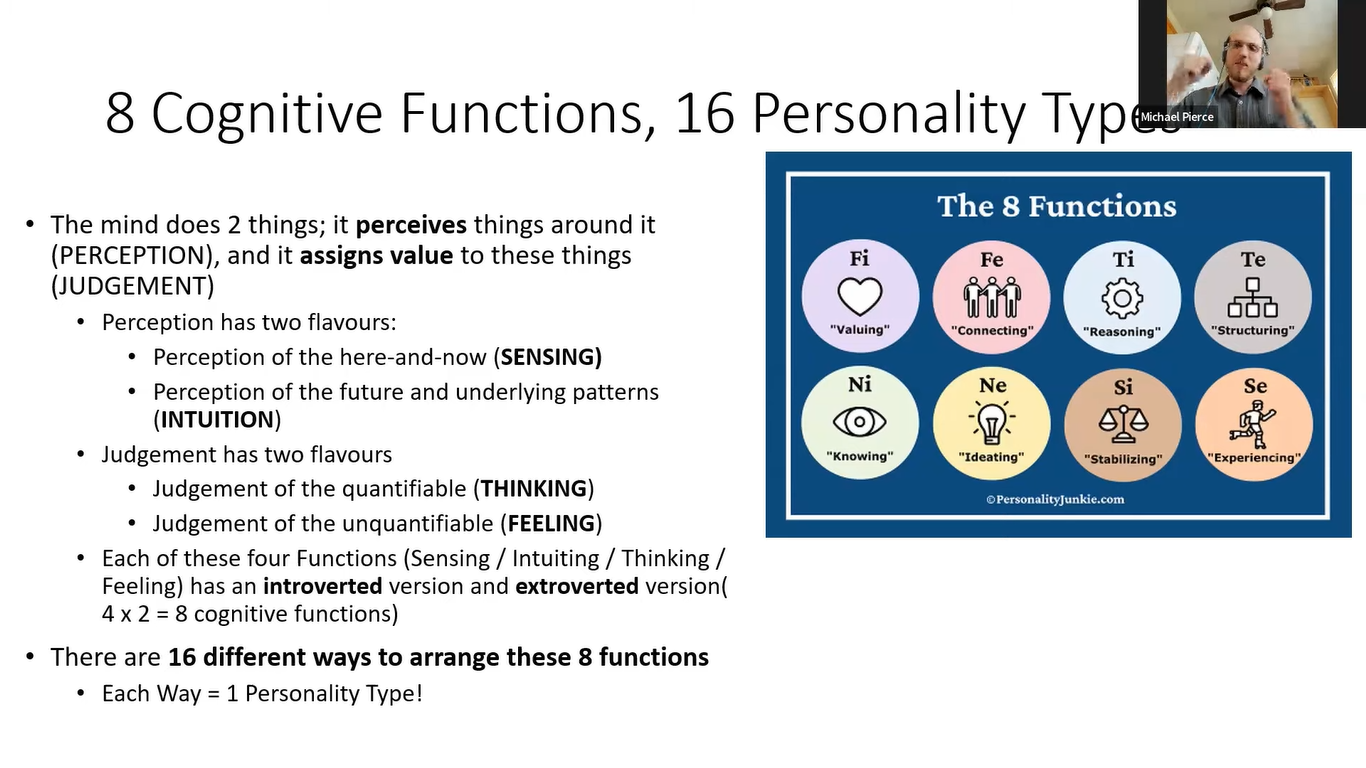
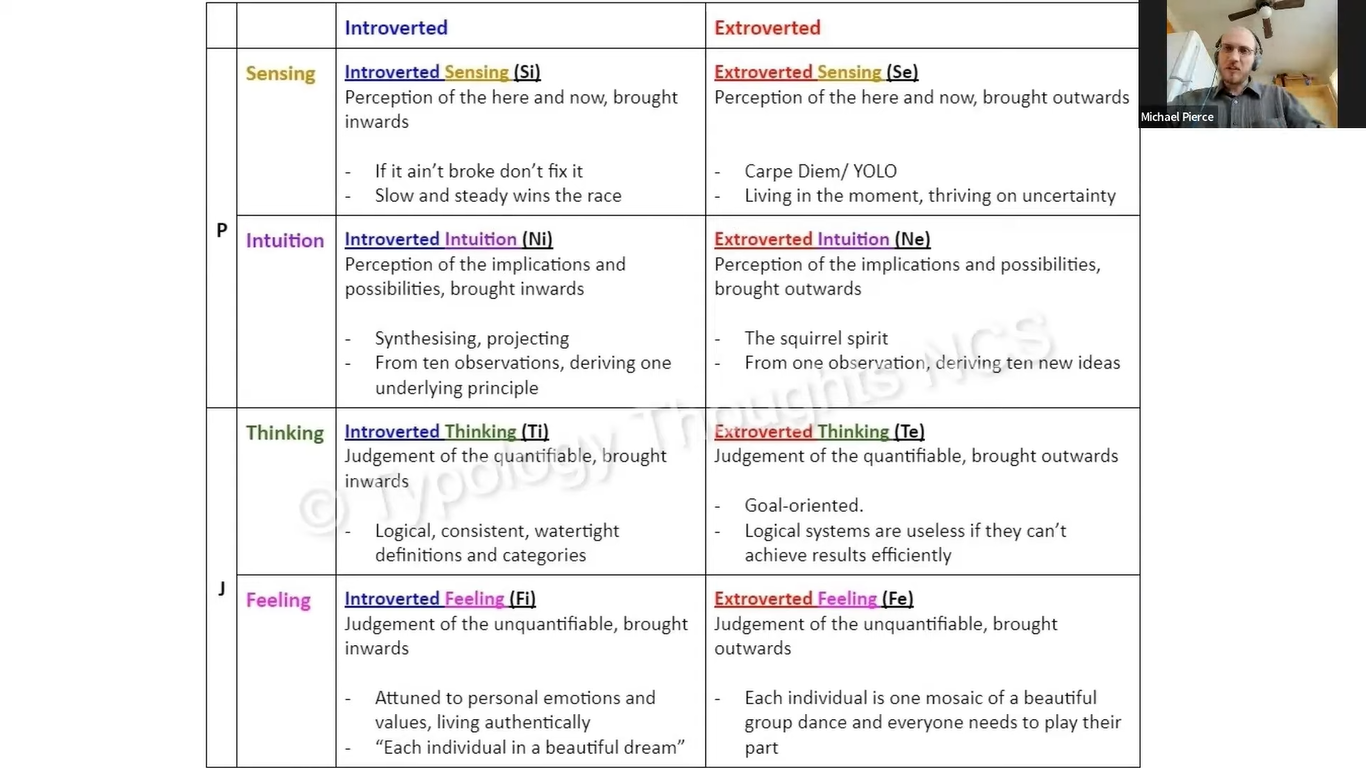
Michael: “You’re about to join me down the rabbit hole of this more complex, advanced system known as Cognitive Function Theory or Jungian Theory. So, we begin with Perception and Judgment. These appear in the MBTI test as a dichotomy pair. In Jung’s Theory, they serve a bit of a different role. Perception simply refers to how you perceive the world. It takes in information and it doesn’t categorize it, it doesn’t make any judgments about it. It is only interested in what the things are that are being perceived and are coming into the personality, into your mind. Judgment, as it’s been laid out here, assigns some sort of value to these things. It categorizes them, it judges them. So these two are opposites, but they’re complimentary. Perception has two flavors, or there are two kinds of perception, and in the same way, there are two kinds of Judgment. There are slightly different theories about precisely the correct way to justify splitting them into two flavors, but for our purposes, we’ll just take it for granted and say Perception has two flavors. One is Sensing or Sensation. That’s the perception of what is actually there, the here and now. It has to do with the present, and it also has to do with concrete objects, a lot of the time. Whereas Intuition is a perception of the future, of underlying patterns, of the possibilities of things. That’s how I often try to refer to it. So Sensation is almost like a more direct line to the object, whereas Intuition tends to go around it to things that are implied by the object. So, Sensation is generally very concrete, down to earth. Intuition is very creative but can also be very head in the clouds about things. Those are two ways of just perceiving the object. Judgment also has two kinds: Thinking and Feeling. It’s important to note that we use the terms Thinking and Feeling in a very different way from how they are more precisely used in Jung’s Theory. But as Ching has laid it out nicely here, Thinking is judgment of the quantifiable, and Feeling is judgment of the unquantifiable. There’s a correspondence, at least in my theory, my approach to it, between Thinking and Sensation and Feeling and Intuition. Thinking has to do with judging things in terms of rigid categories and logic, whereas Feeling has more to do with values, ethics, how you and other people are feeling. So that’s sort of the distinction. Okay, so now we have four functions, and note we’ve just sort of built them beginning from Perception and Judgment, and we’ve built our way up to Sensation, Intuition, Thinking, and Feeling, which again you would recognize those from the MBTI, the Myers-Briggs test, and other tests online.”
The Dichotomy of Extraversion and Introversion
Michael: “So now we’re going to do the division game again. We’re going to introduce a new dichotomy, Introversion and Extraversion, and by doing that, we will multiply the four functions into eight cognitive functions. Extroversion is an attitude. It’s a focus on what we call ‘the object’. So I perhaps should have started with this, but just so you understand the terminology, the object is anything that is not you. It is the thing that you are focusing on, in order for anything to happen in psychology, you have to have an object and you have to have a subject. The subject is the mind, the subject is the person or the being that has the psychology going on inside them, as it were. And for every subject, there needs to be objects that that subject can think about and can focus on. For Extroversion, there is this, as it were, outward turning and outward focus towards the objects that are out there in the world. And Introversion is a turning inwards to the way that your own subject is. So in some sense, Introversion, you could say, is making an object of your own subject. But I don’t want to start getting into loops of language and so forth. The more important thing is the outward motion versus this inward motion. And so we can split up Sensation and Thinking, and Feeling and Intuition via Extroversion and Introversion. So we would get extroverted sensation, introverted sensation, extroverted thinking, introverted thinking, so forth.
You’ll notice in the little chart up here, they are abbreviations. So Fi would be Introverted Feeling. So the F is for Feeling, the T is for thinking, the S is for Sensation, and the N is for Intuition. Even though intuition starts with an I, it’s abbreviated with an N so it doesn’t get mixed up with Introversion. And then each of those has a little I for Introversion after it or a little E for Extraversion after it. So that’s the notation and how that works. It’s a lot faster to just write, say, Fe rather than Extroverted Feeling because that would get a lot of letters on the page. So finally, we have eight cognitive functions. And now what we’re going to do is we’re going to arrange these functions in order to get 16 different personality types. Let’s just run over what these cognitive functions are and how they work.”
What is “Sensation”?
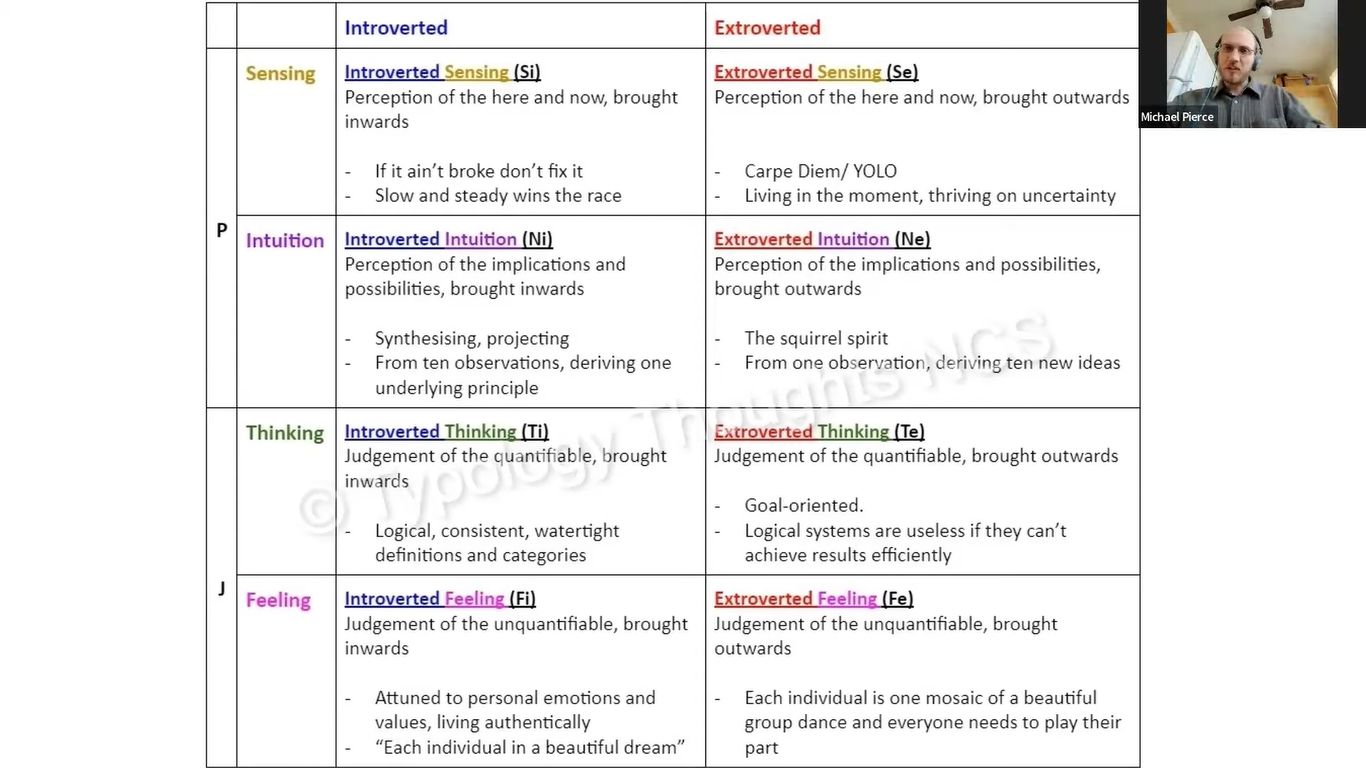
Michael: “There are two kinds of Sensation: Introverted and Extroverted. I’ll start with Extroverted Sensation. Going by our definitions, Extroverted Sensation would be sensation but directed outward, as it were. It is directed to objects in the here and now. Somebody who is using Extroverted Sensation is someone for whom that is the dominant function they prefer to use. There tends to be a very, as it were, carpe diem, YOLO, living in the moment, thriving on uncertainty. People who are Extroverted Sensing types in my experience thrive in situations where there’s a bit of chaos, and it can stress them out as well, but they’re often much better than introverted types at dealing with that because they’re just going moment by moment. They see what concretely is happening around them, and they just keep track of everything and flow in order to adapt to what is happening in the moment. So, you know, emergency workers, firefighters, police, a lot of people who have to deal with emergency situations. It doesn’t just have to be that. You can still find them in more academic disciplines at times, though that is usually through focus on other functions. So that’s Extroverted Sensation, very in the moment. Introverted Sensation reverses that in an interesting way, because the sensation is directed inwards. So Introverted Sensation people, not in a political sense at all, per se, but there’s a kind of conservatism, they’re much slower and more removed from the outside world, as compared to the extroverted sensor. It is perception of the here and now but brought inwards.
My mother, for example, is a dominant Introverted Sensation type, and she has a very sensitive palate. She usually does a lot of the cooking. She prefers to do the cooking because she can cook the things right. And every time we sit down to dinner, she will eat the food and she will be comparing what she is tasting here and now with these sort of ideal sensations that she has in her own mind. And she compares those sensations to that ideal sensation, and it’s that ideal sensation which is more real for her than the sensations in the here and now. And so she will taste and say, “This tastes like it has too much salt. This shouldn’t have as much salt as it does at the moment,” whereas I’m sitting there, and I’m like, “Oh, this is a salty dish“. But for her, it’s like, “No, it’s more salty than the way it should have salt”. And if you’re clever, you might notice there’s some relation with judgment, which I don’t really have time to get into that right now, but it’s a valid observation. So anyway, you get a conservatism there. It’s not “live-in-the-moment”. One of the other things my mother would do is when something flashy or wild or very quick would happen, she would take a moment and she would just say, “I’m just processing what just happened”. And she’s processing the sensory aspect of it. So they all also will often be very good journal keepers, very meticulous, able to remember all of the details and repeat those back.
What is “Intuition”?
Michael: “So now we move on to Intuition. We have Extroverted Intuition, which is a perception of implications and possibilities brought outwards. It is a focus on ideas and possibilities. Almost like they’re juggling a lot of different ideas at one time. But more importantly, it’s the fact that those ideas are out there. A better way of putting it is it’s almost like ideas are actual objects for them that exist outside of themselves and exist on their own. So the result of this is that ideas tend to diverge for them. From one observation, you can derive ten new and distinct ideas from it. So there’s this branching out, and it very quickly can turn into a kind of chaos for them. But it’s very, very fruitful because they will see all of the ways you can split up one topic into different topics.
Introverted Intuition does sort of the opposite. Introverted intuition, because it turns inwards, has a tendency to see similarities between things to a certain extent and to say, “This idea is really just this idea if you put them next to each other.” You can sort of collapse things into each other. From 10 observations, you derive one sort of vision or one underlying principle. Extroverted Intuition is almost like, you have one point, and then you draw an infinite number of lines through that one point to show all of the different ways you can diverge from that one point. Whereas intuition or introverted intuition, you have say 10 points, and then you try to draw a line of best fit, if you know that from algebra, you try to draw a single line that sort of averages out all of those individual observations, and that is the single idea which is then kept in Introverted Intuition. So kind of like with Introverted Sensation where I mentioned this notion of having ideal sensations that you kind of use to organize the sensations in the outside world, similar idea with Introverted Intuition, but with ideas, you have sort of a single idea that you are relating things back to. So Extroverted Intuition is stereotypically… it doesn’t necessarily look like this, but stereotypically, lots of different ideas. Very kind of scattered brains, running all over the place, whereas introverted intuition is like, “I have the eyes that stare into your soul,” you know, kind of like the chess grandmaster or something like that.”
What is “Thinking”?
Michael: “Thinking is judgment that is based on logic and facts, and it’s broader than that, but that’s the quickest way to explain it. So Extroverted Thinking is very goal-oriented. It’s very, “I want to accomplish things out there in the world. I want to organize the actual materials or people or resources that I see outside of me. I want to work with the external facts of a situation. Here’s where we should go with something. Here’s how we make things more efficient.’” Ching: “Everyone always has this mindset that Extraversion means party animal, you know? So when I meet someone and I say, ‘Oh, I think you have a very strong Extraverted Thinking,’ they often say, ‘Oh, I’m not an extrovert. I’m just doing all the work in the background,’ but it is precisely the fact that they are doing all the work that is the Extroversion, and that is the Jungian definition of Extroversion that is that we don’t really use nowadays.” Michael: “Thank you, Ching. Yes, that’s a very good point. It’s important to leave aside some of your preconceptions about what Extroversion and Introversion mean in order to properly understand these. You can get people who will seem very introverted in a colloquial sense, in an everyday sense, but the way that their mind actually functions would be described better by one of the extroverted functions. Perhaps, and as we shall see soon, everybody has extroverted sides and introverted sides. It’s just a matter of how they are arranged in relation to each other. So it’s never as simple as whether you’re a party animal or you want to stay home and read books.
So that’s Extroverted thinking, very pragmatic. Introverted Thinking, again, we have this idea where it’s almost the thinking idea inside of one’s own subject which takes precedence over the facts out there. So there’s a focus on refining logical ideas, refining and making those ideas perfectly precise, pure mathematics almost all the time. That’s where you’re going to find more Introverted Thinking types. But they’re much more interested in the theory and in making things logical and consistent, and then taking that theory and then after the fact applying it to what’s going on out there. They’re always much more interested in making the definitions and ideas more precise. Rene Descartes, a French philosopher, he’s famous for saying, “I think, therefore, I am”. That is very introverted thinking because what he literally did was said, “I can’t trust any of my external knowledge of the outside world because, you know, it’s possible that I am deceived or I’m hallucinating or I’m dreaming or something. All I can trust, and what is more real for me, is my own thoughts, my own principles that I’ve developed.” This is very introverted thinking. So that’s how those two go. You kind of have this difference between theory and practice, which would be a very general way of differentiating them.”
What is “Feeling”?
Michael: “Finally, we have Feeling. Extroverted Feeling is a feeling which is sort of directed outwards. It is objectified. Extroverted Feeling will generally be much more naturally outwardly expressive. It will be in tune with what expressions are the most socially acceptable or most harmonious to the needs of the group. Ching wrote a nice little thing, actually, a very nice little description here: “Each individual is one Mosaic of a beautiful group dance, and everyone needs to play their part.” That’s great. The dance especially is a great way of putting it because you have this notion of the need to not focus on how you’re feeling or your own feelings, but to harmonize with the group and to try to promote the feelings of the group as a whole. So you see there’s this movement outwards in terms of one’s ethics. When someone has dominated Extroverted Feeling, there will often be this sort of blurring of the line where they will be literally feeling what they think should be felt. And if they’re not feeling what should be felt, then they’re like, “Something’s wrong. If I’m not crying at a funeral, something’s probably wrong. This isn’t how you’re supposed to feel objectively in this situation”. They also don’t say certain things to certain people because they think they’re just going to screw everything up.
Introverted Feeling is where the feeling is directed inwards. You have to get past some of the connotations of the language because when I say they’re much more focused on how they are feeling, it sounds as though they’re self-absorbed and selfish. And from the Extroverted Feeling perspective, they are. From that perspective, that’s what’s going on. But then that gets challenged when you find that some of the most empathetic and self-sacrificing people I’ve met have been Introverted Feeling types. And that’s because it sort of messes with the selfishness-selflessness division. Introverted feeling is that feeling which is internal or individual to you. If you’re crying at a funeral because you knew the person and you had a personal connection with them and you are genuinely, like, this is how I feel regardless of how everybody else is feeling, that’s good because that indicates that you are more in alignment with your own feelings and your own soul. But if you’re just crying at the funeral because that’s what you’re supposed to do, then that’s like, who are you? You’re like an empty shell. I once had an argument with a friend of mine who wasn’t a dominant Introverted Feeling, but they had that in there as one of their major functions, and they were always asking me, like, “So, how do you feel about this or that controversial issue?” And I, being more Extroverted Feeling, was always like, “I don’t really want to answer that .. What’s more important is how are you going to react to how I feel about such and such”. As far as my feelings go, those just seem so ephemeral and so kind of unrelated to the topic… and it would turn into just us arguing over whose feelings are right, and that wasn’t useful. But that wasn’t how she thought about the things. So, that’s your crash course in the eight functions.“
How are cognitive functions organized to form personality types?
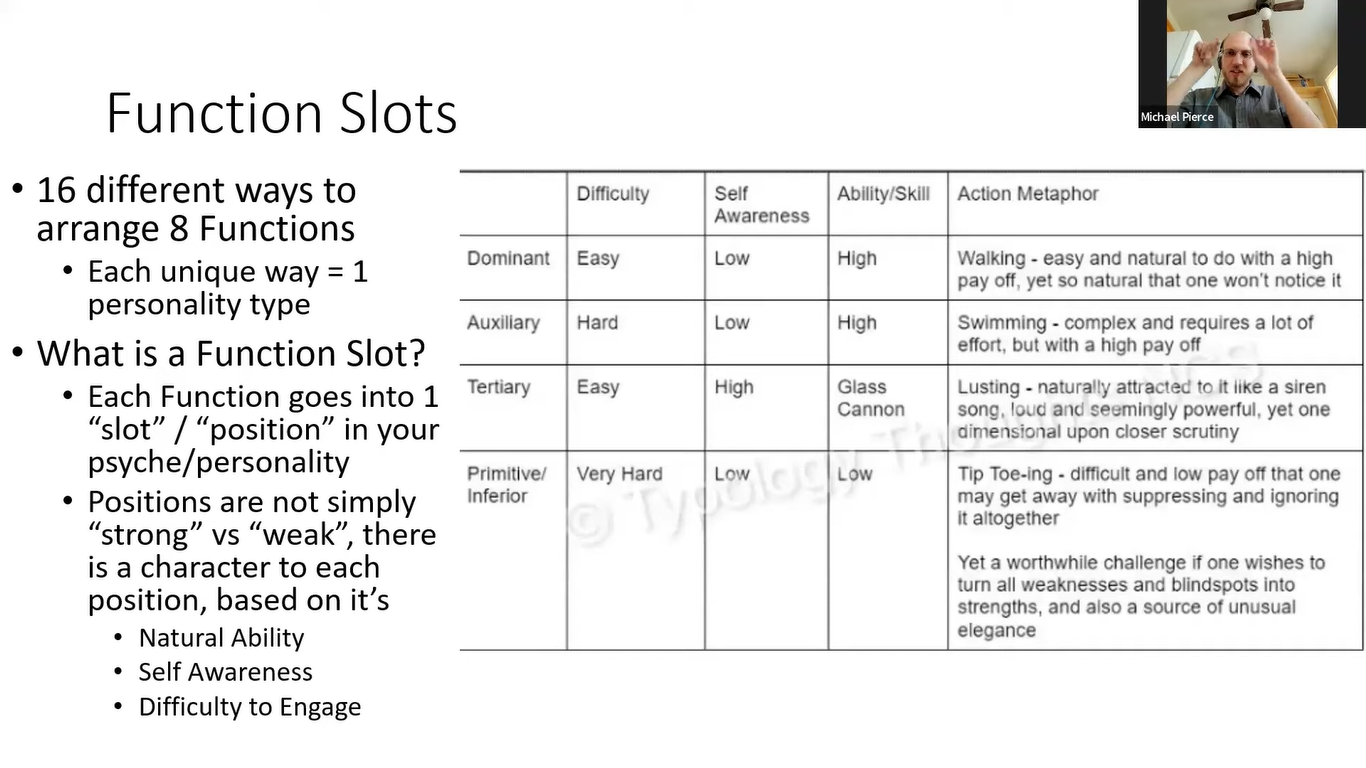
Michael:“The way that the functions are organized in a personality is that you have four function slots. You have the dominant function, you have the auxiliary function, the tertiary function, and the primitive or inferior function. We’ll start with the dominant.
The dominant function is the one that most defines you and the way that you tend to think. It’s the one that you use the most. Nicely compared with walking here, which I know is drawn from the book. Thank you, Ching. Yes, it’s the most easy and natural thing for you to do. In some cases, it can be so natural that the person will not even notice that that is definitely their mode of thinking, and that can actually sometimes be a bit of a challenge in typing people or at least in self-typing. But in any case, that’s sort of the easiest one to understand in a lot of ways. But in order to function as a person in general, you can’t just have one function, because you need multiple ways to see and to situate yourself in reality. So you have to start off with the auxiliary function, which compensates for your dominant function. So there’s always a bit of opposition there. The auxiliary function nicely compares to swimming; it requires more effort to do it, but you can do it, and it’s very useful for you to orient yourself in society. For example, I believe my dominant function is introverted intuition, so that’s what I sort of just do in the background all the time naturally. My auxiliary function is Extroverted Feeling. That is what helps compensate for my Introverted Intuition so that I’m not just sitting in my room, staring, and reading a text and trying to understand the secrets of the universe. I can actually go out and buy food and act like a normal human being. That’s a silly way of putting it, but more importantly, I associate it with my ability to situate myself in relation to other people and also a concern with social harmony.” Ching: “The Fe auxiliary really helps you in a teaching role because you’re always focused on translating that vision to something that’s palatable to the people we are speaking to, or tailoring it specifically to the people you are talking to.” Michael: “Exactly, yes. It’s not the thing that you’re naturally doing; it’s something that assists your dominant function with what it wants to do. Then you get the tertiary function. The tertiary function is something that you are very interested in, but you may not realize that you’re not actually the best there ever was at it. There can often be a bit of overestimation of one’s abilities with the tertiary function. It’s like the term here, the action metaphor, is lusting. Though you might associate it more with infatuation or fascination, you’re attracted to it, and yet it’s one-dimensional in your understanding of it, which sometimes can be a benefit. But you’re not actually, if you go up against somebody who is dominant in that function, it often becomes clear where the weaknesses lie or where the naivete lies, where the lack of cultivation there lies. So my tertiary function is Introverted Thinking, and you can see this, say, in my book where I’m creating these strict structures that are very Introverted Thinking, very logical, and they build one thing after the other. So my natural tendency would be to say, “Wow, it’s like I’m an Introverted Thinking type. I’m the master at ‘logic’ and figuring things out.” And then you compare it with my father, who is an Introverted Thinking dominant type, and he is an actual mathematician, and he can manipulate concepts and logical concepts in a way that is just completely out of my league. But in a way, he’s much more… he would not make some of the bold leaps that I make in Introverted Thinking precisely because he’s more of a veteran with it. So there’s a trade-off there. So that’s sort of scratching the surface of auxiliary and tertiary. I hope that maybe helps to differentiate them a bit.” Ching: “Oh, maybe just one point I can add to that. So, in Chinese, there is a phrase that goes “showing off in front of a master”. I use this phrase to help people differentiate between dominant and tertiary because basically when the first person, you know, who uses the tertiary function meets someone who is using it in a dominant way, they would be exactly that phrase where you are showing off in front of this master.” Michael: “Yeah, I really like that because that’s exactly what happens, that’s actually a very good phrase.” Ching: “And also, I can think of some examples. For instance, there’s a friend of mine who is an ENFJ, and she said her boyfriend is an ESTP. The ESTP’s tertiary function is extroverted feeling, making him a super party animal and a social butterfly. He’s always friendly, saying “Hey, what’s up?” to everyone and making everyone laugh. My ENFJ friend feels that he doesn’t need to be that friendly to everyone. In fact, she believes he may encourage inappropriate behaviors or enable the wrong people to become popular by focusing on only one aspect of the tertiary function.” Michael: “Yes, that’s very good, and in some sense, there is a descending order of maturity to the functions, is another way of characterizing it. The dominant function is your most mature function, the auxiliary function is pretty mature, but it’s almost like the assistant to the hero. The tertiary is much younger, much less experienced, and finally, you get the inferior function, which is the least experienced and often the most… all-or-nothing, in a lot of ways. You compared it to tiptoeing, which is very nice, difficult, and low payoff. One may get away with suppressing and ignoring it altogether. It can be a worthwhile challenge if one wishes to turn all weaknesses and blind spots into strengths and also a source of unusual elegance. So all of the functions have a function, which is the most directly opposite to it. The dominant function represses its opposite function, and its opposite function thereby becomes the inferior function. So introverted intuition is opposed to extroverted sensation, because extroverted sensation has to do with the actual objects outside of me, whereas introverted intuition has to do with the ideas inside of me. So you have this repression between the two of them, and yet it’s sort of a yin-yang, complementary association between them because you can’t have one without the other. You get a similar opposition between the auxiliary and the tertiary, where you’ll have somebody who, say, with the ESTP example that Ching gave, the ESTP is much better with Introverted Thinking, and they’ll use that in order to organize their life and give themselves principles of action. But especially as they get older, they’ll become more infatuated with Extroverted Feeling and almost think that is more important and want to associate more with that than with the introverted thinking, which they’re much better at. So, there’s this element of natural ability, self-awareness, engagement. That’s sort of the organization for the different types. So you get 16 types, in which each type has four functions, and these different slots. The reason that there are only 16 types built from eight functions is because of the natural oppositions I mentioned, where if you have Ni as your dominant function, you must have Se as your inferior function. That’s just they always go together in that way. And you can… if you have a perceiving function as your dominant, then you have to have a judging function as your auxiliary. So you get these natural oppositions, and in this almost very geometrical, mathematical way, it works out, so you only end up getting 16 distinct types.”
Do you ever wonder why you get so attached to potential partners so quickly? Why you bend over backwards to make them happy, even when they seem distant? At the core, you likely yearn for a relationship where you can truly be yourself without fear of being “too much” or not “enough.” If so, you’re not alone. Many people struggle with one of two issues – getting too invested too quickly, or keeping others at an emotional distance. Both can leave us frustrated in relationships when desires for closeness aren’t balanced with needs for independence.
The root of such relationship difficulties often traces back to differences in attachment styles – ingrained patterns that shape how we emotionally connect with others. Whether you find yourself constantly longing for approval, naturally hesitant around intimacy, or somewhere in between, awareness is the first step towards positive change. This comprehensive guide will help you recognize your attachment style, which is the key to breaking out of this pattern and navigating relationships more effectively.
The Four Attachment Styles
According to psychologist John Bowlby, there are four primary attachment styles formed in childhood: secure, anxious-preoccupied, dismissive-avoidant, and fearful-avoidant. Each style results from our early life experiences with caregivers. The attitudes and responses of our first attachments – our parents or guardians – lay the foundation. When children have attentive caregivers who respond consistently and warmly to their needs, they are likely to develop a secure attachment style. Caregivers who are absent, rejecting, or inconsistent may lead children to develop one of the insecure styles – anxious, dismissive, or fearful.
Fast forward to adulthood, and these ingrained childhood attachment styles are awakened when romantic relationships become emotionally intimate. Our early programming kicks in, and we unconsciously default to the same attachment patterns, even if they no longer work. We continue responding from the emotional blueprints carved out in our first relationships. Let’s take a closer look at the four attachment styles and how they impact our relationships – for better or worse.
The Secure Attachment Style
The secure attachment style is often considered the gold standard of attachment styles, characterized by individuals who have a positive view of themselves and others. According to research, 50 percent of the population has a secure attachment style. Such individuals feel comfortable with both intimacy and independence, forming healthy and balanced relationships. They typically have a strong sense of self-worth and believe in their own capabilities. They are confident in expressing their needs while also being attentive and responsive to the needs of their partners.
Secure individuals have a natural inclination to provide emotional support and comfort to their partners. They offer a sense of stability and reassurance, creating an environment where both partners feel seen, heard, and validated. This emotional availability and responsiveness cultivate a strong sense of intimacy, reliability, and trust within the relationship. As a result of these characteristics, those with a secure attachment style often experience stable and satisfying relationships.
While individuals with a secure attachment style may still face challenges and occasional relationship conflicts, their secure foundation allows them to navigate these difficulties with resilience and adaptability. The secure attachment style serves as an inspiring model for cultivating healthier relationship dynamics, even for those who may currently identify with other attachment styles.
The Anxious-Preoccupied Attachment Style
The anxious-preoccupied attachment style or often simply known as anxious attachment is characterized by a strong desire for closeness and intimacy, coupled with a fear of abandonment. Estimates suggest that 20 percent of the population possesses an anxious attachment style. Individuals with this attachment style often seek constant reassurance and validation from their partners, yearning for a deep emotional connection. However, their fear of rejection and abandonment can create challenges within their relationships.
Individuals with an anxious-preoccupied attachment style tend to have a negative perception of themselves. They may struggle with self-doubt, insecurity, and a fear of not being worthy of love. As a result, they often seek external validation to soothe their anxieties and boost their self-esteem. This constant need for reassurance can lead to clinginess, possessiveness, and a strong emotional dependency on their partners.
Communication for those with an anxious-preoccupied attachment style is often marked by emotional intensity and a tendency to overanalyze. They may frequently seek clarification and confirmation of their partner’s feelings, fearing any signs of potential rejection. This hyper-vigilance can strain the relationship as they constantly seek validation and reassurance, leading to repetitive questioning, jealousy, and heightened anxiety.
Individuals with this attachment style may have difficulty managing disagreements and may fear that conflicts will lead to the dissolution of the relationship. As a result, they may avoid conflict altogether or become excessively anxious and emotional during conflicts. The fear of abandonment and the need for constant reassurance can amplify their emotional response and hinder effective resolution.
The Dismissive-Avoidant Attachment Style
Anxious-preoccupied and dismissive-avoidant attachment style are two sides of the same coin. They are both the result of ineffective and extreme emotional regulation, where the former seeks constant validation while the latter disassociates and tries to drown out emotions all together. Often simply known as avoidant attachment, it is characterized by individuals who exhibit emotional distance and a strong inclination towards independence. Research estimates suggest that around 25 percent of individuals are dismissive-avoidant, making it the second most common attachment style. Those with this attachment style often struggle with forming deep emotional connections and may find it challenging to rely on others.
They tend to have a positive view of themselves but a dismissive and avoidant attitude towards others. They often prioritize self-reliance and autonomy, valuing independence over emotional intimacy. They may downplay the importance of close relationships and prefer to maintain a level of emotional distance to avoid feelings of vulnerability or dependency.
Communication for individuals with a dismissive-avoidant attachment style can be marked by a preference for logical reasoning and a tendency to minimize emotional expressions. They may struggle to fully express their own emotions and may have difficulty understanding or empathizing with the emotions of their partners. This emotional distance can create a barrier to deeper emotional connection and understanding within the relationship.
Conflict resolution can be particularly challenging for those with a dismissive-avoidant attachment style. They have a tendency to withdraw emotionally or physically during conflicts, seeking solitude as a means of self-protection. They often struggle with addressing emotional needs or may downplay the significance of conflict, dismissing its impact on the relationship. This avoidance of conflict and emotional disengagement can hinder effective resolution and create further distance between partners.
The Fearful-Avoidant Attachment Style
The fearful-avoidant attachment style, also known as the disorganized attachment style, is characterized by conflicting desires for closeness and independence. According to research, it is the least common attachment style, found in only 5 percent of the population. Individuals with this attachment style often experience internal struggles and mixed emotions when it comes to forming and maintaining relationships.
Those with a fearful-avoidant attachment style often have a negative view of both themselves and others. They may struggle with trust and may have experienced past traumas or inconsistent caregiving, leading to a fear of both intimacy and abandonment. As a result, they may exhibit ambivalence and unpredictability in their relationships, experiencing a push-pull dynamic of seeking closeness while simultaneously fearing it.
Communication for individuals with a fearful-avoidant attachment style can be marked by confusion and uncertainty. They may have difficulty expressing their needs and emotions clearly, as they may feel torn between their desire for connection and their fear of vulnerability. This conflicting internal struggle can result in mixed signals, emotional distancing, and difficulties in establishing effective communication patterns with their partners.
When it comes to conflict resolution, such people may oscillate between avoiding conflicts altogether or becoming overwhelmed by intense emotions during conflicts. This ambivalence can lead to a fear of rejection and a reluctance to address relationship issues head-on, further complicating the resolution process and potentially perpetuating cycles of unresolved conflicts.
Impact of Different Attachment Styles on Relationships
Different attachment styles can significantly impact relationship dynamics and satisfaction. In relationships where both partners have a secure attachment style, there is a strong foundation of trust, effective communication, and emotional support. These relationships tend to be characterized by mutual respect, healthy boundaries, and a sense of security. Partners can rely on each other for support and navigate challenges with a sense of resilience and understanding. Securely attached people are often very good at forming long lasting relationships.
However, when partners have different attachment styles, challenges may arise. For instance, when a person with an anxious-preoccupied attachment style is in a relationship with someone who has a dismissive-avoidant attachment style, it can create a cycle of pursuit and withdrawal. The anxious-preoccupied individual may crave closeness and reassurance, while the dismissive-avoidant individual may resist emotional intimacy, leading to a pattern of emotional disconnection and frustration.
Similarly, relationships involving a person with a fearful-avoidant attachment style can experience intense fluctuations between the desire for closeness and the fear of abandonment. This can create an unpredictable and emotionally volatile environment, making it challenging for both partners to establish a sense of stability and security.
Can a Secure Attachment Style be developed?
The key for healthier relationship patterns are for partners to work towards developing a more secure attachment style. The good news is that your style is not set in stone. While our early experiences with caregivers play a significant role in shaping our attachment style, it is not the only factor. Later life experiences, such as positive romantic relationships or therapeutic interventions, can help individuals develop a more secure attachment style.
With awareness and effort, an “earned secure attachment” can be developed. Just like a skill you can develop over time, you have the power to cultivate a more secure attachment style. It is a personal growth process that starts with self-awareness and continues with intentional efforts. Reflect on your own attachment patterns and how they show up in your relationships. Identify any patterns or triggers that contribute to feelings of insecurity or emotional challenges.
Another effective approach for personal development is being in a relationship with a secure partner. Regardless of whether you lean toward anxious or avoidant tendencies, there’s much to glean from observing how a secure partner maintains healthy communication and boundaries. The key is to approach this with an open mind and avoid hastily labeling the emotionally stable partner as boring or uninteresting, since many mistakenly equate emotional highs and lows with genuine love.
Conclusion
Every attachment style comes with strengths as well as areas for growth. While challenging at times, recognizing unhealthy patterns and unconscious beliefs within yourself is the first step to overcoming them. Reflect on how your style affects your relationships, seek perspectives from loved ones and be open to improving communication and compromise. As you practice these skills, even deeply ingrained attachment patterns can evolve over time. Anxious types can learn to balance dependence and focus on self-worth. Avoidants can overcome defenses and open up to true intimacy. Whatever your attachment style, learning more about yourself and others holds the potential to transform your relationships into ones filled with trust, warmth and fulfillment.