A Crash Course on MBTI Cognitive Functions

The Myers Briggs Type Indicator (MBTI) is one of the most popular personality tests and frameworks since the 1950s, created by the mother-daughter duo Isabel Myers and Catherine Briggs. Officially licensed under the Myers Briggs Company, the MBTI becomes even more popular due to the proliferation of (questionable) free online tests and generic type descriptions, often known as 16P or 16-personality test.

Why You Should Go Beyond Tests and Type Descriptions
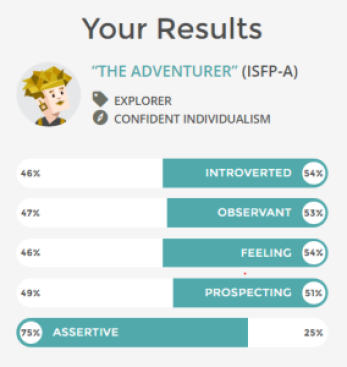
sample results from 16personalities.com of an MBTI type
A typical result chart from 16personalities.com

As a result, there are generally two levels of understanding that we have seen. In the first group are those who came across the popular 16P personality quiz, or similar sites like truity.com. These sites peddle a type of personality assessment that simply asks “are you Extroverted or Introverted”, “are you an Intuitive or a Sensor”, “are you a Thinker or a Feeler”, “are you a Judger or a Perceiver” with percentage scores and give you your “MBTI type” based on those results.

It is a dichotomy (“strictly one or the other”) method that leaves much to be desired, because in a dichotomy system, you cannot have balance in your capability for sensing/intuition, or thinking/feeling. The end result is that many test-takers feel like they do not fit the extreme definitions of “introvert” / “extrovert” / “thinker” / “feeler”, because naturally every person is a bit introverted at times, a bit extroverted at times, and uses logic and inner values depending on the situation at hand.

Picture of Carl Jung
Portrait of Carl Jung

In the second group are those who look further back to the origins of the modern MBTI, to the original theory introduced by Carl Jung in his 1921 book “Psychological Types” and expanded by Jungian analysts like John Beebe. Based on this theory, all our psychological thought processes can be categorized into 8 different cognitive functions.

This group also recognizes sixteen different types, but organizes each of the sixteen types by a unique combination of these 8 cognitive functions. It is a more holistic and nuanced understanding of personality types that accounts for the fact that everyone has a bit of everything, and the difference between types lies in the different order of strengths and weaknesses.

Here’s where the confusion arises: both groups have 16 types with the same 16 names, but a very different and incompatible understanding of what defines each of those 16 personality types.
Funny memes: seeing the cognitive functions as savior light in the distince
Have you seen the light of the cognitive-function perspective?

We are firmly in the second group, and we have seen that generally, people in the first group who start to learn about cognitive functions will almost always “see the light” and join the second group, seeing the types through the lens of cognitive functions rather than the simple dichotomies.

Once a person sees the more robust and comprehensive system, they will naturally accept it over the simplistic dichotomies. In writing this post, I hope to bring you from the shallow pools of the 16P and truity.com to the real nuts and bolts of Jung’s theory of personality!

What are Jungian/MBTI cognitive functions?

Perception can be done in two ways; it can be in the present, the “here and now” (Sensing) and it can be looking beyond into the future and inferring patterns beneath the surface (Intuition)

Sensing means looking more in to the here-and-now and concrete details instead of abstract patterns

On the other hand, judgement can be also done in two ways; it can be done for quantifiable things, judging value between two black-and-white comparisons (Thinking). It can be also be done for unquantifiable things, judging value in aspects like love or personal values (“do I love Alice or Bob more?”) (Feeling)

So as a result, we have 4 functions (Sensing, Intuition, Thinking, Feeling) and for each of these four functions , there is an introverted and an extroverted version.

Picture of a swimming person to illustrate the idea of introversion vs extroversion
Think of introversion and extroversion like water and land, for introverts, the inner mind is the relaxing land while it takes effort to “swim” in the outer word

The extroverted functions are oriented outwards towards the external world, they are:

  • Extroverted Sensing (Se): Enjoying the finer aspects of life in food, fashion. Being physically in tune with the world
  • Extroverted Intuition (Ne): From one observation, deriving ten different ideas and possibilities
  • Extroverted Thinking (Te): Real-world practicality, results-driven, things that can be written down on a resume
  • Extroverted Feeling (Fe): Being able to “read the room”, attuned to the social atmosphere, tailoring your words to your audience

The introverted functions are oriented inwards towards the subjective personal world

  • Introverted Sensing (Si): Seeing and remembering things as they were in the past, taking things step by step
  • Introverted Intuition (Ni): From ten observations, deriving one single theory that explains everything. Projecting the one future path that most likely will happen
  • Introverted Thinking (Ti): Logical and consistent, having various categories to ensure that everything has its own place in a water-tight system
  • Introverted Feeling (Fi): Having a clear idea of individual desires, values, tastes. Living life authentically without being affected by what the rest of the world does

A more detailed explanation of each of the functions can be found here.
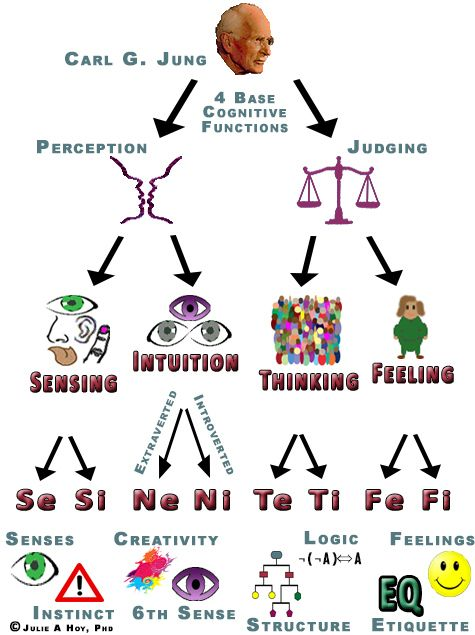
Flow chart of how Jungian psychology branched into the 8 mbti functions
A flow chart that summarizes how Jung theorized the existence of 8 cognitive functions

How to determine the Function Stack of an MBTI Type?

  1. A person’s combination of functions (i.e. the function stack) can’t simply be randomly picked from the list of 8 functions (otherwise we would have 8^8 = 16,777,216 types! There are commonly accepted rules for the positions and pairings of the functions developed by readers of Jung such as Myers Briggs and John Beebe.
  2. Each function has a partner: its “opposite” within the same Judging/Perceiving category.
    • Perceiving function pairs
      • Introverted Intuition (Ni) + Extroverted Sensing (Se) Contextual
      • Extroverted Intuition (Ne) + Introverted Sensing (Si) Universal
    • Judging Function Pairs
      • Introverted Feeling (Fi) + Extroverted Thinking (Te) Contextual
      • Extroverted Feeling (Fe) + Introverted Thinking (Ti) Universal
  3. Every person’s first four function slots are comprised of one Perceiving function pair and one Judging function pair
    • Thus four possible combinations; there are four different ways to pair one Perceiving function pair with one Judging function pair
DemocraticTheocratic
Ne/Si + Fi/TeNi/Se + Fe/Ti
AtomicMonarchic
Ne/Si + Fe/TiNi/Se + Fi/Te
  1. Within a person’s first four function slots, one function pair will occupy the 1st (“Dominant”) and 4th (“Inferior”/”Primitive”) slots. The other function pair will occupy the 2nd (“Auxiliary”) and 3rd (“Tertiary”) slots
  2. Between the Dominant and Auxiliary Functions,
    • There is one extroverted and one introverted
    • There is one perceiving (N/S) and one judging (T/F)

To put everything together, here is an example of how we determine the functions of the ENFP type:

Step 1: Determine the orientation of the dominant function:

First letter tells you the orientation of the dominant function

The first letter “E” means Dominant function is Extroverted

Position

Orientation

Function

Dominant

Extroverted

(Intuition or Sensing or Thinking or Feeling)

Auxiliary

(Introverted or Extroverted) 

(Intuition or Sensing or Thinking or Feeling

because the dominant function is Extroverted, the Auxiliary function must be Introverted

Position

Orientation

Function

Dominant

Extroverted

(Intuition or Sensing or Thinking or Feeling)

Auxiliary

Introverted

(Intuition or Sensing or Thinking or Feeling

Step 2: Use the fourth letter narrows down the extroverted function

Fourth letter “P” means the Extroverted function is a Perceiving function (either N or S)

Position

Orientation

Function

Dominant

Extroverted

(Intuition or Sensing)

Auxiliary

Introverted

(Intuition or Sensing or Thinking or Feeling)

because the Extroverted function is a Perceiving function, the Introverted function must be a Judging function (T or F)

Position

Orientation

Function

Dominant

Extroverted

(Intuition or Sensing)

Auxiliary

Introverted

(Thinking or Feeling)

 Step 3: Use the second letter to decide whether the person is “Intuition” or “Sensing”

ENFP: “N” stands for Intuition rather than Sensing

Position

Orientation

Function

Dominant

Extroverted

Intuition

Auxiliary

Introverted

(Thinking or Feeling)

 Step 4:  Use the third letter to decide whether the person is “Thinking” or “Feeling”

ENFP: Letter F stands for Feeling rather than Thinking

Position

Orientation

Function

Dominant

Extroverted

Intuition

Auxiliary

Introverted

Feeling

 Step 5: Determine the tertiary function

Each function has a partner: its “opposite” within the same Judging/Perceiving category.

The Tertiary is simply the function pair of the Auxiliary

Position

Orientation

Function

Dominant

Extroverted

Intuition

Auxiliary

Introverted

Feeling

Tertiary

Extroverted

Thinking

 Step 6: Determine the inferior function

The Inferior/Primitive is simply the function pair of the Dominant

Position

Orientation

Function

Dominant

Extroverted

Intuition

Auxiliary

Introverted

Feeling

Tertiary

Extroverted

Thinking

Inferior / Primitive

Introverted

Sensing

Do you get it? Why not try to apply the same process above to determine the top four cognitive functions of your MBTI function stack? For a quick cheat sheet to look up different types’ stacks, click here.

So I hope you have had a better understanding of the other “deeper” aspect of MBTI and the commonly accepted model of the function stack in each type. This will unlock a more in-depth level of self-understanding for yourself based on your type.

The next step is to relook at your specific function stack and familiarize yourself with the definition and usage of each of these functions. Then, you can reflect on how these functions manifest in your life, then learn the theory further, and repeat. It will be a fulfilling and amazing journey of self-discovery with the aid of MBTI and Jungian functions!

References

  1. Myers, Isabel Briggs, and Peter B. Myers. Gifts differing: Understanding personality type. Consulting Psychologists Press, 1980.
  2. Beebe, John. Energies and patterns in psychological type: The reservoir of consciousness. Routledge, 2016.
  3. Jung, Carl. Psychological types. Routledge, 2016.

This was a guest article written by CS Ng. For more content from the author, check out here.

A more detailed explanation by him on the function stack can be found here

Cheat Sheet: The Function Stack of Each MBTI Type

The eight cognitive functions

The four extroverted functions are oriented outwards towards the external world, they are:

  • Extroverted Sensing (Se): Enjoying the finer aspects of life in food, fashion. Being physically in tune with the world
  • Extroverted Intuition (Ne): From one observation, deriving ten different ideas and possibilities
  • Extroverted Thinking (Te): Real-world practicality, results-driven, things that can be written down on a resume
  • Extroverted Feeling (Fe): Being able to “read the room”, attuned to the social atmosphere, tailoring your words to your audience

The four introverted functions are oriented inwards towards the subjective personal world

  • Introverted Sensing (Si): Seeing and remembering things as they were in the past, taking things step by step
  • Introverted Intuition (Ni): From ten observations, deriving one single theory that explains everything. Projecting the one future path that most likely will happen
  • Introverted Thinking (Ti): Logical and consistent, having various categories to ensure that everything has its own place in a water-tight system
  • Introverted Feeling (Fi): Having a clear idea of individual desires, values, tastes. Living life authentically without being affected by what the rest of the world does

Cheat sheet: Use this table for quick reference to see which functions are in each type

DominantAuxiliaryTertiaryInferior / Primitive
ISFJIntroverted Sensing (Si)Extroverted Feeling (Fe)Introverted Thinking (Ti)Extroverted Intuition (Ne)
ESFJExtroverted Feeling (Fe)Introverted Sensing (Si)Extroverted Intuition (Ne)Introverted Thinking (Ti)
INTPIntroverted Thinking (Ti)Extroverted Intuition (Ne)Introverted Sensing (Si)Extroverted Feeling (Fe)
ENTPExtroverted Intuition (Ne)Introverted Thinking (Ti)Extroverted Feeling (Fe)Introverted Sensing (Si)
ISTJIntroverted Sensing (Si)Extroverted Thinking (Te)Introverted Feeling (Fi)Extroverted Intuition (Ne)
ESTJExtroverted Thinking (Te)Introverted Sensing (Si)Extroverted Intuition (Ne)Introverted Feeling (Fi)
INFPIntroverted Feeling (Fi)Extroverted Intuition (Ne)Introverted Sensing (Si)Extroverted Thinking (Te)
ENFPExtroverted Intuition (Ne)Introverted Feeling (Fi)Extroverted Thinking (Te)Introverted Sensing (Si)
INFJIntroverted Intuition (Ni)Extroverted Feeling (Fe)Introverted Thinking (Ti)Extroverted Sensing (Se)
ENFJExtroverted Feeling (Fe)Introverted Intuition (Ni)Extroverted Sensing (Se)Introverted Thinking (Ti)
ISTPIntroverted Thinking (Ti)Extroverted Sensing (Se)Introverted Intuition (Ni)Extroverted Feeling (Fe)
ESTPExtroverted Sensing (Se)Introverted Thinking (Ti)Extroverted Feeling (Fe)Introverted Intuition (Ni)
INTJIntroverted Intuition (Ni)Extroverted Thinking (Te)Introverted Feeling (Fi)Extroverted Sensing (Se)
ENTJExtroverted Thinking (Te)Introverted Intuition (Ni)Extroverted Sensing (Se)Introverted Feeling (Fi)
ISFPIntroverted Feeling (Fi)Extroverted Sensing (Se)Introverted Intuition (Ni)Extroverted Thinking (Te)
ESFPExtroverted Sensing (Se)Introverted Feeling (Fi)Extroverted Thinking (Te)Introverted Intuition (Ni)

Thinking and Feeling: Two Distinct Ways of How Our Minds Judge Information Differently

Can I ask if you are left-handed or right-handed? The chance is you are a right-handed person, because it is the majority of our population. How do you know that you are right-handed? It is a very obvious question almost without a need to explain. If we need to break down the reasons, there are three ways you know that your type is a right-handed: 1) The frequency of you using your right hand in a day is higher than your left and 2) Your right hand feels a lot more natural and real and 3) Your right hand will objectively be better at handling heavier objects or more complex tasks. 

That is how you should think about your opposing function of Thinking and Feeling as well. Do keep the above ideas of left and right hand in mind as we further learn about the true definition of Thinking and Feeling in Jungian psychology.

If you are a visual learner, you can also follow this video below:

The definitions

Carl Jung

Besides Introversion and Extroversion, Thinking and Feeling are the second dimension in analytical psychology (the third dimension is Intuition versus Sensing). These concepts were first introduced in the early 20th century by Carl Gustav Jung (1875 – 1961), a famous Swiss psychiatrist who developed the idea of Psychological Types, the precursor to the extremely popular Myers Briggs Type Indicator (MBTI) test and framework.

My philosophy for Our Human Minds have always been to adhere as much as possible to the original understanding and work of Carl Jung to help readers understand accurately the cognitive functions. It is a longer path, but trust me, it is more rewarding and surer way to achieve more accurate self-understanding than purely taking the online test and read the descriptions of the 16 MBTI personalities!

Unlike left and right hand, Thinking and Feeling preferences in analytical psychology are more distinct, serving very different purposes. Your two hands do not oppose each other, but Thinking and Feeling do by definition. Hence, being aware of them and knowing how to develop your weaker function and learn to make them synchronize holds the potential for not only more productivity but also psychological maturity and wholeness.

The definition of  “Thinking” and “Feeling” in Jungian psychology are easily confused with the more layman definitions that we use in our daily languages. They should not be confused with logic versus emotion. You need to understand them in a more fundamental way, that they are evaluative & rational processes to judge incoming information, whether something is right or wrong, good and bad…

Thinking and Feeling aim to clearly distinguish between the two distinct preferences for decision-making: impersonal versus personal/interpersonal respectively. The easiest way to visualize this difference is in the common stereotype between men versus women in our society. Men are known to prefer to “solve problems” and break down problems “logically” while on the other hand, women simply want to be listened to, to be empathized and understood. 

Thinkers (both men and women) prefer to solve problems objectively

While this is a stereotype, indeed, some of the surveys  have shown that there is a slight preference (55%) among men for Thinking and a strong preference (75%) of women who have a Feeling preference. How much of this is the surveyed individuals’ true preferences and how much is a result of social expectation & conditioning, is for another debate. However, I would like to add that based on this survey, thinking that all men are or have to be super logical or women have to be relationship-oriented is a gross simplification and unfair treatment to both sexes.

To break it down further, thinking manifests itself as preference for using objective and measurable frameworks for clear-cut decision making. It is about using objective criteria, conceptual frameworks, pros and cons, structures, logical systems… People with Thinking preference value and take pride in being efficient, precise, goal and task-oriented. Something is good if it is placed in the right category, gives better measurable results, more efficient etc.

On the other hand, Feeling places stronger emphasis on human’s welfare, values and preferences. As an introverted function, it’s about knowing a strong moral sense of right and wrong, of feeling an urge to help the less fortunate, to be humanitarian, to overcome unfairness and restore equality. Extroverted version is about about maintaining a harmonious atmosphere (when hosting a house party for example), making sure common pleasantries and “civilized” etiquettes are adhered to, while making sure everyone has a good time.

ThinkingFeeling
DefinitionImpersonal evaluationInterpersonal and value-based decision-making
Related conceptsobjective criteria, pros and cons, measurable results, conceptual frameworks, logical systemsvalues, morality, harmony, personal preferences, gut feels of right and wrong

Quick Exercise : What is your true preference based on the above definition?
You might need to think about when you are younger or in a more comfortable place at home without any stress of work or “have to” pressure. Social expectation and work stresses might force us to over-compensate to the point of losing sight of who we truly are, like Feeling men are often expected to appear logical and tough, or your jobs have required you to develop your weaker function, even if in your younger years you are the opposite.

Develop Thinking

This section is more relevant for Feeler who has a natural strength in making decisions based on personal values or harmony, but as a result, devoting less consciousness energy in using systemic/impersonal perspectives. We will look at concrete steps that you can take to gradually build up confidence in using the skills and become more holistic in decision making.

Playing a big part of your ego, Feeling – the preference for using value and personal-preference based approach, is part of your identity. The cause that you care about, friends and family, the social connection and status that represent your deepest conviction and meaning of life, are valid. As much as it’s important to acknowledge the other side of the equation, in the end, Thinking should serve in a supporting role and not to dominate your preference for  personal values or interpersonal harmony.

Just like this two-people bike, you should let your dominant function to take the lead and guide the other function, not the other way round!

The development of your weaker functions and achieving wholeness is a life-long quest, so the instruction below serves as a general direction and examples of the kind of steps you can take to develop Thinking.

Remember that the basic definition of Thinking is the use of impersonal systems, framework and measurable results and data. Hence, you can:

  1. Learn from someone close to you who is strong in Thinking like your family members or colleagues. Talk to them more or reflect on the time you guys spend time together. Learn about how they conduct themselves differently, understand why they do it and see if you can learn and integrate some of their techniques or philosophy.
  2. Develop interests in activities that require strong impersonal reasoning and decision making such as chess, finance, computer games…
  3. Integrate productivity tools such as planner, calendar, deadlines and KPIs clearly for both personal work and managing others.
  4. Take courses, read books, watch videos… on productivity, time and project management.
  5. Learn to say No. It’s very natural for Feeler to go with the flow and say yes to keep harmony. Saying No doesn’t mean being harsh or rude if you can explain yourself clearly. It doesn’t have to be black and white either, you can also negotiate what you’d like to do and what you cannot do or you feel is not fair. It’s hard at first, but it’s an essential skill that will go a long way!

Knowing other ways to develop your Thinking side that can help other readers? Feel free to comment below!

Develop Feeling

This is more relevant to Thinking dominant type. Again, it’s important that you acknowledge and embrace your identity as a Thinker and develop Feeling as a support for a more holistic decision making process. Your Thinking function should still be in the driver seat!

  1. Find friends, family or colleagues who you know well and you are fairly certain they are stronger in Feeling. Get to know them more and reflect on how they conduct things differently and see whether you can integrate some of their physiology and methods to your daily life.
  2. Engage in reflective activities like meditation, arts, writing… to reflect on your values and what’s important to you. Remember, it’s a gradual process that requires patience and regular practices.
  3. Engage in social activities and roles that you have to interact more with people. Recognise some of your biases and see it from a more positive light when it comes to social relationships. 
  4. Immerse yourself in nature, away from distraction of work and technology, to hear and embrace your inner voices, values and feelings.

Are you a Thinker that has other ways that work? Feel free to share below.

I hope you now have a clearer understanding of the distinction between these rational dimensions of Thinking versus Feeling. In reality, these two preferences never exist as standalone in a healthy person’s psyche but work in tandem. But since they are mutually exclusive/cancelling out, it’s natural to prioritize and put your conscious energy into one while “send to exile” the other, giving little conscious energy to nourish and maintain it.

If possible, you should learn further about how Introversion and Extroversion are combined with Thinking and Feeling to give rise to 4 distinct Cognitive Processes/Functions: Introverted Thinking, Extroverted Thinking, Introverted Feeling and Extroverted Feeling. This breakdown will bring in a whole new level of depth and opportunities for self-understanding and development. Good luck!

References

Type Fundamentals Guide @mbti-notes

Psychological types by CG. Jung

How To Motivate An Introverted Employee

Do you have an employee who gave the first impression that they are a very thoughtful, creative, and smart person?  Even though this person can produce high-quality work from time to time, they seem a bit distant and uncommunicative or even arrogant…

The chances are your new employee is an introvert!  You wish there was a way to motivate them and make that employee more productive and communicative.  The solution is first to understand how and why they are different, to realize that their minds are made-up differently from the mind of an extrovert.  

Introversion versus extroversion:

The basic definition of introversion versus extroversion is that extroverts are more comfortable with and prefer to direct their mental energy toward the outside world, other people, or objects.  In contrast, introverts tend to prefer living in the world of their minds and their thoughts.  When introverts are forced into a team or a very crowded environment for too long, the situation will deplete their energy, and they will become very drained. 

Introverts gain energy from the comfort of their inner thoughts and feelings

Swiss psychiatrist and psychoanalyst Carl Gustav Jung (1875 – 1961) was the first to distinguish extroversion and introversion, the two major orientations of personality.  We continue to learn from Jung’s findings and ongoing psychoanalytical research leads to greater understanding of personality types to help managers in the workplace.

Cognitive sciences have discovered two main ways that introverted minds are different:

1.    Introverts process incoming information more slowly because they filter information thoroughly before considering the input. Their neural pathway to process information is longer than that of extroverts.  This is because they use the parasympathetic side of the brain, and the pathways are much longer, meaning they need more time for the information to be processed.  Hence introverts can easily become over-stimulated with too much external information from the environment. 

Scientists can detect the differences between introvert and extrovert babies as early as four months old. Extroverts easily take stimulation because the two parts of the brain they use have a much smaller pathway than introverts. This neurological difference explains why extroverts tend to be active and action-oriented, actively seeking out stimulating experiences. While, in contrast, introverts tend to be more idiosyncratic in their preference for a slower and manageable pace.

Scientists can detect introverted babies as early as 4-month old!

2. The second difference is that because the part of the brain used to process information and the part of the brain connected to communication and processing verbal input are quite separated in introverts.  Hence, they can go on for long periods of time without talking or communicating with other people.   Conversely, an extrovert will get the juices flowing, think, and speak at the same time.  They will enjoy brainstorming with other people, thinking and talking simultaneously.  

So, when you know these differences, you can begin to understand why there are behavioral differences between introvert and extrovert team members.  You see, it’s not that your introverted employee is having an attitude or trying to be distant on purpose; it’s just how their brain works.

How to spot an introverted employee

They tend to be

  1. Calm: He or she exudes a calming presence.
  2. Listeners: They tend to listen more than they talk.  This is especially noticeable in a team meeting when they appear more reflective.
  3. Having subdued Dress Style: Introverts tend to dress subtly.  Their clothing is usually understated, preferring dark colors.  They don’t want to stand out too much.  Compare this with extroverted employees who dress in more vibrant, outstanding colors and styles.

In fact, a lot of people think that introverts are a minority in the population.  However, many surveys have shown that introverts and extroverts are actually about 50/50 in a population.

The reason they seem to be the minority is that they don’t compete with the extroverts for attention.  They don’t speak up that much, preferring to think through the information before voicing an opinion.  They’re the silent half of the population! Another possible explanation is that many introverts would put on an “extrovert mask” on social settings to blend in better (even if it’s pretty draining), giving the impression that there are ways more extroverts to the untrained eyes.

Introverts bring unique strengths to the team

Now you know the differences between introverts and extroverts, you can appreciate the unique strengths of the introverted employee:

  • Because they spend more time reflecting and coming up with something that is truly unique, you can expect their work to be more creative and original.
  • You can also expect them to be thorough and meticulous because they think things through and process a lot of information inside their head before they talk about and show the result.   
  • Lastly, introverts have high moral principles.  Most of the time, introverts value their integrity and authenticity very highly.  It’s a useful attribute to balance the team in the workplace, especially against the fast-paced and cut-throat cultures of many workplaces nowadays.

How to motivate the introverted employee

So, how do you as a manager nurture and encourage better productivity and motivation from an introverted employee?  There are four ways you can do it:

1. When you assign them some work or a task, give them a lot of upfront information so they can process it, but then give them space.  There is this golden rule of two to forty-eight hours, depending on the complexity of the task, that works very well with introverts.  Give your introverted employee the time to think through all the input and process the information. In return, they will give you very thorough and very considered work results. 

2.  The second way you can help them is to complement their weaknesses.  Since they are a more reflective and somewhat individualistic employee, you can support them with your own strengths or that of another team member:

For example, you can provide them with social connections to others in the team.  Because it’s usual that introverts find it challenging to initiate social contact themselves, you can quickly introduce them to other team members.  By introducing them to other stakeholders that are relevant o the project, you help them to be able to touch base and integrate into the team.

You can assist an introverted employee by introducing him or her to other stakeholders/coworkers

3. You can assist them by giving clear deadlines and KPI expectations.  Because introverts are so reflective and usually perfectionistic, they are not good with deadlines.  So, you need to be clear regarding when you need the result.   When you have clear KPIs, they are certain of your expectations, and you can best optimize their thought process and creativity.

4.   Lastly, keep your introverted employee motivated.  Once they have finished their work, it’s important to praise the work, but moderately, because they can easily detect unnecessary and superfluous compliments.   So give them the praise that they deserve for their originality and creativity.  Praise them for their hard work and their meticulousness.  This valid, genuine praise will be a sure way to make sure you keep your introverted employee happy and motivated.

Conclusion

When you are aware of introverted characteristics you are better able to manage introverted team members.  Doing so is a case of considering how the different personality types function.  Introverted employees are motivated by receiving information in advance of meetings, enabling them to think about the content prior to the meeting.  Introverts will also think about ideas and get back to you later with their contributions.  A manager who considers personality types of the whole team are rewarded with wider contributions and a happier team.  

References:

https://www.lifehack.org/412467/why-introverts-are-introverts-because-their-brains-are-different

https://www.insperity.com/blog/managing-introverts/

How To Overcome Perfectionism

If you are someone who struggles to get started on a project or to complete complicated projects, you may be a perfectionist.  Things can never feel good enough and you may get stuck in a painful spiral of paralysis by analysis! Perfectionism is a much more complex personality trait than many people realize.  Ultimately, it is the desire for perfection that drives the perfectionist mindset. 

The perfectionist personality can be healthy and highly effective when high standards are required.  Healthy perfectionism can drive a person to achieve success, and it can be a valuable trait for overcoming adversity for some, it sets high self-motivation skills.  However, perfectionism is frequently a self-sabotaging behavior; perfectionism can also be a toxic trait that leads to a downward spiral of despair, anxiety, obsession, and feeling overwhelmed.

The root causes of perfectionism

Perfectionism likely stems from genetics or experiences in early childhood.  Opinions vary around whether perfectionism is a learned behavior or if some people are predisposed to perfectionism.  Some believe that a person may be genetically predisposed to perfectionism.  Scientific studies of twins indicate that genetics rather than upbringing and circumstance predispose a person to perfectionism.  The studies discovered that identical twins had a much closer perfectionism score than non-identical twins.   

However, many experts maintain that perfectionism can also be a learned behavior.  When a child is raised with high or even unrealistic parental expectations or those who never felt good enough or who learned to gauge their value by their achievements may learn to embrace perfectionism and show classic perfectionist traits. 

4 strategies to effectively overcome perfectionism:

1.   Acknowledging that perfectionism isn’t perfect

Whether the source of perfectionism is genetic or learned from environmental factors in early childhood, it is frequently a problem to be overcome for the successful completion of projects. Many people believe that the psyche of the perfectionist leads to high standards. However, that is not always the case because the high standards set by perfectionism may come at a price. Perfectionism can be a barrier to effective, efficient productivity. Furthermore, perfectionism is likely to stunt creativity, delay action, and create unnecessary stress for those involved. 

The first approach to dealing with your perfectionism is understanding the perfectionist trait. The better you understand perfectionism, the better you can work through the negative aspects of your perfectionism while utilising the advantages that perfectionism brings.

Perfectionism is a single personality trait that exhibits in three ways:

  • The self-oriented perfection which sets unrealistic aims to be perfect oneself  
  • Other-oriented perfectionism which is imposing unrealistic perfectionism onto others
  • Social perfectionism is having a perception that others require perfection from them.

A manager with perfectionism sets themselves or their team unrealistic goals. Frequently, the hardest part is getting started. The perfectionist usually sees things as success or failure; there is no in between. The problem is that this idealistic outlook means that you do not always live up to the exceptional standards you set yourself. You become so fixated on the end goal and making sure that the end project is perfect that you fail to start the project at all.

2. Pareto Principle or 80/20

As well as overcoming procrastination and failing to get started through over-analysis, there are recognized principles that can help you get started, including the Pareto Principle or 80/20 system. Vilfredo Pareto, an Italian economist, developed the Pareto principle in 1896. Initially relating to the ownership of land in Italy whereby 80% was owned by only 20% of the population. He also observed the principle in other areas of his life. As well as economics, you can observe the phenomenon in sports, business, and time management.

Identify highest-impact priorities first

The Pareto Principle is a system worth investigating when you want to work efficiently. The trick is to work smart, not work hard; working hard and always being busy is not always as effective as working smart. The 80/20 rule is about doing the things that make the most significant difference to the project. In other words, use 20% of your time to achieve 80% of your work. It’s worth reminding yourself of this rule whenever you find yourself procrastinating. You can use the Pareto principle to help with time management. Work out the 20% that will have the most impact on the creativity and effectiveness of the project. Break these down into easily managed sub-tasks that help to streamline the project. By concentrating on the most effective areas for moving the project forward, you take giant leaps forward in productivity.

3. Addressing your exaggerated fear of failure

The element of perfectionism seldom encountered when learning about perfectionism is the fear of failure, yet that is the crucial element of the trait that is stalling you when you need to get started on a project. Perfectionism is subjective, and your idea of perfection as a perfectionist is holding you back!.

Ultimately, your fear of failure is holding you back, so you have to strategize to overcome your fear of failure. Finding the courage and resolve to accept that failure is not something to fear, that it is a normal part of growing the project will empower the perfectionist manager to find balance. Furthermore, mistakes along the way are not failures.

As a perfectionist, your fear of failure is so intense that it could hijack the whole project. It’s what holds you back from getting started. However, by learning to utilize the positives of perfectionism in a way that doesn’t negatively impact the project, you effectively manage your perfectionism and have the opportunity to learn from any mistakes. 

The perfectionist mindset will want you to hold onto the project until it is completely ready and perfect. Yet, it may never seem perfect to you. So what will you do then? 

  • Never complete the project and hand nothing in
  • Let down your team
  • Have nothing to show for all the hours spent procrastinating?

Not handing the work in is the biggest failure of all. The worst-case scenario is that it is preferable to do something, to have something to hand in rather than nothing at all. Correctly managed failure is a prodigious step towards the required outcomes.

How the concept works:

  • Firstly, realize that the only real failure is to hand nothing in. 
  • Realize that the project you perceive as not ready is acceptable to everyone else.
  • Realize that we learn through mistakes. 
  • See failure as a neutral, not a negative. Do this by rewording ‘failure’ when you think of it to ‘learning opportunity’.

4. Gain Continuing Feedback for Approval

Regular reporting to your manager or client is a valuable method to stop procrastinating and get the project started, then throughout the project to prevent your perfectionism from impeding progress. Don’t be afraid to ask a member of your team for advice and input. 

Approval from your manager or the client offers a confidence boost when you are at risk of going over and over the plan for the project or the pitch. To overcome the fear of failure requires letting go of control. Plan to report to your manager or client in steps along the way. Accept that each stage is a step towards completing the project. By asking for and gaining feedback at each stage, you will gain their input and ultimately approval about how the project is progressing. You learn from the feedback; it’s a tool to improve the work. 

Feedback helps you adjust your goals quickly

This methodology is similar to the concept of Minimum Viable Product (“MVP”), which is from Eric Ries’ book ‘Lean Startup’. MVP is a mechanism for validated learning through testing market reactions. MVP is a system built around feedback and validation. You use the feedback and validation at each stage of the project in the same way. You can find out more about MVP here.
When you select a trusted person from the team to co-work with, they can reassure you when the work is good enough. By co-working with another person in the team to go over the draft pitch, you may be surprised that the plan or pitch is actually completely acceptable. As a perfectionist, your mindset is biased to look for and concentrate on what needs fixing, looking for the faults and what is wrong. Another mindset will see all that is good about the work. When their honest opinion is that it is good enough, it probably is ready for submission.

Sharing stages of the project along the way will take some getting used to, but once you conceptualize and accept that doing so is a necessary strategy to get the project underway and to its satisfactory conclusion, you will overcome the resistance. 

By gaining approval when the stages submitted are acceptable, you teach your mind to work in a more accepting way. By accepting feedback when a stage is not quite right, you learn from it. You can’t learn without mistakes. Failure or mistakes are an option in stages; by breaking the project down into stages and acting on the feedback given, you are actually getting closer to achieving the perfect outcome for your manager or client.    When you break the project down in this way, each stage becomes a mini-project in its own right, thus simplifying the project into smaller goals which in turn, help it to become less insurmountable.

Conclusion

Various conceptual methodologies help you when you recognize the pull of perfectionism in your personality. We have shared these highly effective methodologies above. When you realize why the perfectionist’s perceived failure is frequently not failure at all, just part of the natural progression of the project, it’s how you learn from the failures along the way that counts. Being solution focussed and thorough are helpful to a project, but being overzealous about perfectionism is not. When you manage your perfectionism effectively, you actually move closer to the perfectionism that you seek through the mistakes made along the way.

References:

https://www.liquidplanner.com/blog/7-secrets-highly-productive-project-managers/

https://www.psychologytoday.com/gb/basics/productivity

https://asana.com/resources/pareto-principle-80-20-rule

https://www.forbes.com/sites/theyec/2021/12/08/a-review-of-the-minimum-viable-product-approach/

https://www.psychologytoday.com/gb/basics/perfectionism

https://www.psychologytoday.com/gb/blog/understanding-hypnosis/202204/overcoming-perfectionism-can-lead-enhanced-achievement

https://www.business-standard.com/article/pti-stories/being-a-perfectionist-may-lie-in-your-genes-scientists-112110500378_1.html

https://www.psychologytoday.com/gb/basics/perfectionism

https://allthingstalent.org/2019/07/24/managing-perfectionist-workplace/

https://onlinelibrary.wiley.com/doi/abs/10.1002/ert.21370

https://www.webmd.com/balance/features/how-to-overcome-perfectionism

Intuition vs Sensing: Two Distinct Ways Our Mind Takes In Information

The Myers Briggs Type Indicator (MBTI) personality test and framework have popularized the concepts of extroversion, introversions and the cognitive processes that you probably have heard of: Thinking vs Feeling, Intuition vs Sensing. However, these concepts were first introduced in the early 20th century by Carl Gustav Jung (1875 – 1961), a famous Swiss psychiatrist who founded analytical psychology.

Understand the fundamentals of these processes is crucial for any further learning and reading of MBTI-related theories and Jungian psychology. At the very least, you will be able to decipher the various functions that make up your personality type and how they interact together to form your unique cognitive patterns.

So let’s dive in to the first pairs of two opposite processes: Intuition and Sensing! If you prefer to watch instead of reading, below is a detailed video explanation I have made on the same topic:

The Definitions

This dichotomy is how we perceive and make sense of information, either in a dominantly concrete or abstract manner.

Concrete information is tangible sensory information, something that you can feel, see, taste, hear. With regards to time, it’s also related to what is here and now, what’s currently going on in society and most immediate environment. Jung termed this process of accessing concrete information: sensing and those with this preference are called sensors

Abstract information is intangible conceptual information, such as reading between the lines, metaphors, meaning behind things, future possibilities … The person likes to think far ahead, using past data to foresee future outcomes and behaviors. The process of using abstract perception is termed Intuition and the people who prefer it over sensing are called intuitives.

We both can use sensing and intuition at will, we have preference to prioritize one over the other. Our preferred side is more dominant, natural, and more developed like the left and right hand. Sensors are generally better at noticing and remembering details of a discussion while intuitives often only remember the key points or vibe. 

 Intuition dominantSensing dominant
How an intuitive and sensor notice a book in bookshop differently (in order
of what the person see first)
Essence of what’s it about
Relevance to me
Seem a bit worn out
Eww one corner is torn off!
The cover design is corny
What is it about?
Example of how an intuitive and sensing person would notice an object differently

According to statistical studies, Sensors significantly outnumber Intuitives in the general population.(70-75% of the population are sensors). It is a big advantage if you are aware of the sensing-intuitive difference because this dichotomy is often a common source of misunderstanding in work and personal relationships.

Sensors look for concrete facts and details and take things as they are and work with them. Intuitives look for abstract patterns and connections because they prefer to deal with the potential of objects, believing that reality can be different or changed, with a hopeful lens for the future. Sensors are more realistic and grounded while intuitives are more idealistic.

When Sensors intuit for too long, they feel impatient with too much theory and abstract thoughts. Meanwhile, intuitives can easily be put off by feeling forced to explain or sequence “every little detail” and would rather get back to entertaining new or interesting possibilities to restore equilibrium to their personality.

Evolutionary and social roles

Many would think that Intuition – the ability for more abstract thinking should exist only in humans or modern humans but the truth is both Intuition and Sensing exist in animals too. A lot of animals are known for their gut feeling or ability to memorise patterns (like salmon or birds that migrate thousands of miles to the places they are born). Of course, abstract thinking is more pronounced in humans because we have developed tools like languages and the concept of time, which significantly boosts our capacity for abstract thinking.

Any MBTI types are capable of both, as mentioned above. The average humans, regardless of types, are capable of comprehending and using way more abstraction than any other species on planet earth. I suspect that the part of Intuition and Sensing in our brains are pretty distinctive and mutually exclusive. However, why don’t we all evolve to become abstract thinkers? 

Because both ways of thinking are important to get any society or any project to function. It is a matter of spectrum. For example, Einstein came up with the E=MC2 formula, which is an example of highly abstract work! But society don’t just exist out of a formula! We need to further “concretize” the abstraction into practical and applicable tasks – the realm of Sensing. We further apply it to build space craft, atomic bomb… then we need people who like to take specific instruction on how to make that part of the space craft, what color is the craft, what materials is it made of… down to the smallest details!

What does it mean for you?

I hope the overview above gives you a more accurate and objective view of the two primary modes of information perception in the population. Keep it in mind when you interact next with other people and see if you can tell if they are sensors or intuitives. Two people of the same types will have an easier time communicating while you should be a bit more mindful of people who do not share the same preference. In essence, intuitive people love abstract and somewhat theoretical discussion while sensing-dominant people want to know the details and concrete steps.

No preference is better than the others. We have our respective social roles and strengths and weaknesses. In particular, if you are an intuitive, you might be the minority but with great potential for big-pictured thoughts and acquisition of abstract and innovative information. If you ever feel misunderstood or broken in some ways cause you are not in tune or don’t care about the latest social trends or norms, it’s ok. There are other people like you and there are exciting discovery ahead when things start to make sense and you will finally discover your true identity and purpose, even if it takes slightly longer than usual.

Decoding If You Are An Introvert Or Extrovert Using Fundamental Jungian Definitions

Discovering whether you are an introvert or extrovert can be one of the most important revelations about yourself. Firstly, it can lead to a profound understanding of who you are, setting you apart from the other half of the population. Secondly, it serves as an essential foundation for further learning of MBTI and the eight cognitive functions.

However, many people lack the correct understanding, often simplifying introversion and extroversion to mere social energy or talkativeness. This oversimplification can be confusing, leading many to adopt a vague label like “ambivert,” which doesn’t provide much clarity. The accurate definition, as proposed by Carl Jung emphasizes that as self-aware psychological beings, we inherently distinguish between our inner world, representing our identity, and the outer world of external experiences and other people.

Carl Gustav Jung (1875 – 1961) was a Swiss psychiatrist and psychoanalyst who founded analytical psychology.

He was the first to distinguish the two major attitudes or orientations of personality – extroversion and introversion. He also identified four basic cognitive functions (thinking, feeling, sensing, and intuiting).

To continue, you can read the article below. If you are a visual learner, you can also watch the video version instead.

To determine whether you are an introvert or extrovert, the first fundamental step is to observe your consistent patterns of judgment and perception. Consider whether your important decisions and behaviors stem from something unique about yourself or if they are geared towards seeking approval, interacting, or accommodating the tribe (other people). The second way involves assessing your sense of energy gain and drain.

Step 1: Understand the Inner World (Identity) and Outer World (Others)

First, let’s take a step back and define two distinct psychological worlds as proposed by Jung. For any self-aware human being, there is the objective outer world, encompassing people, objects, common shared knowledge, and even ideas that are widely accepted by the public. This domain is external, not under personal control, and some consider it part of one’s conscious or ego. In contrast, the subjective inner world comprises thoughts and memories, representing personal, controlled aspects, often tied to one’s identity.

To illustrate, consider the above photograph of the Waterloo Bridge in the UK. Different artists could then draw distinct paintings based on the same scenery, showcasing the subjective nature of art. Artists, often labeled as introverts, prioritize their unique perceptions and thoughts. This sets the stage for the first crucial distinction—two different worlds based on the attitude toward them.

Step 2: Determine Your primary attitude towards the two worlds

There is a fundamental difference in their approach: extroverts tend to adapt and orient themselves toward the external world of people, feedback, and objects. While everyone uses both introversion and extroversion to make decisions and considers feedback, the external world plays a deciding and final factor for extroverts.

On the other hand, introverts seek to orient themselves away from the external world. Their final deciding factors revolve around subjective opinions, interpretations, and personal goals—elements that are intrinsic to themselves and not dependent on the external world’s popular opinions. The distinction becomes evident when observing individuals in private, where their true colors emerge.

Step 3: Where do you gain your energy from

I would say this is the more popular (and still quite correct) understanding of introversion and extroversion, which has to do with where we naturally direct our energy and recharge in regards to the inner world and the outer world:

Extraverts have a stronger relationship with the objects of the outer world because they feel a stronger cognitive need for frequent interaction with the world. To Extraverts, what’s going on outside is more important than what’s happening inside. Overall, they are more “action-oriented”.

Introverts have a stronger relationship with the inner world because they feel a stronger cognitive need to connect with their inner subjective experiences. To introverts, what’s happening inside is more important than outside. They are characterized for being more “reflective”.

A good metaphor for extroversion vs introversion is land vs water. You can naturally be comfortable in both, but to an extrovert, the outer world is like the shore and the inner world is like water. They can certainly enjoy staying in water but where do they eventually get respite from? The shore. Vice versa for introverts, the inner world is like the shore and the outer world of objects is the water!

Bonus: Neuroscience Point of View

Neurologically, scientists have discovered that Extraverts and Introverts have different pathways in the brain for processing information. Extraverts use a shorter pathway and are much faster at processing incoming information from the world. Therefore, they have a higher tolerance for stimulation and tend to actively seek out stimulating experiences.

Introverts’ pathways are much longer as the information is processed and filtered internally. They are easier to suffer from “information overload” given the same amount of external stimuli. Hence they prefer a slower “reflective” pace and tend to avoid situations that might overwhelm them. This difference is noticeable in babies as young as 4-months old!

According to statistical studies, Extraverts and Introverts are roughly evenly split in the general population, with a few studies finding a slightly greater number of Extraverts.

I hope you have now gained a deeper and fundamental understanding of the definition and your preference between introversion and extroversion. Still not sure where you fall in this dichotomy? You can read how to know if you are an introvert or extrovert using a behavioral approach.

References:

https://mbti-notes.tumblr.com/

Valid or pseudo science? A brief history of the MBTI

Carl Jung and cognitive functions

Carl Gustav Jung (1875 – 1961) was a Swiss psychiatrist and psychoanalyst who founded analytical psychology. He was one of the best students and confidants of Sigmund Freud, a forefather of modern psychology who is well known for the discovery and study of the unconscious. The unconscious is defined as a reservoir of feelings, thoughts, urges, and memories that are outside of conscious awareness. Many of these unconsciousness are influenced by our early memories as an infant and young child.

While Feud theory is only about the personal unconscious, Carl Jung studied and developed the unconscious further to show the collective unconscious, which represent a form of the unconscious common to mankind as a whole and originating in the inherited structure of the brain. It is distinct from the personal unconscious, which arises from the experience of the individual.

He was the first to distinguish the two major attitudes or orientations of personality – extroversion and introversion. He also identified four basic functions (thinking, feeling, sensing, and intuiting) which in a cross-classification yield eight pure personality types. He advocates for individuation, which can be defined as the achievement of self-actualization through a process of integrating the conscious and the unconscious.

Jung’s theory is less mainstream than Freud’s as it is very abstract and related to the magical realm of dreams and historical symbols… However, the testimonials for the soundness and usefulness of his work are the continued development of his theory into more structured framework by renowned psychologist in the field such as Isabel Myers, Linda Beren, Lenore Thompson, Dario Nardi..

About the MBTI

The MBTI by Isabel Myer is probably the most popular (extremely popular to be exact) with 1.5 million people taking the official test each year and almost 90% of Fortune 500 companies using them. Its popularity certainly drew criticism with questions from the scientific community about its validity and reliability as a test.

Jung’s theory is less mainstream than Freud’s as it is very abstract and related to the magical realm of dreams and historical symbols… That is one of the main reason for the MBTI being questioned in its scientific foundation as well as the its accuracy as a psychomtric test, which is another matter and debate on its own.

However, the testimonials for the soundness and usefulness of his work are the continued development of his theory into more structured frameworks by renowned psychologist in the field such as Isabel Myers, Linda Beren, Lenore Thompson, Dario Nardi…

Recent discovery in cognitive science does reveal and prove that introversion and extroversion exist as real pattern in the brain with extroverts having the thinking and talking parts wired together while for introvert, they can work independently. Dario Nardi’ Neuro science of brain scan book, he used EEG method to show that across hundreds of participants, similar MBTI types do have similar brain activity patterns at work or when in flow.

Example of brain scan images of different MBTI types – Credit to Dario Nardi

The importance of having strong sense of self

What is a sense of self

Your sense of self refers to your perception of the collection of characteristics that define you. It refers to what you think are your personality traits, strength and weaknesses, like or dislikes, moral values and your goals and aspirations…

Why is it important?

Self-confidence

Having a strong sense of self allows you to appreciate both your strengths and weaknesses. It allows you to be at peace and comfortable in your own skin and not too affected by people’s opinions. Otherwise, you will be pushed around and feel bad about things about yourself that you shouldn’t


Motivation and making decisions

Knowing your likes and dislikes from small things like the choice of food to bigger things like the kind of career or life partners you want will allow you to make decisions quickly and confidently. You won’t have to spend time agonising and taking forever to decide or worse, simply choosing jobs or settling for relationships because that’s what your parents or other people choose for you.

And of course, if you have a strong enough “why”, you can go through any “how” to achieve your dream goals and career outcomes.

Relationships

Besides that, your sense of self allows you to be confident in choosing the right friends and partners, but also allows you to communicate and manage relationships better. You won’t have to deal with crippling anxiety when trying to speak up your mind at your jobs. You can become a better leader in the workplace. You can tell your friends or partners clearly what you like or dislike to keep a healthy boundary.

How to build self-identity?

To build a strong sense of self, from young kids to adults, we need time to experience and explore, to fail and learn about what we like, dislike and our strengths and weaknesses. Having the right theory of mind based on rigorous frameworks will also help to allow you to build a more accurate picture of yourself faster.

Why Does Your MBTI Make You A Late Bloomer

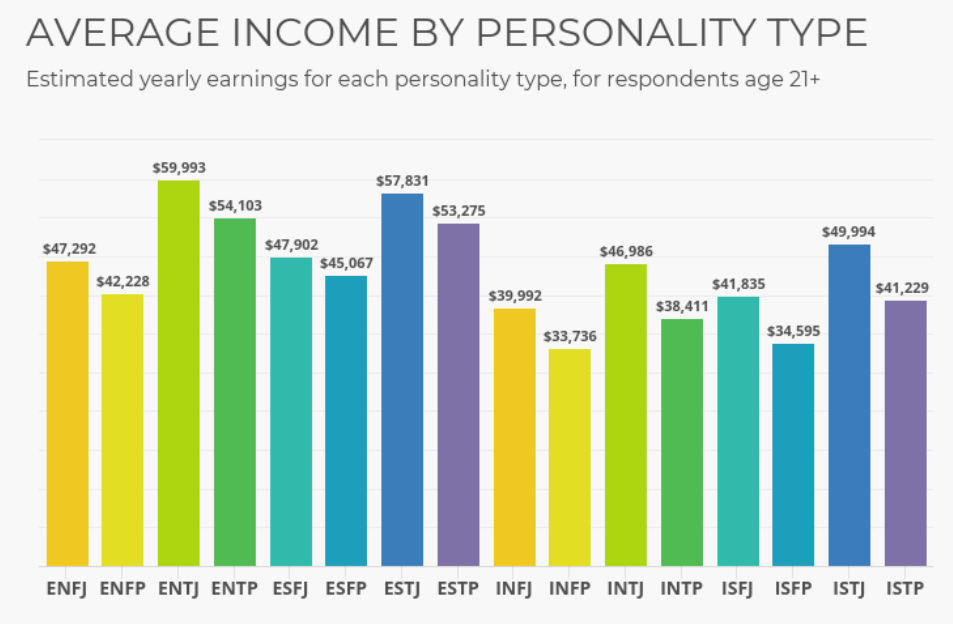
Source: truity.com

Let’s face it, even in the 21st century, what society defines as success is still very much materialistic. Whether someone is considered to do well in life depends on how high is his or her earning, his material possession and other status symbols including having (attractive) romantic partners.

The average income chart above by MBTI types portray a perspective of success. The highest earners on average are ENTJ and ESTJ while the lowest earners are INFP and ISFP. Overall, higher scores on extraversion (E), thinking (T), sensing (S) and judging (J) better predict financial success.

The reason that I phrase this article as “late bloomer” is because even though there is no survey that I know of, I do believe the material gap between types will lessen as people become more mature and balanced. The second reason is that even if the gap is still there, you will better accept who you are and the non-material and non-traditional sense of success that you create, which will give you better self-confidence and happiness down the road.

Introversion

There has been a rising support for the power of the introvert in the past decades with many books and articles that talk about the hidden advantage of being an introvert. They might be stereotyped as wallflowers who are meek and easily pushed over.

The truth is that introverts are not the minority. They are almost equal in the share of population as extroverts and introversion and shyness are not the same, though they can be easily mistaken. Introversion simply means the information processing pathway is longer and consumes more energy. Hence, introverts tend to think more and are easily overwhelmed by external stimuli.

It’s easy to see how introversion leads you to become a late bloomer. Life is tough and complicated at the start. You can be overwhelmed by the world when younger and it will take longer for introverts to consolidate and master this wave of insights and nuances in their brilliant but overwhelming minds. 

Not only can introverts catch up with extroverts later in life in material success, their insightful minds allow them to excel in highly skilled and specialized careers such as writer, scientist and philosopher. These careers might not be the best paid, but they have the potential to be highly celebrated and to propel society forward.

FEELING

If your type has letter F instead of T, you lean more towards feeling, which has to do with either intrapersonal or interpersonal relationships than efficiency and logic (T).

Feeling can either be introverted or so-called intrapersonal (Fi) (most dominant in INFP and ISFP) or extraverted/interpersonal (Fe) (which is dominant in ENFJ and ESFJ). Introverted feeling will likely have it the hardest at younger age because it is very hard to express and easily misunderstood. It is primarily concerned with moral right and wrong, living authentically and freely according to their inner compass of beauty.

This inward feeling may make you artistic yet impractical because deep down you yearn to express something of profound beauty but also makes you unable to take on more practical tasks and jobs, which feels inauthentic to your being. It will take time and sometimes luck to find a path that is both spiritually fulfilling yet lucrative. Introverted feelers like ISFP and INFP make the best artists and poets but their path will be long and rocky.

Extraverted feeling users, especially introverted ones (INFJ and ISFJ) would also feel under par because they find it hard to assert themselves and risk upsetting others. This function chiefly concerns maintaining a harmonious social atmosphere, causing you to feel it hard to just simply put people aside to get what you want. But humans are ultimately social creatures and being able to get on the good sides of the group often can take you far ahead, including in your finance and career.

INTUITION

I believe the Intuitive (N) – Sensing (S) dimension is the most interesting yet often overlooked in MBTI. Only about 25-30% of the population are intuitive, so they are way more rare than introverts! You can think of the intuitive-oriented person simply as a nerdy book-smart kind of person who is more interested in philosophy and theories than concrete facts and actions.

Intuitives, especially INFP, INTP, ENFP and ENTP (extraverted intuition) are often scattered-brain big-pictured people who have a hard time being decisive. To them the world is full of possibilities where traditional and well-accepted concepts like marriage, houses, children and even money should be questioned and explored.

With so much information and so many questions being shifted and synthesized, no wonder it takes longer for them to reach a stable stage in life. They make for smart students but somewhat clueless and restless young or even middle-aged adults while their sensing-dominant peers have happily accepted and settled into more traditional paths and roles.

However, the gift of this unconventional and big-picture mindset is the potential for paradigm shifting and holistic perspectives. Survey might suggest that intuitives earn slightly less than sensors but one reason is because the former takes longer to synthesize their perspectives, which can go beyond the immediate needs of themselves and families to challenge the status quo and propel society’s understanding forward. They make for wise and profound innovators and teachers of arts, philosophy and sciences.

So in conclusion, even if you are at the receiving end of all the disadvantaged factors above, like even in the case of INFP and ISFP, don’t be discouraged. Your mind is uniquely created for a special purpose with unique strengths and values. Of course life is tough for everyone and everyone needs a certain degree of material and practical success, but social contribution and your path to success are just not in a traditional sense. Your life purpose might be more towards helping others or helping society make new breakthroughs or to find the secrets of the universe, at the expense of the practical aspects – and that is ok!