Champion (ENFP) – Type Description

ENFP is one of the 16 personality types as defined by the Myers-Briggs Type Indicator (MBTI), characterized by extraversion, intuition, feeling and perception. ENFPs, also known as “champions”, are enthusiastic, outgoing and spontaneous individuals. They are considered the most optimistic of all personality types, who always tend to see the best in people. They thrive on making connections with others, and are very good at understanding their motivations. 

ENFPs base their self-image on being seen as empathic, benevolent, and authentic, and are driven by intuition rather than concentrated willpower. Their lives often consist of a succession of projects, and they are stimulated by difficulties, finding themselves most ingenious in solving them. They are tireless when it comes to things that interest them, but may find it difficult to get other things done. Since ENFPs are more focused on “what could be” than “what is”, they often end up losing interest once they have accomplished a part of their vision. 

Cognitive Functions of ENFPs:

To gain insight into the characteristics of ENFP personalities, it is helpful to understand the dominant and auxiliary cognitive functions that drive them. According to the MBTI system, each personality type has a set of cognitive functions that they use most frequently, which leads to consistent patterns and characteristics. For ENFPs, 

Dominant Ne: Extraverted Intuition (Ne) allows an individual to come up with new ideas and  possibilities, and see connections between seemingly unrelated things. It gives people the ability to see beyond the present, with a clear vision of what could be. People with a dominant Ne have a strong intuition for spotting trends and future developments, often before others have even recognized them.

Due to their dominant Extraverted Intuition (Ne), ENFPs tend to be more attracted to new possibilities and challenges than what is already verified and known, which makes them great problem solvers, innovators and visionaries. However, their dominant Ne also means that they change their mind frequently. As soon as a “possibility” becomes a “fact”, the intuitive part of their personality loses interest and starts exploring other ideas. This is because they are far more captivated by the possibilities of “what could be” than by the realities of “what is”. Furthermore, since they are so enthusiastic about their ideas, they often share them with others before they have had the opportunity to critically analyze them, which may make ENFPs come across as unrealistic, immature, and childish. 

Auxiliary Fi: Introverted Feeling (Fi) helps individuals make decisions based on personal values, beliefs, and emotions. Healthy Fi users are in touch with their own emotions and have a strong sense of personal ethics and morality. An auxiliary Introverted Feeling (Fi) function enables individuals to be responsible for the decisions they make and resolve issues that cannot be dealt with through their dominant function. 

ENFPs’ dominant Ne allows them to scan the environment and quickly absorb information. However, the constant influx of information can sometimes make it difficult for them to focus on what’s important. They rely on their auxiliary Fi to prioritize ideas based on their personal values. Moreover, ENFPs are forward-thinking and can see how changing a situation can improve people’s lives, but they may struggle to determine the best course of action to make their vision a reality. They use their Fi to set their priorities and determine their agenda. This allows them to focus on the ideas that are most important to them and make choices that align with their beliefs and values.

Strengths

Like all personality types, ENFPs have their own unique set of strengths, some of which include:

  • Imaginative and curious: ENFPs have a rich inner world and a vivid imagination, thanks to their Ne. They are constantly curious and open to new experiences, ideas, and perspectives. Their imaginative nature allows them to think outside the box and come up with creative solutions to problems.
  • Natural cheerleaders: ENFPs have a natural talent for uplifting and motivating others. They are natural-born cheerleaders who can inspire and encourage those around them with their optimism, enthusiasm, and support. They have a knack for boosting the morale of their peers and colleagues, helping them feel empowered and motivated to achieve their goals.
  • Empathetic: ENFPs are people’s people. They are able to put themselves in other people’s shoes and understand their perspectives. Their Ne helps them to pick up on subtle emotional cues of others and read between the lines. This makes them empathetic listeners as well as excellent negotiators, who are able to find common ground with different parties.
  • Light-hearted and fun: ENFPs are known for their ability to bring levity and humor to any situation. They have a light-hearted and playful approach to life, which can help create a positive and enjoyable atmosphere in their interactions with others.

Weaknesses

ENFPs may have some potential weaknesses that could impact their personal life, relationships, as well as their performance and effectiveness in their workplace. These weaknesses may include the following.

  • Difficulty with follow-through and organization: ENFPs can struggle with follow-through and organization, as they are more focused on exploring new possibilities rather than maintaining structure and routine. ENFPs can easily become distracted by their own ideas or those of others, and can lose track of the task at hand. 
  • Overly Idealistic: ENFPs tend to be overly idealistic and can often overestimate their own abilities and the abilities of others. They have a natural trust in the environment, which can cause them to ignore sensory data that might signal danger (due to their weak Sensing function), or take risks that others might avoid. They also become easily discouraged when faced with a reality that does not live up to their expectations. 
  • Difficulty with decision-making and structure: ENFPs can have a hard time making decisions, as driven by their dominant Ne, they want to consider all options and perspectives before making a choice. This can lead to indecision, poor time management, and difficulty maintaining boundaries and structure. 
  • Poor Attention to Detail: ENFPs are full of ideas, owing to their dominant Ne, and they love working towards making those ideas a reality. However, due to Sensing being their weaker function, ENFPs often overlook details and struggle to pay attention to the finer points of a task, which may result in poor execution of their plans if not thought through properly.

Career choice

ENFPs are extremely enthusiastic individuals and can excel in any career they are interested in. The most suitable ones are mentioned below.

  • Sales or marketing: ENFPs’ dominant Ne allows them to think creatively, anticipate customer needs and tailor their pitch accordingly, which makes them great at sales and marketing. They are charismatic, persuasive and have great communication skills which help in building relationships with customers and closing deals. 
  • Entrepreneurship or business: ENFPs are well-suited for careers in entrepreneurship, as they have a natural enthusiasm for exploring new possibilities, and are able to think creatively and identify gaps in the market.
  • Counseling or coaching: ENFPs are often drawn to counseling, as they enjoy the challenge of understanding each person’s unique problem and exploring potential solutions while helping them communicate their thoughts and feelings. 
  • Human resources: ENFPs are able to connect with others and understand their needs and motivations, thanks to their Ne, which makes them well-suited for careers in human resources. Their auxiliary Fi allows them to evaluate ideas and actions in terms of their moral values and beliefs, which can help them to bring authenticity and integrity to their work in HR.

ENFPs require a career that allows them to satisfy their Ne by continuously working on new ideas and projects. Further examples of such careers could include: writing, where each book presents a different topic to explore; politics, with progression of campaigns for higher positions; education, where it would be about the renewed challenge of teaching a different class; and psychiatry, where it would be about the intricate mystery of each patient’s mind. If ENFPs feel blocked in their pursuits they may become bored and discontent in their career. 

Workplace

ENFPs are often well-liked in the workplace and make great team members. Due to their extraverted nature, they have a natural tendency to be outgoing and sociable, which can help them build positive relationships with colleagues and create an inclusive work environment. They possess the ability to pick on the needs and intentions of others, and this “client-centered” approach can be particularly useful in situations such as conferences and interviews, where the ability to connect with the interviewees or colleagues can lead to more effective communication and a deeper understanding of their motivations. 

ENFPs are authentic in their work approach, since their auxiliary Fi serves as their moral compass, helping them take on projects that align with their own beliefs and values. For this reason, ENFPs may have difficulty picking up on ideas and projects initiated by others. To fully lend their energy and interest to a project, it must align with their moral values, allowing them to consider that idea their own.

Moreover, ENFPs are known for their enthusiasm for new ideas and projects, which makes them highly productive employees. But this enthusiasm can also lead to inattention to time and energy limitations. They may become so absorbed in their current project that they neglect their needs to take breaks for rest, which ultimately leads to burnout. However, as soon as ENFPs see their idea turning into a factual reality, they often lose interest in the rest of the project, getting distracted by newer possibilities. They tend to rely on others to handle the follow-through of a project and may not stick with a situation long enough to see the final results.

Relationships

In relationships, ENFPs are often warm and affectionate, and they enjoy expressing their feelings to their partners. They are gentle, caring, and understanding, and tend to be spontaneous, which can often lead to pleasant surprises for their partners. Due to their dominant Ne, they tend to seek new and exciting experiences, which brings excitement and adventure to relationships.  With their strong sense of curiosity, they are always excited to learn about their partners and explore new things together.

However, ENFPs can struggle with organization in relationships, as they are more focused on exploring new possibilities, rather than maintaining structure and routine. They may not prioritize practical matters such as maintaining the household, having life insurance, or keeping a steady cash flow, and be inconsistent in terms of their spending habits, sometimes indulging in luxuries while neglecting necessities. 

ENFPs are known to be devoted parents, giving their children a variety of stimulating experiences, but may be unpredictable in their parenting style. They may shift between being a friend to their child to a stern authority figure. They may have strong opinions on discipline, but may not be willing to enforce them to maintain a good relationship with their children. They tend to leave it to their partner to follow through with discipline. 

In conclusion, ENFPs are charismatic, outgoing, and optimistic individuals, who are passionate about their interests. They are full of ideas about different topics and are often seen as the life of the party. They are versatile, easy to get along with, and have a keen eye on the future. They possess strong initiative and a creative impulse, and can achieve anything they set their minds to. With their wisdom-like intuition, enthusiasm, and desire to make a difference, ENFPs are capable of achieving great things while embracing life to the fullest and inspiring others to do the same. 

Debater (ENTP) – Type Description

ENTP is one of the 16 personality types as defined by the Myers-Briggs Type Indicator (MBTI), characterized by extraversion, intuition, thinking and perceiving. ENTPs, also known as the “debaters” or “inventors,” are known for their quick wit, clever ideas, and love of a good argument. One of the most striking things about ENTPs is their ability to think on their feet. They are quick to come up with new ideas, are not afraid to take risks, and are always eager to explore new possibilities. These qualities make them natural inventors, scientists, trouble-shooters, and entrepreneurs. 

ENTPs can be impulsive and may have trouble committing to one idea, but it also makes them very adaptable and able to pivot quickly when necessary. ENTPs are very clever and are often able to think their way out of tricky situations and persuade others to see things from their point of view. They have a tendency to value reason and intellect over emotions and feelings, and they enjoy being around those who can keep up with their fast-paced thinking and conversation. 

Cognitive Functions of ENTPs:

To gain insight into the characteristics of ENTP personalities, it is helpful to understand the dominant and auxiliary cognitive functions that drive them. According to the MBTI system, each personality type has a set of cognitive functions that they use most frequently, which leads to consistent patterns and characteristics. For ENTPs, 

Dominant Ne: Extraverted Intuition (Ne) allows an individual to come up with new ideas and  possibilities, and see connections between seemingly unrelated things. It gives people the ability to see beyond the present, with a clear vision of what could be. People with a dominant Extraverted Intuition (Ne) have a strong intuition for spotting trends and future developments, often before others have even recognized them.

Due to their dominant Extraverted Intuition (Ne), ENTPs tend to be more attracted to new possibilities and challenges than what is already verified and known, which makes them great problem solvers, innovators and visionaries. They use their Ne to think on their feet and come up with new ideas on the spot. However, they sometimes can get overstimulated or distracted by too many new ideas and need to learn to balance their energy by using their auxiliary function of Introverted Thinking (Ti).

Auxiliary Ti: Introverted Thinking (Ti) allows individuals to analyze their thoughts in a logical and systematic way. This function helps people critically evaluate the information and gain leverage through logical frameworks.

ENTPs use their auxiliary Introverted Thinking (Ti) to be more self-reflective, to understand their own thought processes and to identify any inconsistencies in their own reasoning. They also use Ti to be more efficient in decision making and to identify priorities and best course of actions. As they learn to apply Ti to their own actions, they become more self-disciplined and recognize their responsibility to others in the larger scheme of things.

Due to ENTPs emphasis on these dominant and auxiliary functions, their Sensing and Feeling functions are less developed. This can lead to weaknesses such as difficulty being present in the moment and paying attention to details (Sensing), as well as understanding and expressing emotions, empathizing with others, and understanding the impact of their decisions on others (Feeling).

Strengths of ENTPs 

ENTPs possess many strengths, some of which include:

  • Adventurous and innovative: ENTPs are always on the lookout for new adventures, be it in their personal or professional lives. Due to their dominant Ne, their minds are always exploring innovative ideas, seeing multiple perspectives in every situation. This makes them natural explorers, always ready to delve into the unknown and embrace change.
  • Agents of progress: ENTPs are natural troubleshooters and agents of progress. Their dominant Ne allows them to explore abstract possibilities and their auxiliary Ti critically evaluates the plan before the ENTP rushes into a situation. This Ne-Ti combination makes them great at solving problems and making good judgments.
  • Leadership and persuasion: ENTPs are able to persuade others to see things from their point of view, and are natural leaders. As mentioned before, they use their Ne-Ti to make sound judgments, leading to a high level of confidence in the conclusions they arrive at. This confidence in their ideas allows them to communicate clearly and effectively, making them skilled speakers. They possess the ability to argue their point of view persuasively or even play devil’s advocate and argue on both sides just for the fun of it.
  • Entrepreneurial spirit: ENTPs are naturally good at identifying business opportunities due to their ability to think outside the box. Thanks to their dominant Extraverted Intuition (Ne), they are good at thinking on their feet, which allows them to approach challenges with a creative and bold mindset.

Weaknesses of ENTPs

ENTPs may have some potential weaknesses that could impact their personal life, relationships, as well as their performance and effectiveness in their workplace. These weaknesses may include the following.

  • Lack of focus and practicality: ENTPs have a tendency to get easily distracted by new and exciting ideas, making it difficult for them to commit to a single plan. Due to their dominant Ne, their minds are always active, thinking of new possibilities, but this can make it challenging for them to stick with one project or plan. ENTPs also have a natural tendency to be overly hopeful and optimistic about their ideas, which can lead them to miscalculate the outcomes and make impractical plans (which can also be explained by their weaker Sensing functions which are responsible for attention to details).
  • Impulsivity: ENTPs rely on their ability to solve problems as they arise, rather than carefully creating a detailed blueprint in advance. When they resist the “advice” from their auxiliary Ti, they feel confident with just a rough draft and proceed into action. This impulsive behavior can lead them to neglect preparing adequately for a given task. 
  • Resistance to rules and routine tasks: ENTPs may struggle with tasks that are repetitive or require a lot of attention to detail. With their dominant Ne and corresponding weaker Sensing functions (aka attention to details) they find it difficult for them to follow set protocols and procedures. They value their freedom and autonomy, and may be resistant to rules and regulations that they see as restrictive.

ENTPs & career choice

It is important for ENTPs to choose a career that aligns with their interests and allows them to use their strengths and skills. Some suitable careers for ENTPs include the following.

  • Entrepreneurship and business: ENTPs, with their love for exploring new ideas and possibilities, are well-suited for entrepreneurship. Their Ne allows them to dream big and come up with new entrepreneurial ideas, and their Ti helps them make effective business plans. These skills are crucial for starting and running a successful business. Their adaptability allows them to pivot their strategies according to changing market conditions and stay ahead of the competition. 
  • Sales and marketing: ENTPs would make great salespeople due to their dominant Ne, which allows them to think creatively, anticipate customer needs and tailor their pitch accordingly. They are charismatic, persuasive and have great communication skills which help in building relationships with customers and closing deals. 
  • Law: As lawyers, ENTPs thrive in the courtroom with their ability to debate and explore different perspectives. Their natural inclination for abstract thinking, provided by their dominant Ne, allows them to anticipate opposing viewpoints in court. This, paired with their auxiliary Ti, enables them to critically evaluate their own arguments, spot any weaknesses and come up with counterpoints beforehand, making them formidable legal opponents.
  • Science: ENTPs are very well-suited for careers in science. Their minds are always at work, identifying problems around them, coming up with new unconventional ideas to solve them in one way or another. 

Careers that involve a lot of stability, predictability, and adherence to set rules and procedures may not be a good fit for ENTPs. They value their freedom and independence, and may find it challenging to work within a highly structured or bureaucratic environment. They may also struggle with jobs that require a high degree of conformity, such as certain government jobs, or jobs in industries like finance or accounting which demand a high degree of attention to detail.

ENTPs in the workplace

ENTPs in the workplace are known for their curiosity and open mindedness. This curiosity is contagious and can inspire others, who find themselves admiring the ENTPs’ insatiable hunger for knowledge. ENTPs are not satisfied with doing things the way they have always been done, they are always on the lookout for a better way, new projects, new activities, and new procedures, owing to their dominant Ne.

ENTPs also make great employers and managers due to their imaginative and enterprising nature. In leadership positions, they are intellectually competitive and want a team that can keep up with them. They encourage independence among their team members, valuing different perspectives and ideas. However, they also use their Ti to critically evaluate and analyze all ideas before coming to a decision, and with the help of their Ne, they are able to assess which plan would be the most effective.

ENTPs in their relationships

When it comes to relationships, ENTPs are often outgoing, adventurous, and full of energy. They are typically in good humor and enjoy making others laugh. They are known for their spontaneity and love for trying new things. Being with them is never boring as they are always looking for new experiences. They enjoy surprising their partner with unexpected gestures and activities which can make for an exciting and dynamic relationship. They are also open-minded and accepting of their partner’s interests and passions.

ENTPs may struggle with overindulging in their Ti function, leading to a lack of emotional understanding and connection with their partner. They sometimes rely too heavily on logical solutions and dismiss the importance of emotions and feelings in relationships, causing the other person to feel unsupported and unvalued. To improve, ENTPs should focus on developing their Feeling function, becoming more emotionally capable, listening more, showing appreciation and being willing to be vulnerable and share emotions in the relationship.

As parents, ENTPs are focused on raising independent and self-reliant children. They want to provide their kids with new experiences and opportunities, but also encourage them to explore and experience life on their own.

In conclusion, ENTPs are innovative and dynamic individuals who are always on the lookout for new ideas and opportunities. They are natural problem-solvers and enjoy the thrill of overcoming challenges. They are confident risk takers, open-minded, and value the input of others. Despite their occasional need for independence, ENTPs are highly social creatures and enjoy interacting with others. They are not afraid to challenge the status quo and strive to make the world a better place.

Mastermind (INTJ) – Type Description

INTJ is one of the 16 personality types as defined by the Myers-Briggs Type Indicator (MBTI). INTJs, also known as “Masterminds,” are intellectual and inventive individuals who are known for their rational and strategic thinking. They are driven by a strong desire to understand and analyze the world around them and are often able to see benefits and flaws in different situations that others might miss. They are independent in their approach to problem solving, and are curious, scientific, and research oriented. 

INTJs are skilled at creating logical, structured plans in order to achieve their goals. They have a clear understanding of the big picture and are able to anticipate potential contingencies in a project. When given a task, INTJs will quickly begin formulating their strategies, prioritizing their actions, or creating flow charts in order to efficiently use their time and resources. They are able to see the sequential steps needed to complete a project and are adept at ensuring that all necessary measures are taken to keep the project on track. However, they can also be perceived as stubborn or aloof by others, as they can be single-minded in their pursuit of their goals and may not always fully consider the feelings or perspectives of those around them.

Cognitive Functions of INTJs:

To gain insight into the characteristics of INTJ personalities, it is helpful to understand the dominant and auxiliary cognitive functions that drive them. According to the MBTI system, each personality type has a set of cognitive functions that they use most frequently, which leads to consistent patterns and characteristics. For INTJs, 

Dominant Ni: People with a dominant Introverted Intuition (Ni) tend to be highly intuitive and imaginative. Ni gives people the ability to see patterns and connections that others may not. Those who have a dominant Ni have a strong sense of the future, and are often able to make seemingly sudden, intuitive leaps in their thinking. 

INTJs use their dominant Ni to interpret and synthesize information, to develop a big-picture view, and to make decisions based on their internal understanding of the world. They also use their Ni to make accurate predictions and to uncover hidden patterns and meanings in data. Their Ni can be used to delve deeply into topics of interest, to find creative solutions to problems, and to recognize the potential implications of their decisions. INTJs validate their intuitions using rational criteria such as principles, laws, and organizational structures.

Auxiliary Te: Extraverted Thinking (Te) allows an individual to analyze information objectively. It is oriented towards the external world and involves making decisions, organizing, and structuring the environment. It is focused on the tangible, on facts, and on the practical aspects of life. People who rely heavily on Te tend to be efficient, analytical, and decisive.

In INTJs, their Te helps them test their intuitions against logical ideas and principles. Te brings structure to their inner world and helps them decide what to do under different circumstances. Because INTJs use Te to deal with the outside world, they have a very scientific, and often skeptical approach towards reality.

While Ni allows INTJs to understand patterns and connections, Te helps them to analyze and organize the data they gather in a logical, efficient manner. This combination allows INTJs to process information quickly and to come up with creative, innovative solutions to problems. The Ni-Te combination helps INTJs to be strategic and analytical thinkers who are able to see the potential outcomes of different actions and make logical, well-informed decisions.

Strengths

Like all personality types, INTJs have a combination of strengths and weaknesses. Some of strengths of INTJs include: 

  • Strategic thinking: INTJs are known for their ability to think strategically and see the big picture. Their dominant Ni allows them to gather information and analyze it to form a comprehensive understanding of a situation or problem. 
  • Independent and self-motivated: INTJs prefer to work independently and have a strong sense of self-motivation. They are able to set their own goals and devise their own plans to achieve them, as they don’t depend on others to guide or motivate them.
  • Analytical and logical problem-solving: INTJs are skilled at analyzing complex problems and finding logical solutions. Their auxiliary Te allows them to process information in a systematic way and make objective, unbiased decisions.
  • Leadership: Although unimpressed by degrees, titles and credentials of others, INTJs are known for their natural leadership abilities and their tendency to take charge in situations where they feel they can make a positive difference. The combination of Ni-Te gives them the ability to remain level-headed under pressure. They trust their own ability to analyze and interpret information, which gives them the confidence to make difficult decisions when needed.
  • Efficiency and productivity: INTJs are very efficient in their work and are able to accomplish a lot in a short amount of time. Their auxiliary Te helps them to prioritize and focus on the most important tasks and make good use of their time.

Weaknesses

Like all personality types, INTJs have their own set of weaknesses, some of which are:

  • Difficulty with social skills: INTJs may struggle with picking up on social cues or may have trouble adapting to changing social dynamics. Their auxiliary function, Te, can make them focus on facts and logic, rather than emotions and personal connections. Moreover, they tend to prioritize their inner world, due to their Ni, and may neglect the development of their social skills. 
  • Being overly critical: INTJs may be perceived as dogmatic and difficult to satisfy due to their tendency to point out the logical limitations of others’ ideas. They enjoy engaging in theoretical discussions and are comfortable considering multiple paradigms, but their use of Te may lead them to be overly critical and to consistently highlight the flaws in others’ ideas. This can make them seem impossible to satisfy and may negatively impact their relationships with others.
  • Difficulty with delegation: Since INTJs can often be overly critical of others, they struggle with delegating tasks to others, as they may feel that they can do things better themselves. This can lead to a tendency to micromanage. 
  • Tendency to be impatient: INTJs may come across as impatient or dismissive when communicating with others, as they may be unwilling to repeat themselves or may cut others off when they feel that a conversation is unnecessary. Their desire to find alternate viewpoints in order to understand something (due to their Ni-Te combination) may be misinterpreted as disagreement or negativity, leading others to believe that the INTJ is indifferent or critical towards them.

Career choice

INTJs are natural problem solvers who thrive in fast-paced positions. Some careers that may be well-suited for INTJs include:

  • Scientists and engineers: INTJs are highly interested in scientific fields, and often go on to make great inventions and discoveries. Their Ni contributes to the innovation required in science and engineering, and their Te helps them bring structure and objectivity to their thought processes, which can be valuable in such fields.
  • Managers: INTJs’ natural leadership abilities and their tendency to take charge makes them well-suited for management positions. Because of their Ni-Te combination, they possess the ability to develop long-term plans and to identify potential problems before they arise, which can be valuable in this role.
  • Lawyers: INTJs’ ability to develop logical, structured arguments due to their auxiliary Te can be extremely valuable in the field of law.
  • Business owners & entrepreneurs: INTJs also make great business executives as their Ni-Te interact to give them the ability to gauge potential risks and benefits of different actions and investments.

No matter which career an INTJ chooses, they have the ability to make large-scale changes in their chosen field, and are sure to excel and make a positive impact. 

INTJs in the workplace

INTJs in the workplace tend to be self-confident and decisive, with a drive to complete tasks and achieve their goals. They are highly stimulated by difficulties and challenges, and enjoy responding to problems with creative solutions. INTJs are typically hardworking and responsible, and may rise to positions of leadership due to their dedication and steady pursuit of goals. They tend to focus on the positive and prefer to move an organization forward rather than dwelling on past mistakes. 

In terms of their approach to work, INTJs use their auxiliary Te to make cost-effective decisions and look for ways to streamline operations and eliminate waste. They prefer consistency, and are quick to realign systems and processes to achieve their goals more efficiently. They are mostly indifferent to or critical of the ideas of others if they believe that their own ideas are superior. 

However, INTJs may become single-minded at times, focusing so tightly on their own pursuits that they ignore the points of view and wishes of others. They may also prioritize internal and external consistency and efficiency to the point where they overlook the needs and perspectives of others. INTJs may be perceived as unemotional, but this is often due to their serious dedication to the goals of an institution and their desire to achieve those goals efficiently. 

It is important for INTJs to be aware of this tendency and to make an effort to consider the perspectives and needs of others in their decision-making and problem-solving processes. Despite this tendency, INTJs are loyal and dedicated employees who are committed to the success of the system rather than to individual relationships within the system.

Relationships

INTJs are known to be analytical, independent, and logical individuals, and these traits tend to carry over into their relationships as well. They tend to approach relationships in a thoughtful and rational way and may have high standards for themselves and their partners. Due to their auxiliary Te, they approach the process of choosing a mate in a logical, rational way, basing their decisions on a mental list of physical and intellectual requirements, which may make them seem cold. Being strategic planners, when INTJs do not see a future with someone (with help from their dominant Ni), they do not waste their time on that relationship. They also need a significant amount of alone time to recharge and maintain their connection to their intuitive processes, and may become restless, bored, and emotionally exhausted when there is too much outer stimulation or conflict. 

Although they can be analytical and serious at times, they are also deeply caring and loving, and value meaningful connections with their partners. INTJs in committed relationships make loyal partners who value honesty and practicality. Since they use Te to engage with the outside world, their feelings and emotions may be hard to read at times. They may not be very good at expressing their feelings verbally, but they will likely show their love and affection through actions.

As parents, INTJs are loving and devoted, supporting their children and allowing them to develop their own interests and independence. However, they recognize the importance of setting clear limits and are firm and consistent in enforcing those boundaries.

In conclusion, the INTJ personality type is truly remarkable, characterized by their exceptional intuition, logic, and strategic thinking abilities. Their introverted nature often leads them to keep their emotions private, yet they possess a deep sense of loyalty and honesty that is deeply appreciated by those they hold dear. INTJs are always looking for the most efficient ways to accomplish a task and thrive in positions where they have the autonomy and flexibility to do so. Their ability to think critically and independently makes them valuable assets in any team and they are truly destined to achieve great things. 

Find Your True MBTI Type Through the Dichotomies

The human personality is a complex and multifaceted aspect of our being that influences how we perceive and interact with the world around us. There are several theories and frameworks that have been developed over the years to help us understand our own personality traits and tendencies. In this guide, we will delve into the popular Myers-Briggs Type Indicator (MBTI), which categorizes individuals into 16 distinct personality types based on four dichotomies: Introversion vs. Extraversion, Intuition vs. Sensing, Thinking vs. Feeling, and Judging vs. Perceiving. 

Through this guide, you will gain a deeper understanding of each dimension and its role in shaping your personality, allowing you to better identify your own preferences and tendencies.

Depending on your preference, you may watch the video or continue reading the rest of the article below.

Introversion and Extraversion: Two Distinct Worlds

The concept of introversion and extraversion was first introduced by Carl Jung, who identified two very distinct but equally valid worlds – the inner world and the outer world. The inner world is more subjective and is where our thoughts, memories, feelings, and priorities reside. This is a world that only we, as individuals, can see. On the other hand, the outer world is the world of people, objects, activities, and common knowledge that is accepted and shared by others.

Introversion and extraversion are not simply a matter of being right or left-handed, but rather a response to our environment. To understand this concept, consider the metaphor of the shore and land. Strong swimmers still need to go back to the shore to recharge, just as introverts need solitude to replenish their psychic and cognitive energy. To determine whether you are an introvert or an extrovert, consider whether solitude and the inner world energize you or tire you out. For introverts, the inner world and solitude are similar to the shore, where they go to recharge after a day spent swimming in the world of people and activities. For extroverts, the outer world (the sea) is where they feel energized and thrive.

Some people are ambivert, meaning they are well-developed in both introversion and extroversion, and may have trouble figuring out their true preferences.

In terms of characteristics and behavior, extroverts tend to be lively, animated, talkative, and have a warm and friendly demeanor. They may dress in bright colors and have a fast-paced way of speaking. On the other hand, introverts are usually calm, quiet, reflective, and may have a more understated style of dressing, often in black or dark colors. They may appear aloof or distant, but this is often simply because they are feeling comfortable in their own space.

Intuition versus Sensing: The Two Ways of Perception

Intuition and sensing are two different ways of perceiving information. They are often used to describe different personalities and how individuals process information. Understanding the distinction between these two concepts can help us understand why some people see things in different ways.

Intuition looks at the meaning of things and the connections between them. It’s about possibility and potential. Intuitive people are more interested in abstract ideas and concepts, and less concerned with concrete details. They care about what things represent, and are more focused on the bigger picture.

Sensing, on the other hand, is concrete. Sensing people prefer to see things as they are, and process information through their five senses. They are practical, grounded in reality, and are less interested in the abstract connections between things. They are very curious and want to know the specifics of a situation, like the color of a bridge or the details of a book.

In terms of behavior, sensing individuals tend to be more realistic, traditional, and detail-oriented. They are down-to-earth, and focused on facts, as opposed to abstract concepts. Intuitive individuals, on the other hand, are more creative, imaginative, and less concerned with the practical reality. They’re more of “head in the clouds” kind of people and can be considered quirky or absent-minded.

An example of the contrast between intuition and sensing can be seen when two individuals look at the same book in a store. A “sensing” person is likely to first notice the tangible details of the book first, like its cover, color, and size. After noticing these details, the person may then start to consider the idea behind the book and if it is relevant to them. An intuitive person, on the other hand, might first notice the bigger picture. They might be more interested in the ideas, concepts and possibilities the book represented, rather than just the details like the cover, color, and age.

Ultimately, where an individual falls on the scale of intuition to sensing is a matter of personal preference. Some individuals may have a strong preference for one over the other, while others may fall somewhere in between. 

Thinking versus Feeling: The Two Sides of Decision Making

When it comes to decision making and evaluating, there are two distinct approaches that people tend to follow – thinking and feeling. While both of these approaches have their own logic and make sense in their own right, they are fundamentally different from each other.

Thinking is impersonal in nature and is more about objectively evaluating the facts and data involved in a decision. It is concerned with making decisions that are based on facts and data, rather than personal preferences. A person who relies more on thinking might, for example, consider factors like speed, investment value, and utility when deciding on which car to buy.

On the other hand, feeling is more subjective and personal. It is concerned with making decisions based on personal values, principles, and emotions. A person who relies more on feeling might choose a car based on color, brand, or simply what appeals to them. They may not be as concerned with quantifiable factors like investment value or speed, but rather the emotional connection they have to a particular car.

Of course, most people use both thinking and feeling to some extent when making decisions, but there are often different weights given to each approach depending on the individual, which shapes their personality and how they interact with the world. 

Judging and Perceiving: Two Different Approaches to Structure and Closure

The Judging/Perceiving preference is indicated by either a “J” or “P” in a person’s MBTI type code, and it is one of four dichotomies that make up a person’s personality type in the MBTI framework. 

Judging individuals are typically seen as needing closure and structure in their lives. They tend to like rules, procedures, and norms, and they prefer to have clear and measurable objectives. They like to finish projects and like to know what they’re working towards.

Perceiving individuals, on the other hand, tend to be more flexible and go with the flow. Their sense of time is often more fluid, and they may not be as concerned with deadlines and structure. They like to keep their options open and are comfortable with change.

As you reflect on these dimensions of personality, consider which preferences resonate with you the most and how they may shape the way you perceive and interact with the world around you. What do you feel are your tendencies for each dimension?

We hope this guide helped you identify your 4-letter MBTI code, as it is essential for furthering your personal growth and self-awareness. By understanding your unique type, you can gain a greater understanding of your capabilities, strengths, and weaknesses, as well as how to best use them to your advantage. With this knowledge, you can make the most of your potential, more effectively strive towards your goals and achieve greater success and happiness in your personal and professional life.

Advocate (INFJ) – Type Description

INFJ is one of the 16 Myers-Briggs personality types, characterized by introversion, intuition, feeling, and judging. People with this type are known for their creativity, insight, and idealism, and are often described as “the Counselor” or “the advocate”. INFJs make up approximately 1-2% of the population. INFJs are sensitive, compassionate, and highly attuned to the emotions of others, making them excellent counselors and confidantes. They are often seen as the “mystical” types, who are deeply in tune with the spiritual and metaphysical aspects of life.

INFJs are deep thinkers, and are often seen as wise beyond their years. They are also known for their ability to see the big picture and to develop meaningful long-term plans and goals. Despite their introverted nature, they are highly skilled at reading people and situations, and they are able to use this insight to bring about positive change. INFJs are idealistic individuals and are able to see potential in situations that others may not be able to see. 

Cognitive Functions of INFJs:

To gain insight into the characteristics of INFJ personalities, it is helpful to understand the dominant and auxiliary cognitive functions that drive them. According to the MBTI system, each personality type has a set of cognitive functions that they use most frequently, which leads to consistent patterns and characteristics. For INFJs, 

Dominant Ni: People with a dominant Introverted Intuition (Ni) tend to be highly intuitive and imaginative. They are known for their ability to see patterns and connections that others may not, and they often have a strong sense of the future and the potential outcomes of different actions. They may also have a tendency to get lost in their own thoughts and ideas and may need time alone to reflect and process information. 

Their dominant Ni is the source of many of INFJs’ greatest gifts. This function allows them to delve into psychological areas that others may avoid. It gives them flashes of inspiration, imagination, originality, access to their unconscious mind, ingenuity, and visions of what could be. 

Auxiliary Fe: People with an auxiliary Extraverted Feeling (Fe) function tend to be empathetic and sensitive to the needs and emotions of others. They are skilled at interpreting and responding to social cues, but may struggle with confrontation or expressing their own needs. They pay attention to the impact their actions and words have on others and may seek to create a sense of connection and community.

This function makes INFJs deeply concerned with the well-being and feelings of others, which can make them appear extraverted.

INFJs’ dominant Ni provides them insight to see reality as subjective and relative, giving them the ability to acknowledge someone’s viewpoint as valid without requiring logical justification or factual accuracy. This, paired with their Fe makes INFJs highly receptive listeners and gives them the ability to connect with others on a deep emotional level.

However, due to these dominant functions, INFJs may have less conscious energy to develop their weaker functions in Thinking and Sensing. This can lead to certain challenges in areas such as logical analysis, objective decision making (Thinking), staying in the present moment or picking up & adapting to sensory information in their environment (Sensing). 

Strengths

Like all personality types, INFJs have a combination of strengths and weaknesses. Some of strengths of INFJs include: 

  • Idealism: INFJs are often very idealistic and have a strong sense of purpose. They are deeply committed to living in accordance with their values and are highly motivated to work towards a greater cause to make the world a better place. 
  • Empathy: Their auxiliary Fe allows them to be empathetic and sensitive to the feelings and emotions of others. They are great at understanding others’ needs and motivations, which makes them good team players and helps them build strong relationships with colleagues. 
  • Conflict resolution: INFJs are skilled at facilitating harmony and consensus in groups and excel at resolving conflicts, owing to their auxiliary Fe. They are also excellent negotiators, and are great at finding common ground with different parties. 
  • Problem-solving: INFJs have the ability to see the big picture, develop long-term goals, and anticipate potential challenges or limitations in their plans, thanks to their dominant Ni. This intuitive insight into situations makes them skilled at identifying and solving complex problems.

Weaknesses

Some weaknesses of INFJs include:

  • Sensitivity and struggle with confrontation: INFJs’ sensitivity to the emotions of others and desire to maintain harmony, due to their auxiliary Fe, can make them easily overwhelmed by negative emotions, unable to confront others or express their own needs and boundaries, affecting their relationships and work performance. 
  • Perfectionism: INFJs may struggle with perfectionism due to their tendency to hold themselves and others to high standards. This can lead to overthinking and being overly critical, as they ruminate on ways to improve perceived flaws. Their dominant Ni may cause them to get lost in thought patterns and grand visions, rather than taking a realistic approach. 
  • Struggle with expressing themselves: INFJs may have difficulty expressing themselves in a straightforward way, which makes it difficult for them to assert themselves in group situations. This may be due to their dominant Ni, which encourages them to process information internally and can make it difficult for them to communicate their insights in a way that others can easily understand.
  • Knowing others but not themselves: INFJs excel at understanding others but may struggle with understanding and expressing their own emotions. This can lead them to prioritize the needs of others over their own and to sometimes say or do things that others want to hear, even if they do not align with their true emotions.

Career choice

INFJs excel in abstract and symbolic concepts and can pursue careers in research-driven fields, but they seek work with both intellectual challenge and meaning. They are drawn to careers that have a positive impact on the world, such as:

  • Counselor or therapist: INFJs excel as therapists or psychologists, as their Fe gives them the unique ability to connect with their patients’ inner lives and they can use their personal warmth, insight, and interpretive skills to help their patients. 
  • Writer or journalist: INFJs’ creativity and ability to see the deeper meaning or purpose behind events and experiences may make them well-suited to careers in writing or journalism. They may excel in roles where they can express their ideas and insights through the written word.
  • Educator: INFJs may also enjoy careers in education, where they can inspire and guide others to reach their full potential. They excel in roles where they can connect with their students and help them understand complex concepts.
  • Nonprofit or humanitarian work: INFJs’ idealism and desire to make a positive impact on the world may lead them to careers in the nonprofit or humanitarian sector. 
  • Artist: INFJs make great artists, as their creativity and originality allow them to express themselves and share their vision with others. This is often due to their dominant Ni which allows them to see patterns, visions, and symbolism in things. INFJs may struggle to communicate these ideas verbally, and instead resort to expressing themselves through abstract artwork that holds deeper symbolic meaning.

INFJs are not suited for careers in politics, sales, or marketing due to their introverted nature and unwillingness to compromise on their beliefs, which conflicts with the need for social interaction and stretching the truth in such careers. 

Workplace

INFJs have a natural ability to work well with others. They enjoy helping people with their problems in the workplace, value staff harmony and strive to create a pleasant work environment. 

INFJs’ need for innovation and alternative perspectives (due to their dominant Ni) combined with their ability to form strong connections with people (due to their auxiliary Fe), may also often lead them to positions of authority. They are appreciated for their ability to listen and consider the feelings and values of the group, and as a result, they may be elected to serve on boards and committees by others, even if they do not actively seek out leadership roles.

INFJs are known for their strong commitment to integrity in their work. Their inner vision and conviction for what is best for the greater good earns them respect and honor from others. Due to their natural inclination towards harmony, they often try to persuade others of the validity of their points to avoid conflict. However, when subjected to hostile working conditions or constant criticism, INFJs expend a lot of energy trying to bring everyone on the same page. As a result, INFJs may become exhausted, and struggle to maintain their effectiveness in the workplace.

INFJs, being perfectionists, may struggle to balance their career demands with the needs of their families. If their jobs involve working closely with others in personal development, such as teaching or counseling, they can become so wrapped up in the needs of their students or clients that they neglect the needs of their loved ones. They may need to learn how to prioritize and set boundaries in order to ensure that their loved ones are given the time and attention they need.

Relationships

INFJs seek more than just a life partner in their relationships – they want a “soul partner” with whom they can connect on a deep, spiritual level. They value intimacy and honesty in their relationships and want to be able to share their complex inner lives and communicate openly about their feelings, causes, fantasies, and ethical dilemmas. Their auxiliary Fe makes them the master of intimacy. It gives them a strong ability to understand and relate to the thoughts and feelings of others, which allows them to completely take on another person’s mental state. This makes their partners feel completely understood and accepted, and allows INFJs to build close, loving relationships naturally. 

However, INFJs may often struggle with emotional dependence in their relationships. While they are often sensitive and caring, they may become resentful if their partners become too reliant on them for emotional support and validation. They may feel pressure to provide their partners with the ideal love, understanding, and acceptance that they desire. This can be a challenge for INFJs, as they struggle to balance their own emotional needs with those of their loved ones

In conclusion, INFJs are deeply introspective and empathetic individuals who strive to find harmony in their environment. They are natural nurturers and have a strong sense of purpose in their lives. They are creative, sensitive, and complex individuals who can struggle with self-doubt and feeling misunderstood. However, when they are able to tap into their strengths and use their intuition and empathy to make meaningful connections with others, they can achieve great success and make the world a better place. 

Quick Exercise to Find Your MBTI Type (Self-Test)

By following through each of the 4 sections below, you will be able to clarify your MBTI type as well as gain a quick overview of the 4 dichotomies. This is not meant to be a definitive MBTI test, but rather to accelerate your understanding so you can arrive at that aha moment to acknowledge your own type faster as you journey through the learning of the MBTI and Jungian functions.

The recorded bite-size lessons are made by trainer Tuan Le, founder of Our Huan Minds and a long-term learner and trainer of personality psychology frameworks such as MBTI and Enneagram

Tips to achieve the best results:

As we tend to strive to become more balanced with age, we often “stretch” our cognitive preference under the situational stress of work and social demands. To identify what is “natural”, it’s best to contemplate about 1) what naturally come to you when you were younger (as a teenager or young adult) or 2) when you feel truly at home & being yourself. Also, think about it in term of your consistent behaviors across time and not the “ought to” or “ should” adaptive behaviors.

Section 1 of 4:
Introversion – Extroversion (I – E)

  1. Learn about the fundamentals through the video above.
  2. Based on your understanding, do you think you are more Introverted or Extroverted?
    Want better clarity? Go to step 3 below.
  3. Go through the clarification table (you might need a pen and paper)
  4. Give one tick either on the left or right of each pair of statements.
  5. Give two ticks if you strongly believe with the statement.
  6. If it’s too difficult for you to decide , you may leave it blank.
Tick if applies to your more Tick if applies to you more
Regarding your overall attitude towards society or socially endorsed values and systems
 Have a general dislike and often question popular ideas, standards, or tastesSeek to achieve socially approved concepts and objectives, prioritizing the needs of the group 
Quantity vs quality (hobbies, jobs, social circle…)
 Prefer quality, being picky (job, relationship…)Want to experience it all, the more the merrier 
Generalist versus specialist
 Often take pride in being a specialist and expert in a niche fieldOften prefer working in more generalist position with variety of tasks like management and people-facing roles 
How you gain energy
 Energized by thinking and contemplating about a single topic alone or working one-on-oneEnergized by interacting with and managing several on-going activities and people 
Your approach to sharing and communicating
 Reserved and private, thoughtful,  contemplative, share only if necessary, you find people share too muchMore ready to share personal info and enjoy brainstorming and responding quickly to others 

7. Tabulating results:

The total number of ticks on the left is your score on Introversion.

The total number of ticks on the right is your score on Extroversion.

Whichever side has more ticks represents your degree of preference.

Section 2 of 4:
INtuition – Sensing (N – S)

  1. Learn about the fundamentals through the video above (From 07:49 to 16:50)
  2. Based on your understanding, where do you put yourself?
    Want even better clarity? go to step 3 below.
  3. Go through the clarification table:
Tick if applies to your more  Tick if applies to you more
When given a new task, how would you want to receive the information?
 Prefer maximum details, specifics, step-by-step instruction to ensure clarityPrefer to know the big picture and end goals first and as little details or instruction if possible 
The type of information you tend to notice first
 Notice what is apparent through the 5 senses or concrete, factual detailsNotice patterns, concepts, ideas, metaphors, implications, possibilities, hidden meaning 
Are you more pragmatic or visionary?
 You tend to notice and trust what is tangible and measurable and your past experience  You are more energized by imagining what could be and possibilities in the future 
Your problem-solving approach and strengths
 Better at identifying the most efficient common-sense approach & focus on optimizing existing processesTaking pride in generating many ideas or unconventional method to understand and solve problems 

4. Tabulating results:

The total number of ticks on the left is your score on Sensing

The total number of ticks on the right is your score on iNtuition

Whichever side has more ticks represents your degree of preference.

Section 3 of 4:
Feeling – Thinking (F-T)

  1. Learn about the fundamentals via the video above.
  2. Are you able to decide on your preference based on the video?
    If you want better clarity, go to step 3 below.
  3. Type clarification table:
Tick if applies to your more  Tick if applies to you more
What approach should often be given a higher priority for the most satisfactory outcome?
 First step back & analyze the situation impersonallyFirst consider how it impacts each person involved or your own value system 
The thought processes that come to you naturally
 Critique, evaluate & identify flaws for improvementNotice & mention what is working well to build on it or offer moral support 
In problem solving, what do you think naturally is the best way to work with others
 Primarily focused on achieving set goals/outcomesPrimarily focused on developing & preserving connections with others 
In presented with differing points of viewers and opinions
 Comfortable asking probing questions to understand and generally comfortable with argumentsAvoid disagreements to preserve the relationship and harmonious atmosphere unless necessary to argue or fight back 

4. Tabulating results:

Total number of ticks on the left is your score on Thinking

Total number of ticks on the right is your score on Feeling

Whichever side has more ticks represents your degree of preference.

Section 4 of 4:
Judging – Perceiving (J-P)

  1. Learn about the fundamentals through the video above.
  2. Are you able to decide on your preference based on the video?
    Go to step 3 below for even better clarity
  3. Go through the clarification table below:
Tick if applies to your more  Tick if applies to you more
Your overall philosophy and approach to life
 Value order, predictability, structure, and milestonesValue going with the flow, see how things go, adaptability and flexibility 
When plan for a trip or project
 More comfortable when schedules are set and fix, milestones and deadlines are adhered to with minimal unexpected changesPrefer loose deadlines with plenty of room for improvisation and last-minute adaptation and energy bust 
Inclination for multi-tasking
 Rather focused work on a single topic or project until finishLike juggling and multi-tasking with short bursts of inspirations 
Preference on starting and finishing projects
 Prefer more measured and steadier pace from start to finish, especially with an emphasis on early start and timely finishExcited by starting a new project but perform best with deadline and last-minute motivation to finish 

4. Tabulating results:

Total number of ticks on the left is your score on Judging

Total number of ticks on the right is your score on Perceiving

Whichever side has more ticks represents your degree of preference.


Bonus: Pin Point Better with Cognitive Functions

A little bonus video below if you have another 5 minute to spare. This video will show you how to combine the four dichotomies above to form eight cognitive functions. Do watch till the end as I find the function tables pretty effective to get the audience to get that “aha” moment about which functions they clearly prefer. If you know your top two functions, you can easily narrow down your MBTI type using this function stack cheat sheet.

I hope this typing exercise has been both helpful and educational. You might be more sure about some pairs of letters than the others. If you happen to feel 50/50 towards a certain pairing, for example between INFP versus ISFP, you can always read the type description of each of these two MBTI types to see which overall profile resonate better with you.

P.S. What’s next after knowing your MBTI type? Have some doubts and need help with clarifying your identity? Join us to discover the transformative power of our flagship Cognitive Diversity Mastery programme and boost your self-awareness with the two most comprehensive frameworks!

The MBTI Cognitive Functions Handbook

Carl Jung, a Swiss psychiatrist and psychoanalyst, developed a theory of personality that included eight cognitive functions that he believed influenced the way individuals perceive and process information. According to Jung’s theory, each individual has a dominant function that strongly shapes the personality.

His theory on cognitive functions are closely related to the personality types described in the Myers-Briggs Type Indicator (MBTI). The MBTI is a psychological assessment tool that is based on Jung’s theory of personality and is used to identify an individual’s personality type based on their preferences for certain cognitive functions.

According to the MBTI, each individual has a dominant function, followed by a an auxiliary function, which work together to form their personality. The eight cognitive functions identified by Jung are:

  • Introverted Sensing (Si)
  • Extraverted Sensing (Se)
  • Introverted Intuition (Ni)
  • Extraverted Intuition (Ne)
  • Introverted Thinking (Ti)
  • Extraverted Thinking (Te)
  • Introverted Feeling (Fi)
  • Extraverted Feeling (Fe)

Here is a brief overview of how the MBTI personality types correspond to Jung’s cognitive functions:

  • ISTJ (Introverted, Sensing, Thinking, Judging): Dominant function is Introverted Sensing (Si), auxiliary function is Extraverted Thinking (Te)
  • ISFJ (Introverted, Sensing, Feeling, Judging): Dominant function is Introverted Sensing (Si), auxiliary function is Extraverted Feeling (Fe)
  • INFJ (Introverted, Intuitive, Feeling, Judging): Dominant function is Introverted Intuition (Ni), auxiliary function is Extraverted Feeling (Fe)
  • INTJ (Introverted, Intuitive, Thinking, Judging): Dominant function is Introverted Intuition (Ni), auxiliary function is Extraverted Thinking (Te)
  • ISTP (Introverted, Sensing, Thinking, Perceiving): Dominant function is Introverted Thinking (Ti), auxiliary function is Extraverted Sensing (Se)
  • ISFP (Introverted, Sensing, Feeling, Perceiving): Dominant function is Introverted Feeling (Fi), auxiliary function is Extraverted Sensing (Se)
  • INFP (Introverted, Intuitive, Feeling, Perceiving): Dominant function is Introverted Feeling (Fi), auxiliary function is Extraverted Intuition (Ne)
  • INTP (Introverted, Intuitive, Thinking, Perceiving): Dominant function is Introverted Thinking (Ti), auxiliary function is Extraverted Intuition (Ne)
  • ESTJ (Extraverted, Sensing, Thinking, Judging): Dominant function is Extraverted Thinking (Te), auxiliary function is Introverted Sensing (Si)
  • ESFJ (Extraverted, Sensing, Feeling, Judging): Dominant function is Extraverted Feeling (Fe), auxiliary function is Introverted Sensing (Si)
  • ENFJ (Extraverted, Intuitive, Feeling, Judging): Dominant function is Extraverted Feeling (Fe), auxiliary function is Introverted Intuition (Ni)
  • ENTJ (Extraverted, Intuitive, Thinking, Judging): Dominant function is Extraverted Thinking (Te), auxiliary function is Introverted Intuition (Ni)
  • ESTP (Extraverted, Sensing, Thinking, Perceiving): Dominant function is Extraverted Sensing (Se), auxiliary function is Introverted Thinking (Ti)
  • ESFP (Extraverted, Sensing, Feeling, Perceiving): Dominant function is Extraverted Sensing (Se), auxiliary function is Introverted Feeling (Fi)
  • ENFP (Extraverted, Intuitive, Feeling, Perceiving): Dominant function is Extraverted Intuition (Ne), auxiliary function is Introverted Feeling (Fi)
  • ENTP (Extraverted, Intuitive, Thinking, Perceiving): Dominant function is Extraverted Intuition (Ne), auxiliary function is Introverted Thinking (Ti)

Definitions & Examples of the Functions

  1. Extraverted Sensing (Se) – This function involves the use of the five senses to gather and process information about the physical world. People who are strong in this function are practical, detail-oriented, and focused on the present.

Example: A person who is strong in sensing might be a skilled craftsman who is able to accurately measure and cut wood using a ruler and saw.

Or a person who is strong in sensing might be a successful farmer who is able to observe and understand the needs of their crops and animals, and use their practical skills to care for them.

  1. Extraverted Intuition (Ne) – This function involves the ability to process information through pattern recognition and the interpretation of symbolic meaning. People who are strong in this function are imaginative, open-minded, and focused on the future.

Example: A person who is strong in intuition might be a successful entrepreneur who is able to see the potential in a new business idea and take risks to bring it to fruition.

Another example is, a person who is strong in intuition might be a successful writer who is able to generate new ideas and explore multiple possibilities in their writing, and use their imagination to create compelling and engaging stories.

  1. Extraverted Thinking (Te) is a cognitive function that involves the ability to organize and implement ideas in a practical way. People who are strong in this function are organized, efficient, and action-oriented. They tend to focus outwardly on the practical implementation of their ideas, and they are skilled at getting things done.

Example: A person who is strong in extraverted thinking might be a successful project manager who is able to develop and implement plans to complete projects on time and within budget. They might be adept at organizing tasks and resources, and at communicating effectively with team members to ensure that projects are completed successfully.

  1. Introverted Feeling (Fi) is a cognitive function that involves the ability to understand and process one’s own emotions, values, and beliefs. People who are strong in this function are self-aware, independent, and true to their own values and beliefs. They tend to focus inwardly on their own emotions and values, and they are skilled at understanding their own feelings and motivations.

Example: A person who is strong in introverted feeling might be a successful poet who is able to express their own emotions and values through their writing. They might be adept at understanding and exploring their own feelings, and at using their writing to express those emotions in a deeply personal and authentic way.

  1. Introverted Sensing (Si) – This function involves the ability to recall and compare past experiences to inform present actions. People who are strong in this function are reliable, grounded, and detail-oriented.

Example: A person who is strong in introverted sensing might be a successful chef who is able to recall the flavors and textures of various ingredients and use that knowledge to create new dishes.

  1. Introverted Intuition (Ni) – This function involves the ability to foresee and predict the most likely outcome and scenarios, using the whole brain to unconsciously see the hidden patterns and to see the aha moment.

Example: A person with strong Ni can be a visionary business man who foresees potential shift in the market and invest in the right market and products way ahead of his competitors.

  1. Introverted Thinking (Ti) – This function involves the ability to analyze and understand complex systems and concepts. People who are strong in this function are independent, analytical, and logical.

Example: A person who is strong in introverted thinking might be a successful scientist who is able to conduct experiments, analyze data, and develop theories to explain natural phenomena.

  1. Extraverted Feeling (Fe) – This function involves the ability to understand and respond to the emotions of others. People who are strong in this function are outgoing, empathetic, and sensitive to the feelings of others.

Example: A person who is strong in extraverted feeling might be a successful teacher who is able to connect with and understand the emotional needs of their students, and use that understanding to create a positive and supportive learning environment.

I hope the above has shed more light on the various cognitive functions in Jungian psychology & MBTI. Have questions? Feel free to comment below and I will answer promptly!

A Crash Course on MBTI Cognitive Functions

The Myers Briggs Type Indicator (MBTI) is one of the most popular personality tests and frameworks since the 1950s, created by the mother-daughter duo Isabel Myers and Catherine Briggs. Officially licensed under the Myers Briggs Company, the MBTI becomes even more popular due to the proliferation of (questionable) free online tests and generic type descriptions, often known as 16P or 16-personality test.

Why You Should Go Beyond Tests and Type Descriptions

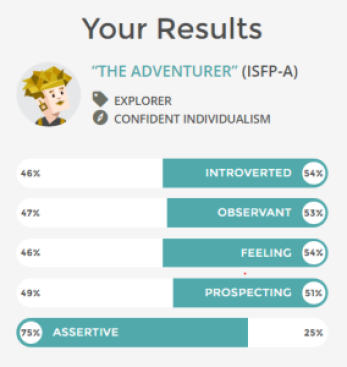
sample results from 16personalities.com of an MBTI type
A typical result chart from 16personalities.com

As a result, there are generally two levels of understanding that we have seen. In the first group are those who came across the popular 16P personality quiz, or similar sites like truity.com. These sites peddle a type of personality assessment that simply asks “are you Extroverted or Introverted”, “are you an Intuitive or a Sensor”, “are you a Thinker or a Feeler”, “are you a Judger or a Perceiver” with percentage scores and give you your “MBTI type” based on those results.

It is a dichotomy (“strictly one or the other”) method that leaves much to be desired, because in a dichotomy system, you cannot have balance in your capability for sensing/intuition, or thinking/feeling. The end result is that many test-takers feel like they do not fit the extreme definitions of “introvert” / “extrovert” / “thinker” / “feeler”, because naturally every person is a bit introverted at times, a bit extroverted at times, and uses logic and inner values depending on the situation at hand.

Picture of Carl Jung
Portrait of Carl Jung

In the second group are those who look further back to the origins of the modern MBTI, to the original theory introduced by Carl Jung in his 1921 book “Psychological Types” and expanded by Jungian analysts like John Beebe. Based on this theory, all our psychological thought processes can be categorized into 8 different cognitive functions.

This group also recognizes sixteen different types, but organizes each of the sixteen types by a unique combination of these 8 cognitive functions. It is a more holistic and nuanced understanding of personality types that accounts for the fact that everyone has a bit of everything, and the difference between types lies in the different order of strengths and weaknesses.

Here’s where the confusion arises: both groups have 16 types with the same 16 names, but a very different and incompatible understanding of what defines each of those 16 personality types.

Funny memes: seeing the cognitive functions as savior light in the distince
Have you seen the light of the cognitive-function perspective?

We are firmly in the second group, and we have seen that generally, people in the first group who start to learn about cognitive functions will almost always “see the light” and join the second group, seeing the types through the lens of cognitive functions rather than the simple dichotomies.

Once a person sees the more robust and comprehensive system, they will naturally accept it over the simplistic dichotomies. In writing this post, I hope to bring you from the shallow pools of the 16P and truity.com to the real nuts and bolts of Jung’s theory of personality!

What are Jungian/MBTI cognitive functions?

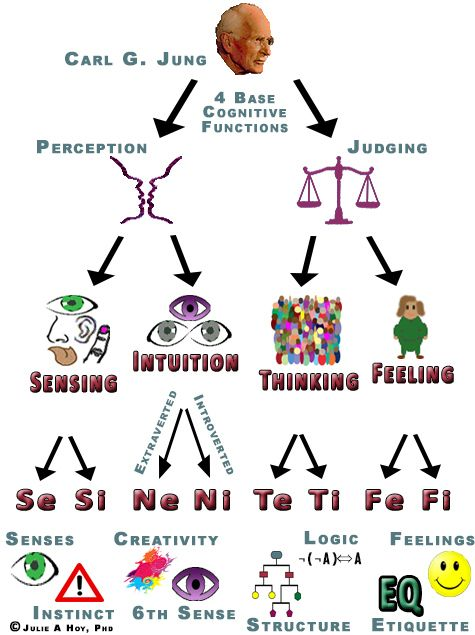
Perception can be done in two ways; it can be in the present, the “here and now” (Sensing) and it can be looking beyond into the future and inferring patterns beneath the surface (Intuition)

Sensing means looking more in to the here-and-now and concrete details instead of abstract patterns

On the other hand, judgement can be also done in two ways; it can be done for quantifiable things, judging value between two black-and-white comparisons (Thinking). It can be also be done for unquantifiable things, judging value in aspects like love or personal values (“do I love Alice or Bob more?”) (Feeling)

So as a result, we have 4 functions (Sensing, Intuition, Thinking, Feeling) and for each of these four functions , there is an introverted and an extroverted version.

Picture of a swimming person to illustrate the idea of introversion vs extroversion
Think of introversion and extroversion like water and land, for introverts, the inner mind is the relaxing land while it takes effort to “swim” in the outer word

The extroverted functions are oriented outwards towards the external world, they are:

  • Extroverted Sensing (Se): Enjoying the finer aspects of life in food, fashion. Being physically in tune with the world
  • Extroverted Intuition (Ne): From one observation, deriving ten different ideas and possibilities
  • Extroverted Thinking (Te): Real-world practicality, results-driven, things that can be written down on a resume
  • Extroverted Feeling (Fe): Being able to “read the room”, attuned to the social atmosphere, tailoring your words to your audience

The introverted functions are oriented inwards towards the subjective personal world

  • Introverted Sensing (Si): Seeing and remembering things as they were in the past, taking things step by step
  • Introverted Intuition (Ni): From ten observations, deriving one single theory that explains everything. Projecting the one future path that most likely will happen
  • Introverted Thinking (Ti): Logical and consistent, having various categories to ensure that everything has its own place in a water-tight system
  • Introverted Feeling (Fi): Having a clear idea of individual desires, values, tastes. Living life authentically without being affected by what the rest of the world does

A more detailed explanation of each of the functions can be found here.

Flow chart of how Jungian psychology branched into the 8 mbti functions
A flow chart that summarizes how Jung theorized the existence of 8 cognitive functions

How to determine the Function Stack of an MBTI Type?

  1. A person’s combination of functions (i.e. the function stack) can’t simply be randomly picked from the list of 8 functions (otherwise we would have 8^8 = 16,777,216 types! There are commonly accepted rules for the positions and pairings of the functions developed by readers of Jung such as Myers Briggs and John Beebe.
  2. Each function has a partner: its “opposite” within the same Judging/Perceiving category.
    • Perceiving function pairs
      • Introverted Intuition (Ni) + Extroverted Sensing (Se) Contextual
      • Extroverted Intuition (Ne) + Introverted Sensing (Si) Universal
    • Judging Function Pairs
      • Introverted Feeling (Fi) + Extroverted Thinking (Te) Contextual
      • Extroverted Feeling (Fe) + Introverted Thinking (Ti) Universal
  3. Every person’s first four function slots are comprised of one Perceiving function pair and one Judging function pair
    • Thus four possible combinations; there are four different ways to pair one Perceiving function pair with one Judging function pair
DemocraticTheocratic
Ne/Si + Fi/TeNi/Se + Fe/Ti
AtomicMonarchic
Ne/Si + Fe/TiNi/Se + Fi/Te
  1. Within a person’s first four function slots, one function pair will occupy the 1st (“Dominant”) and 4th (“Inferior”/”Primitive”) slots. The other function pair will occupy the 2nd (“Auxiliary”) and 3rd (“Tertiary”) slots
  2. Between the Dominant and Auxiliary Functions,
    • There is one extroverted and one introverted
    • There is one perceiving (N/S) and one judging (T/F)

To put everything together, here is an example of how we determine the functions of the ENFP type:

Step 1: Determine the orientation of the dominant function:

First letter tells you the orientation of the dominant function

The first letter “E” means Dominant function is Extroverted

Position

Orientation

Function

Dominant

Extroverted

(Intuition or Sensing or Thinking or Feeling)

Auxiliary

(Introverted or Extroverted) 

(Intuition or Sensing or Thinking or Feeling

because the dominant function is Extroverted, the Auxiliary function must be Introverted

Position

Orientation

Function

Dominant

Extroverted

(Intuition or Sensing or Thinking or Feeling)

Auxiliary

Introverted

(Intuition or Sensing or Thinking or Feeling

Step 2: Use the fourth letter narrows down the extroverted function

Fourth letter “P” means the Extroverted function is a Perceiving function (either N or S)

Position

Orientation

Function

Dominant

Extroverted

(Intuition or Sensing)

Auxiliary

Introverted

(Intuition or Sensing or Thinking or Feeling)

because the Extroverted function is a Perceiving function, the Introverted function must be a Judging function (T or F)

Position

Orientation

Function

Dominant

Extroverted

(Intuition or Sensing)

Auxiliary

Introverted

(Thinking or Feeling)

 Step 3: Use the second letter to decide whether the person is “Intuition” or “Sensing”

ENFP: “N” stands for Intuition rather than Sensing

Position

Orientation

Function

Dominant

Extroverted

Intuition

Auxiliary

Introverted

(Thinking or Feeling)

 Step 4:  Use the third letter to decide whether the person is “Thinking” or “Feeling”

ENFP: Letter F stands for Feeling rather than Thinking

Position

Orientation

Function

Dominant

Extroverted

Intuition

Auxiliary

Introverted

Feeling

 Step 5: Determine the tertiary function

Each function has a partner: its “opposite” within the same Judging/Perceiving category.

The Tertiary is simply the function pair of the Auxiliary

Position

Orientation

Function

Dominant

Extroverted

Intuition

Auxiliary

Introverted

Feeling

Tertiary

Extroverted

Thinking

 Step 6: Determine the inferior function

The Inferior/Primitive is simply the function pair of the Dominant

Position

Orientation

Function

Dominant

Extroverted

Intuition

Auxiliary

Introverted

Feeling

Tertiary

Extroverted

Thinking

Inferior / Primitive

Introverted

Sensing

Do you get it? Why not try to apply the same process above to determine the top four cognitive functions of your MBTI function stack? For a quick cheat sheet to look up different types’ stacks, click here.

So I hope you have had a better understanding of the other “deeper” aspect of MBTI and the commonly accepted model of the function stack in each type. This will unlock a more in-depth level of self-understanding for yourself based on your type.

The next step is to relook at your specific function stack and familiarize yourself with the definition and usage of each of these functions. Then, you can reflect on how these functions manifest in your life, then learn the theory further, and repeat. It will be a fulfilling and amazing journey of self-discovery with the aid of MBTI and Jungian functions!

References

  1. Myers, Isabel Briggs, and Peter B. Myers. Gifts differing: Understanding personality type. Consulting Psychologists Press, 1980.
  2. Beebe, John. Energies and patterns in psychological type: The reservoir of consciousness. Routledge, 2016.
  3. Jung, Carl. Psychological types. Routledge, 2016.

This was a guest article written by CS Ng. For more content from the author, check out here.

A more detailed explanation by him on the function stack can be found here

Cheat Sheet: The Function Stack of Each MBTI Type

The eight cognitive functions

The four extroverted functions are oriented outwards towards the external world, they are:

  • Extroverted Sensing (Se): Enjoying the finer aspects of life in food, fashion. Being physically in tune with the world
  • Extroverted Intuition (Ne): From one observation, deriving ten different ideas and possibilities
  • Extroverted Thinking (Te): Real-world practicality, results-driven, things that can be written down on a resume
  • Extroverted Feeling (Fe): Being able to “read the room”, attuned to the social atmosphere, tailoring your words to your audience

The four introverted functions are oriented inwards towards the subjective personal world

  • Introverted Sensing (Si): Seeing and remembering things as they were in the past, taking things step by step
  • Introverted Intuition (Ni): From ten observations, deriving one single theory that explains everything. Projecting the one future path that most likely will happen
  • Introverted Thinking (Ti): Logical and consistent, having various categories to ensure that everything has its own place in a water-tight system
  • Introverted Feeling (Fi): Having a clear idea of individual desires, values, tastes. Living life authentically without being affected by what the rest of the world does

Cheat sheet: Use this table for quick reference to see which functions are in each type

DominantAuxiliaryTertiaryInferior / Primitive
ISFJIntroverted Sensing (Si)Extroverted Feeling (Fe)Introverted Thinking (Ti)Extroverted Intuition (Ne)
ESFJExtroverted Feeling (Fe)Introverted Sensing (Si)Extroverted Intuition (Ne)Introverted Thinking (Ti)
INTPIntroverted Thinking (Ti)Extroverted Intuition (Ne)Introverted Sensing (Si)Extroverted Feeling (Fe)
ENTPExtroverted Intuition (Ne)Introverted Thinking (Ti)Extroverted Feeling (Fe)Introverted Sensing (Si)
ISTJIntroverted Sensing (Si)Extroverted Thinking (Te)Introverted Feeling (Fi)Extroverted Intuition (Ne)
ESTJExtroverted Thinking (Te)Introverted Sensing (Si)Extroverted Intuition (Ne)Introverted Feeling (Fi)
INFPIntroverted Feeling (Fi)Extroverted Intuition (Ne)Introverted Sensing (Si)Extroverted Thinking (Te)
ENFPExtroverted Intuition (Ne)Introverted Feeling (Fi)Extroverted Thinking (Te)Introverted Sensing (Si)
INFJIntroverted Intuition (Ni)Extroverted Feeling (Fe)Introverted Thinking (Ti)Extroverted Sensing (Se)
ENFJExtroverted Feeling (Fe)Introverted Intuition (Ni)Extroverted Sensing (Se)Introverted Thinking (Ti)
ISTPIntroverted Thinking (Ti)Extroverted Sensing (Se)Introverted Intuition (Ni)Extroverted Feeling (Fe)
ESTPExtroverted Sensing (Se)Introverted Thinking (Ti)Extroverted Feeling (Fe)Introverted Intuition (Ni)
INTJIntroverted Intuition (Ni)Extroverted Thinking (Te)Introverted Feeling (Fi)Extroverted Sensing (Se)
ENTJExtroverted Thinking (Te)Introverted Intuition (Ni)Extroverted Sensing (Se)Introverted Feeling (Fi)
ISFPIntroverted Feeling (Fi)Extroverted Sensing (Se)Introverted Intuition (Ni)Extroverted Thinking (Te)
ESFPExtroverted Sensing (Se)Introverted Feeling (Fi)Extroverted Thinking (Te)Introverted Intuition (Ni)

Overview of MBTI Dimensions: Introversion, Intuition, Thinking, Judging

If you do not know or remember your Myers Briggs Type Indicator (MBTI) results, you can take one of the many free tests available such as 16personalities.com or http://www.truity.com/test/ or http://www.humanmetrics.com

Your result is a personality type with a corresponding 4-letter combo such as INFP (The Mediator) or ENTJ (The Commander). The 4 letters come from 4 dichotomies: Introversion (I)-Extroversion (E), Intuition (N) – Sensing (S), Thinking (T) – Feeling (F), and Perceiving (P) – Judging (J).

What do these letter and dichotomies mean? Those free online tests often come with a general description of your type and functions. You can read them on your own. Below is my own brief but somewhat more advanced description of the functions in these 4 dichotomies that might be worth learning.

1. Introversion vs Extroversion

introvert-or-extrovert

An extroverted behavior is one where objective (environmental) data contributes more weight than subjective input in decision making. If extroverted behaviors become habitual, then such individual is considered an extroverted type. Conversely, if a person spends more energy staying detached from objective data to listen to their own mind, he or she is considered introverted.

A very important point put forth by Jung is that introversion and extroversion are not mere deliberate choices that can be easily changed.  They are more likely to be assigned by birth randomly in the population, representing two distinct yet balancing survival strategies in organisms. An organism can be greedy and aggressively grab food and mate around to maximize successful reproduction. While another is more selective to conserve energy, strike only when absolutely necessary. Basically, introverts prefer to conserve energy while extrovers expand.

Projecting the above strategies further into humans, Jung further points out that extroverts are more likely to adjust their behaviors faster to objective data and immediate surroundings. They are more driven by short-term immediate gains, be it business opportunities or valuable things. Their morals are heavily dictated by the prevailing demand from the society at the moment.

Extroverted behaviors may allow for quick adjustments and gains to a change in environment, but can be at odds with the universal trends or laws. This is where the introverts step in to gain advantage. They listen deeper within themselves and abide by the more universal, but often misunderstood rules coded in their genes and minds since birth.

Can one really change his attitude from introvert to extrovert and vice versa? According to Jung, it could happen, but with significant resulted psychological strains and disorders. For example, a kid having to suppress his natural attitude due to unfavorable parental influence will develop neuroticism  when grow up, which can only be remedied by allowing his natural tendency to redevelop.

Another essential model to keep in mind as proposed by Jung is the insidious influence of the unconscious to the other functions which received less conscious energy from the subject.  He emphasized the importance of the unconscious in balancing the conscious, which is most evident in the case of dreams. Dreams often have prophetic qualities in response to anything done excessive in a person’s waking moments.

According to Jung, no function will be entirely eliminated, it can only be greatly distorted. The suppressed functions become merged with unconscious content and become bizarre in character, though one of great importance to the overall psychological well-being.

Illustration of the functional stack of ENTJ type

 2. Thinking vs Feeling

photo of two women lying on grass

At the most basic level, thinking and feeling point to 2 contrasting approaches of survival for human beings as rational yet social creatures. On one hand, one may prefer collaboration and building relationships as a survival strategy. On the other hand, some choose a more independent approach with the aim of accumulating resources for oneself and devise plans to better compete with others. Of course anyone would need some mixture of these 2 strategies to navigate human’s complex social structures.

At individual level, thinking and feeling are somewhat more visible  and easier to understand than the other dichotomies, especially in the case of extroverts. I find Socionic offered more detailed and interesting description to contrast this dichotomy (Note that they are often referred to as logic versus ethic in socionic, which I find less misleading than the term thinking and feeling): https://www.the16types.info/vbulletin/content.php/429

By Socionic models, thinking individuals are more energized by changes in the “logical world”, which are rules, systems, logical criteria and measurable results. They pay more attention to the demand of the material worlds, and are more black-and-white in terms of statement of facts being correct or incorrect etc. Feeling individuals, on the other hand, are often more expressive and energized by the “ethical world”, which ranges from overall momentary atmosphere to deeply held individual values.

3. Intuition vs Sensing

intuition-versus-sensing

Intuition and sensing are often harder to understand and very often mis-typed in my experience. People would often prefer to be viewed as intuitive than sensing-dominant. Because if thinking is considered a more advanced function which develops later in human’s evolution, the same thing can be said about intuition. Another term for intuition is abstraction, the ability to perceive beyond immediate sensory data to see the hidden patterns and concepts. Intuitive people are big-picture oriented and energized more by abstract parameters such as timing, potential, expectations, meaning etc. 

The rest of the animal kingdom is mostly unable to perform any intuitive task. Everything to them is immediate sensory input and responses. They live in the moment with no concept of time, let alone higher abstract thoughts such as the meaning of life.

Sensor is the term often used to refer to individuals dominant in sensing perception. They are often quicker in noticing surrounding movements and superficial impression: aesthetic beauty, vibe, concrete results and actions. They are often more attuned with pop culture and have highly-discriminated aesthetic tastes, making for great athletes, cooks, singers and artists. They prefer quick and concrete results and action, with little patience for theories or abstract discussions.

With that being said, there are pros and cons in being intuitive or sensing dominant. Intuitive people are stereotyped as being absent-minded professors, bland in taste and impractical. Meanwhile, sensors often have a bad reputation, especially on personality forums, as shallow, conformist, superficial, impulsive and lacking in foresight. Sensors may be the majority in the general population, but they are probably too bored to discuss personality theories online, thus being the minority here.

4. Judging vs Perceiving

This last dichotomy is probably the biggest pain point for many MBTI and Jungian purists. Judging and Perceiving are actually NOT psychological functions. They simply point out how your other two dichotomies, thinking-feeling and intuitive-sensing, orientate. If you are a P, your Dominant Extraverted function is an Perceiving function. Similarly, if you are J, your Dominant Extraverted function is a Judging function.

This is extremely confusing, I know. Perceiving functions are Intuitive or Sensing, while Rational functions refer to either Thinking or Feeling. I will have to explain the difference another time, but in short, jugding functions prioritize the perception of the objects, result or expectations of results while perceiving ones are process-oriented. If you are an INFP, your dominant extraverted function is Extraverted Intuition as compared to an INFJ who possesses a Judging extraverted function of Extraverted Feeling. 

Even though they are important, (INFJ and INFP actually have no function in common), beginners of MBTI should be more comfortable to regard the J and P letter as functions denoting abstract concepts of Being Organized versus Being Impulsive. 

It is important to remember to take them at face value, especially in the case of introverts, because they only denote the outward behaviours. An INFP is actually a Judger at heart because their dominant function is Introverted Feeling, a judging function. They would prefer to start the day with a goal and plan in mind, while an INFJ would actually go with the flow despite their outward quality of being more organized.

Jung, C. G. (2017). Psychological types. Abingdon, Oxon: Routledge.