In the modern era of personal and professional development, various personality frameworks have become increasingly popular for helping individuals understand themselves and others. Among these, the Myers-Briggs Type Indicator (MBTI) and the Enneagram stand out as deep, insightful tools for long-term personal growth. However, other models like the Big Five, Emotional Intelligence (EQ), and StrengthsFinder also offer unique perspectives and are popular in different settings. This article provides a comprehensive comparison of these frameworks, exploring their origins, theoretical foundations, practical applications, pros and cons to help you achieve a more discerning perspective:
1. Myers-Briggs Type Indicator (MBTI)
Origins and Background
The MBTI was developed by Katharine Cook Briggs and her daughter Isabel Briggs Myers during World War II. They based it on Carl Jung’s theory of psychological types, which emphasizes different cognitive processes for interacting with the world. Their goal was to create a system that could help people understand themselves and others, especially in areas of communication, decision-making, and work preferences.
Theoretical Essence
MBTI categorizes individuals into 16 personality types based on four dichotomies:
Extraversion (E) vs. Introversion (I),
Sensing (S) vs. Intuition (N),
Thinking (T) vs. Feeling (F), and
Judging (J) vs. Perceiving (P).
Each type represents a preferred way of processing information, making decisions, and interacting with the world. It highlights the role of dominant and auxiliary cognitive functions, which are essential for self-awareness and understanding the behaviors of others.
Practical Application
The MBTI is highly valued in corporate environments, relationship counseling, and personal development. It helps individuals improve communication, enhance team collaboration, and develop emotional intelligence. Its strength lies in its focus on how people think and operate, which can provide actionable insights for personal growth. However, critics argue that MBTI lacks scientific rigor and can be oversimplifying.
2. Enneagram
Origins and Background
The Enneagram has ancient roots, believed to originate from various spiritual and philosophical traditions, including early Christian mysticism and Sufi teachings. It was modernized in the 20th century by Oscar Ichazo and Claudio Naranjo, who expanded its psychological depth.
Theoretical Essence
The Enneagram categorizes individuals into nine distinct personality types, each associated with core motivations, fears, and desires. Unlike MBTI, which focuses on cognitive functions, the Enneagram emphasizes the emotional and motivational drivers behind behavior. It offers a dynamic model where individuals can shift along “growth” and “stress” lines, reflecting how they adapt to life circumstances.
Practical Application
The Enneagram is often used in both personal and spiritual development, as it provides a pathway for individuals to explore deep-rooted behavioral patterns. Its holistic approach allows for personal transformation by identifying key motivations and emotional triggers. However, the lack of scientific validation, similar to MBTI, is a common criticism.
3. Big Five (OCEAN)
Origins and Background
The Big Five Personality Traits model emerged from decades of psychological research and is considered one of the most scientifically robust personality frameworks. It stems from studies in the 1940s and 50s that aimed to empirically measure personality traits.
Theoretical Essence
The Big Five model measures five core dimensions of personality:
Openness to Experience,
Conscientiousness,
Extraversion,
Agreeableness, and
Neuroticism (OCEAN).
These traits exist on a spectrum rather than as dichotomies, making it a fluid framework. The model’s strength lies in its empirical foundation, which allows for predictive power in various life outcomes such as career success and relationship satisfaction.
Practical Application
The Big Five is widely used in psychological research and clinical settings due to its strong scientific backing. However, its downside is the lack of depth when it comes to cognitive processing or inner motivations. While it provides valuable insights, it may not be as engaging or transformative for personal growth as MBTI or Enneagram.
Pros: This model is scientifically validated and widely accepted in psychology. It measures traits like Openness, Conscientiousness, Extraversion, Agreeableness, and Neuroticism.
Cons: It doesn’t offer the same depth of insights into cognitive functions or personal motivations as MBTI or Enneagram, which might make it less engaging for personal growth enthusiasts.
The DISC Personality Modelfocuses on four primary behavioral traits: Dominance, Influence, Steadiness, and Conscientiousness. Originating from the work of psychologist William Moulton Marston in the 1920s, DISC is widely used in corporate environments to improve communication, teamwork, and leadership. Unlike typology frameworks like MBTI and the Enneagram, DISC assesses observable behaviors rather than deeper cognitive processes or motivations.
Dominance reflects assertiveness and control over situations.
Influence measures sociability and persuasion skills.
Steadiness evaluates consistency and reliability in behaviors.
Conscientiousness focuses on precision, attention to detail, and task orientation.
Pros: DISC is easy to understand and apply, making it popular for organizational development, leadership training, and conflict resolution. It’s particularly effective in workplace settings where understanding behavioral differences is crucial for collaboration.
Cons: While practical, DISC lacks depth when it comes to understanding underlying psychological drivers. It doesn’t delve into cognitive functions or emotional patterns like MBTI or Enneagram, making it more suited for short-term behavior modification rather than deep personal growth.
5. StrengthsFinder (CliftonStrengths)
Origins and Background
StrengthsFinder, developed by Donald Clifton in the late 20th century, focuses on identifying and utilizing personal strengths to maximize performance. It is rooted in positive psychology and is widely used in business and leadership development.
Theoretical Essence
StrengthsFinder identifies 34 individual strengths and categorizes them into four domains: Executing, Influencing, Relationship Building, and Strategic Thinking. The idea is that individuals should focus on honing their natural strengths rather than trying to fix their weaknesses.
Practical Application
StrengthsFinder is commonly used in organizational settings to optimize team performance and leadership capabilities. Its major limitation is that it doesn’t offer the same depth of self-awareness or personal growth opportunities as typology frameworks like MBTI or Enneagram.
Pros: Focuses on identifying and leveraging individual strengths, making it practical and results-oriented. It’s widely used in business and leadership development.
Cons: It doesn’t offer the same depth of self-reflection or holistic view of personality traits and interpersonal dynamics as typology frameworks.
By combining the depth of MBTI and Enneagram with more empirical models like the Big Five, or the actionable skills of EQ frameworks, practitioners can create a balanced and effective program for self-awareness, growth, and relational success. For long-term learning, MBTI and Enneagram remain the cornerstones for deep, transformational understanding.
Here’s a version with visible, copyable links for each model and the reference section:
References:
Jung, Carl G. (1921): Psychological Types, the foundational theory behind MBTI.
Myers, Isabel Briggs & Myers, Peter B. (1995): Gifts Differing: Understanding Personality Type, an exploration of the MBTI and its applications.
Goleman, Daniel (1995): Emotional Intelligence: Why It Can Matter More Than IQ, the seminal work that popularized the EQ framework.
Marston, William Moulton (1928): Emotions of Normal People, where the DISC model’s behavioral dimensions originated.
Riso, Don Richard & Hudson, Russ (1996): The Wisdom of the Enneagram, a modern interpretation of the Enneagram system.
Costa, Paul T. Jr. & McCrae, Robert R. (1992): Revised NEO Personality Inventory, detailing the Big Five (OCEAN) traits.
Webinar timing: 18 Mar (Mon), 9pm-10pm Singapore time (9am EST)
Do self-limiting beliefs hold you back from unleashing your full potential? Ambitious managers and professionals, known for being hard on themselves, often struggle with these negative self-beliefs which can reinforce a cycle of low self-esteem, weak boundaries and burnout.
The key to breaking this cycle lies in objective self-awareness: firmly recognizing your strengths, and acknowledging the accompanying weaknesses. While various tools frameworks are available to aid in your self-awareness journey, the Myers Briggs Type Indicator (MBTI) stands out as a highly comprehensive and popular modern self-discovery framework. It’s widely used by millions of individuals and many Fortune 500 companies to enhance workplace relationships and leadership coaching.
Join our community for this exclusive crash course aimed at helping you conquer your negative self-beliefs and transform them into strengths and confidence through the secrets of the less well-known 8 Cognitive Functions.
Introduction to MBTI and Jungian cognitive functions
A quick crash course on cognitive function definitions
Reflection on how your dominant functions reveal your strengths and corresponding weaknesses
Explore practical strategies for developing your weaker functions
Q&A
The most helpful aspect is I could again a level of self-awareness and how this impacts how I engage with others and what works for me , but also a good list of tips that I can share with others who engage with me often so that they can understand how I work/think.
Denise, English instructor
Guided by a certified Type Coach Tuan Le with over 8 years of experience in personality psychology, participants will engage in lively yet intimate discussions focused on self-healing and self-exploration, emerging with deeper insights and increased self-confidence. Secure your spot now and be part of this enlightening experience.
Note: This form will close 1 day before the event or when the participant limit have been reached.
Registration has now been closed. You may check out the next training here.
This is a recorded webinar, please request for the link via the registration form below.
If you’re feeling frustrated with the dating scene, you’re not alone. Trying to find the right partner can be both fulfilling and dating experience. There’s no easy formula, just like anything worthwhile in life, but there is a way to equip yourself with the right mindset so you can select better as well as be much more understanding with your partners & special people in your life..
Typology or personality science is a powerful tool that categorizes people into personality patterns, allowing you to overcome psychological biases and lack of information to see the core of another person. In this expert-led session, we will learn and discuss:
Agenda:
Introduction: the role of personality in relationship compatibility
Compatibility vs acceptance, what’s more important?
The biggest hindrance to understanding: ego and naive realism
Introduction to Jungian Function & Temperaments as essential tools for people reading
Statistics and discussion of different temperament pairing and happiness
Q&A and sharing
About the trainer: Tuan Le is a passionate veteran in personality psychology. A certified typology coach, he has spent over 8 years learning and later training the public in the psychological frameworks such as MBTI, Enneagram, Socionics…. He is passionate about fostering better self-awareness and interpersonal understanding through objective and deeper understanding of personalities. Read more
Submit the registration form below to receive your link:
Hello personality enthusiasts! We had the honor to be able to have Michael Pierce to do a public session for the Singapore Typology Community. Michael Pierce is a Jungian researcher and well-known figure online with his substantial work published under the book “Motes and Beams”. I hope his beautiful analogies and philosophical analysis can help many beginners to move from simple personality quizzes to the beautifully nuanced world of Jungian Typology.
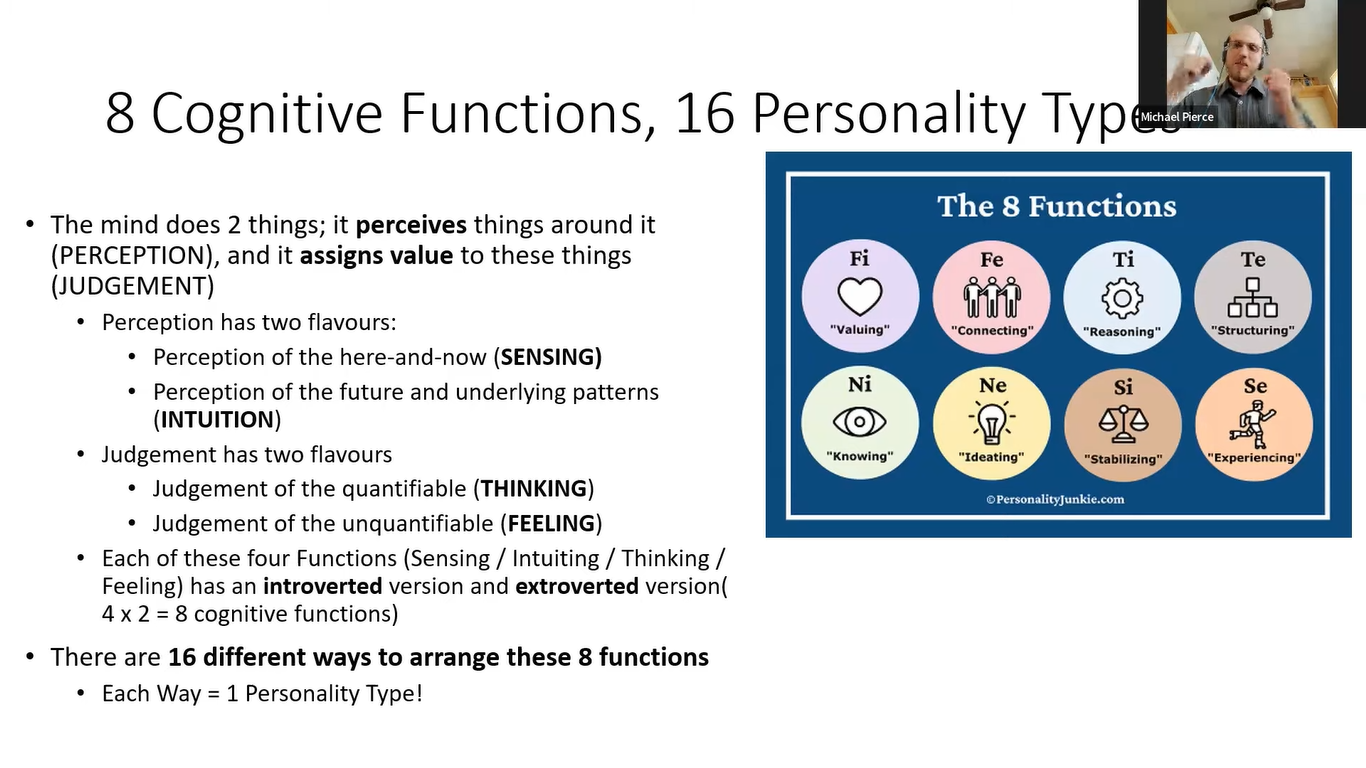
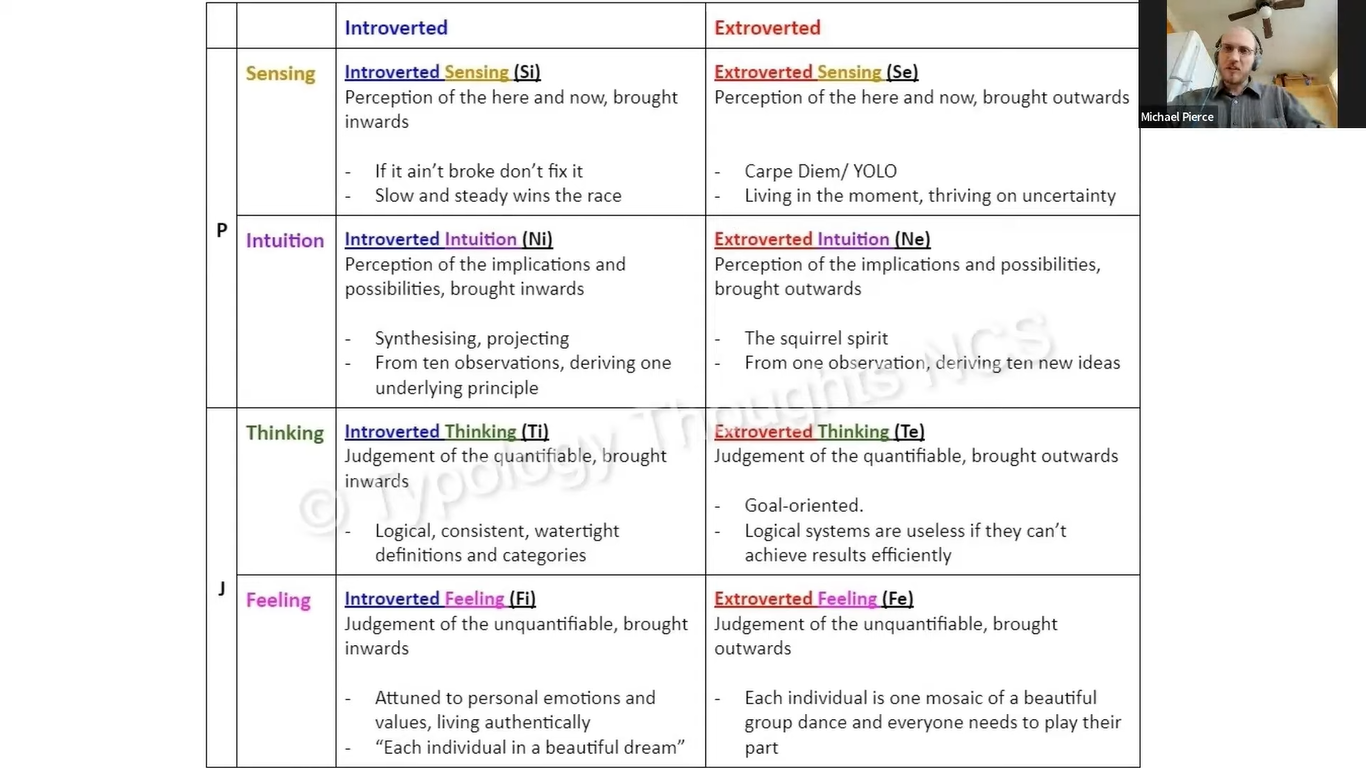
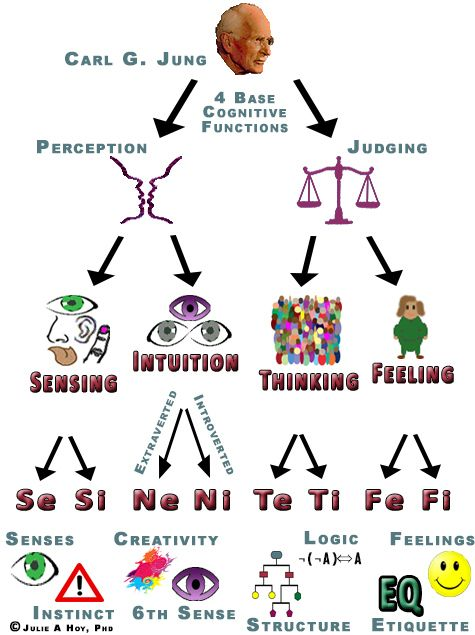
Michael: “You’re about to join me down the rabbit hole of this more complex, advanced system known as Cognitive Function Theory or Jungian Theory. So, we begin with Perception and Judgment. These appear in the MBTI test as a dichotomy pair. In Jung’s Theory, they serve a bit of a different role. Perception simply refers to how you perceive the world. It takes in information and it doesn’t categorize it, it doesn’t make any judgments about it. It is only interested in what the things are that are being perceived and are coming into the personality, into your mind. Judgment, as it’s been laid out here, assigns some sort of value to these things. It categorizes them, it judges them. So these two are opposites, but they’re complimentary. Perception has two flavors, or there are two kinds of perception, and in the same way, there are two kinds of Judgment. There are slightly different theories about precisely the correct way to justify splitting them into two flavors, but for our purposes, we’ll just take it for granted and say Perception has two flavors. One is Sensing or Sensation. That’s the perception of what is actually there, the here and now. It has to do with the present, and it also has to do with concrete objects, a lot of the time. Whereas Intuition is a perception of the future, of underlying patterns, of the possibilities of things. That’s how I often try to refer to it. So Sensation is almost like a more direct line to the object, whereas Intuition tends to go around it to things that are implied by the object. So, Sensation is generally very concrete, down to earth. Intuition is very creative but can also be very head in the clouds about things. Those are two ways of just perceiving the object. Judgment also has two kinds: Thinking and Feeling. It’s important to note that we use the terms Thinking and Feeling in a very different way from how they are more precisely used in Jung’s Theory. But as Ching has laid it out nicely here, Thinking is judgment of the quantifiable, and Feeling is judgment of the unquantifiable. There’s a correspondence, at least in my theory, my approach to it, between Thinking and Sensation and Feeling and Intuition. Thinking has to do with judging things in terms of rigid categories and logic, whereas Feeling has more to do with values, ethics, how you and other people are feeling. So that’s sort of the distinction. Okay, so now we have four functions, and note we’ve just sort of built them beginning from Perception and Judgment, and we’ve built our way up to Sensation, Intuition, Thinking, and Feeling, which again you would recognize those from the MBTI, the Myers-Briggs test, and other tests online.”
The Dichotomy of Extraversion and Introversion
Michael: “So now we’re going to do the division game again. We’re going to introduce a new dichotomy, Introversion and Extraversion, and by doing that, we will multiply the four functions into eight cognitive functions. Extroversion is an attitude. It’s a focus on what we call ‘the object’. So I perhaps should have started with this, but just so you understand the terminology, the object is anything that is not you. It is the thing that you are focusing on, in order for anything to happen in psychology, you have to have an object and you have to have a subject. The subject is the mind, the subject is the person or the being that has the psychology going on inside them, as it were. And for every subject, there needs to be objects that that subject can think about and can focus on. For Extroversion, there is this, as it were, outward turning and outward focus towards the objects that are out there in the world. And Introversion is a turning inwards to the way that your own subject is. So in some sense, Introversion, you could say, is making an object of your own subject. But I don’t want to start getting into loops of language and so forth. The more important thing is the outward motion versus this inward motion. And so we can split up Sensation and Thinking, and Feeling and Intuition via Extroversion and Introversion. So we would get extroverted sensation, introverted sensation, extroverted thinking, introverted thinking, so forth.
You’ll notice in the little chart up here, they are abbreviations. So Fi would be Introverted Feeling. So the F is for Feeling, the T is for thinking, the S is for Sensation, and the N is for Intuition. Even though intuition starts with an I, it’s abbreviated with an N so it doesn’t get mixed up with Introversion. And then each of those has a little I for Introversion after it or a little E for Extraversion after it. So that’s the notation and how that works. It’s a lot faster to just write, say, Fe rather than Extroverted Feeling because that would get a lot of letters on the page. So finally, we have eight cognitive functions. And now what we’re going to do is we’re going to arrange these functions in order to get 16 different personality types. Let’s just run over what these cognitive functions are and how they work.”
What is “Sensation”?
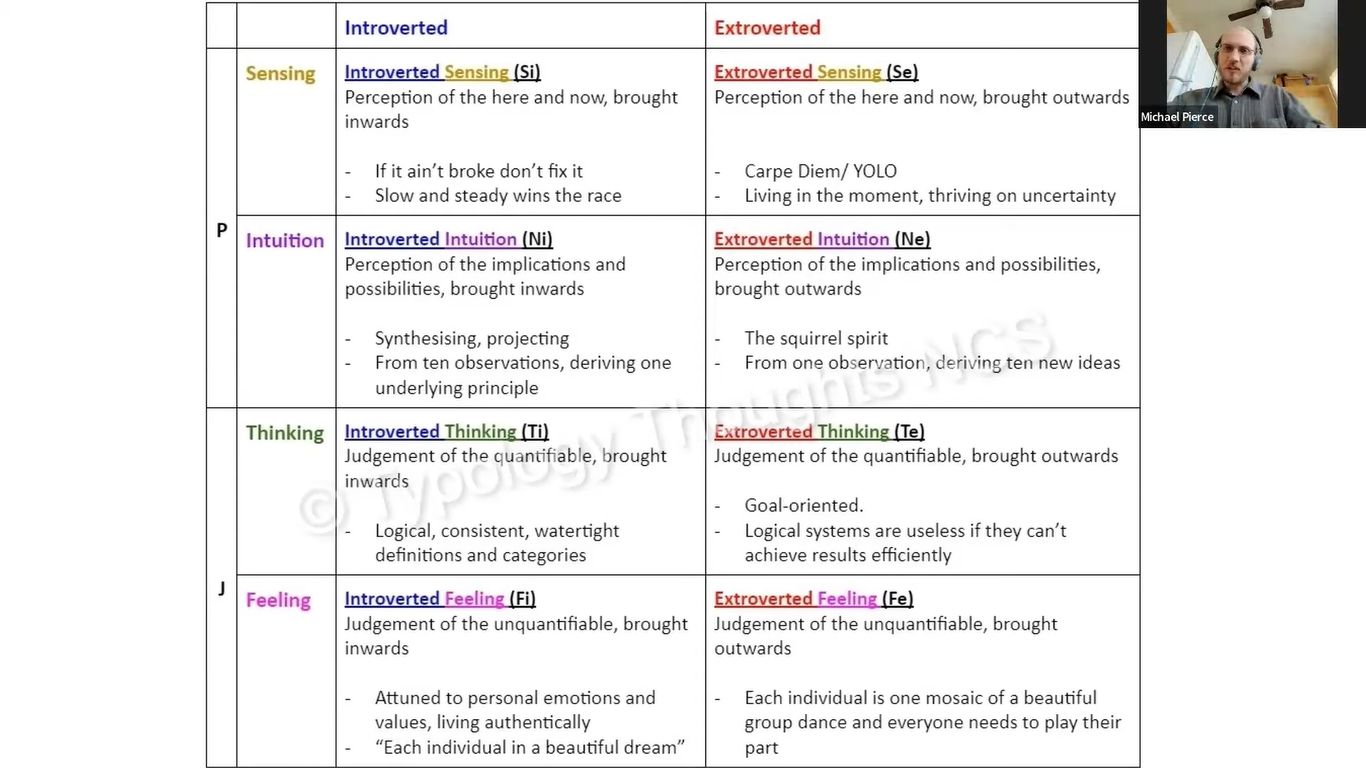
Michael: “There are two kinds of Sensation: Introverted and Extroverted. I’ll start with Extroverted Sensation. Going by our definitions, Extroverted Sensation would be sensation but directed outward, as it were. It is directed to objects in the here and now. Somebody who is using Extroverted Sensation is someone for whom that is the dominant function they prefer to use. There tends to be a very, as it were, carpe diem, YOLO, living in the moment, thriving on uncertainty. People who are Extroverted Sensing types in my experience thrive in situations where there’s a bit of chaos, and it can stress them out as well, but they’re often much better than introverted types at dealing with that because they’re just going moment by moment. They see what concretely is happening around them, and they just keep track of everything and flow in order to adapt to what is happening in the moment. So, you know, emergency workers, firefighters, police, a lot of people who have to deal with emergency situations. It doesn’t just have to be that. You can still find them in more academic disciplines at times, though that is usually through focus on other functions. So that’s Extroverted Sensation, very in the moment. Introverted Sensation reverses that in an interesting way, because the sensation is directed inwards. So Introverted Sensation people, not in a political sense at all, per se, but there’s a kind of conservatism, they’re much slower and more removed from the outside world, as compared to the extroverted sensor. It is perception of the here and now but brought inwards.
My mother, for example, is a dominant Introverted Sensation type, and she has a very sensitive palate. She usually does a lot of the cooking. She prefers to do the cooking because she can cook the things right. And every time we sit down to dinner, she will eat the food and she will be comparing what she is tasting here and now with these sort of ideal sensations that she has in her own mind. And she compares those sensations to that ideal sensation, and it’s that ideal sensation which is more real for her than the sensations in the here and now. And so she will taste and say, “This tastes like it has too much salt. This shouldn’t have as much salt as it does at the moment,” whereas I’m sitting there, and I’m like, “Oh, this is a salty dish“. But for her, it’s like, “No, it’s more salty than the way it should have salt”. And if you’re clever, you might notice there’s some relation with judgment, which I don’t really have time to get into that right now, but it’s a valid observation. So anyway, you get a conservatism there. It’s not “live-in-the-moment”. One of the other things my mother would do is when something flashy or wild or very quick would happen, she would take a moment and she would just say, “I’m just processing what just happened”. And she’s processing the sensory aspect of it. So they all also will often be very good journal keepers, very meticulous, able to remember all of the details and repeat those back.
What is “Intuition”?
Michael: “So now we move on to Intuition. We have Extroverted Intuition, which is a perception of implications and possibilities brought outwards. It is a focus on ideas and possibilities. Almost like they’re juggling a lot of different ideas at one time. But more importantly, it’s the fact that those ideas are out there. A better way of putting it is it’s almost like ideas are actual objects for them that exist outside of themselves and exist on their own. So the result of this is that ideas tend to diverge for them. From one observation, you can derive ten new and distinct ideas from it. So there’s this branching out, and it very quickly can turn into a kind of chaos for them. But it’s very, very fruitful because they will see all of the ways you can split up one topic into different topics.
Introverted Intuition does sort of the opposite. Introverted intuition, because it turns inwards, has a tendency to see similarities between things to a certain extent and to say, “This idea is really just this idea if you put them next to each other.” You can sort of collapse things into each other. From 10 observations, you derive one sort of vision or one underlying principle. Extroverted Intuition is almost like, you have one point, and then you draw an infinite number of lines through that one point to show all of the different ways you can diverge from that one point. Whereas intuition or introverted intuition, you have say 10 points, and then you try to draw a line of best fit, if you know that from algebra, you try to draw a single line that sort of averages out all of those individual observations, and that is the single idea which is then kept in Introverted Intuition. So kind of like with Introverted Sensation where I mentioned this notion of having ideal sensations that you kind of use to organize the sensations in the outside world, similar idea with Introverted Intuition, but with ideas, you have sort of a single idea that you are relating things back to. So Extroverted Intuition is stereotypically… it doesn’t necessarily look like this, but stereotypically, lots of different ideas. Very kind of scattered brains, running all over the place, whereas introverted intuition is like, “I have the eyes that stare into your soul,” you know, kind of like the chess grandmaster or something like that.”
What is “Thinking”?
Michael: “Thinking is judgment that is based on logic and facts, and it’s broader than that, but that’s the quickest way to explain it. So Extroverted Thinking is very goal-oriented. It’s very, “I want to accomplish things out there in the world. I want to organize the actual materials or people or resources that I see outside of me. I want to work with the external facts of a situation. Here’s where we should go with something. Here’s how we make things more efficient.’” Ching: “Everyone always has this mindset that Extraversion means party animal, you know? So when I meet someone and I say, ‘Oh, I think you have a very strong Extraverted Thinking,’ they often say, ‘Oh, I’m not an extrovert. I’m just doing all the work in the background,’ but it is precisely the fact that they are doing all the work that is the Extroversion, and that is the Jungian definition of Extroversion that is that we don’t really use nowadays.” Michael: “Thank you, Ching. Yes, that’s a very good point. It’s important to leave aside some of your preconceptions about what Extroversion and Introversion mean in order to properly understand these. You can get people who will seem very introverted in a colloquial sense, in an everyday sense, but the way that their mind actually functions would be described better by one of the extroverted functions. Perhaps, and as we shall see soon, everybody has extroverted sides and introverted sides. It’s just a matter of how they are arranged in relation to each other. So it’s never as simple as whether you’re a party animal or you want to stay home and read books.
So that’s Extroverted thinking, very pragmatic. Introverted Thinking, again, we have this idea where it’s almost the thinking idea inside of one’s own subject which takes precedence over the facts out there. So there’s a focus on refining logical ideas, refining and making those ideas perfectly precise, pure mathematics almost all the time. That’s where you’re going to find more Introverted Thinking types. But they’re much more interested in the theory and in making things logical and consistent, and then taking that theory and then after the fact applying it to what’s going on out there. They’re always much more interested in making the definitions and ideas more precise. Rene Descartes, a French philosopher, he’s famous for saying, “I think, therefore, I am”. That is very introverted thinking because what he literally did was said, “I can’t trust any of my external knowledge of the outside world because, you know, it’s possible that I am deceived or I’m hallucinating or I’m dreaming or something. All I can trust, and what is more real for me, is my own thoughts, my own principles that I’ve developed.” This is very introverted thinking. So that’s how those two go. You kind of have this difference between theory and practice, which would be a very general way of differentiating them.”
What is “Feeling”?
Michael: “Finally, we have Feeling. Extroverted Feeling is a feeling which is sort of directed outwards. It is objectified. Extroverted Feeling will generally be much more naturally outwardly expressive. It will be in tune with what expressions are the most socially acceptable or most harmonious to the needs of the group. Ching wrote a nice little thing, actually, a very nice little description here: “Each individual is one Mosaic of a beautiful group dance, and everyone needs to play their part.” That’s great. The dance especially is a great way of putting it because you have this notion of the need to not focus on how you’re feeling or your own feelings, but to harmonize with the group and to try to promote the feelings of the group as a whole. So you see there’s this movement outwards in terms of one’s ethics. When someone has dominated Extroverted Feeling, there will often be this sort of blurring of the line where they will be literally feeling what they think should be felt. And if they’re not feeling what should be felt, then they’re like, “Something’s wrong. If I’m not crying at a funeral, something’s probably wrong. This isn’t how you’re supposed to feel objectively in this situation”. They also don’t say certain things to certain people because they think they’re just going to screw everything up.
Introverted Feeling is where the feeling is directed inwards. You have to get past some of the connotations of the language because when I say they’re much more focused on how they are feeling, it sounds as though they’re self-absorbed and selfish. And from the Extroverted Feeling perspective, they are. From that perspective, that’s what’s going on. But then that gets challenged when you find that some of the most empathetic and self-sacrificing people I’ve met have been Introverted Feeling types. And that’s because it sort of messes with the selfishness-selflessness division. Introverted feeling is that feeling which is internal or individual to you. If you’re crying at a funeral because you knew the person and you had a personal connection with them and you are genuinely, like, this is how I feel regardless of how everybody else is feeling, that’s good because that indicates that you are more in alignment with your own feelings and your own soul. But if you’re just crying at the funeral because that’s what you’re supposed to do, then that’s like, who are you? You’re like an empty shell. I once had an argument with a friend of mine who wasn’t a dominant Introverted Feeling, but they had that in there as one of their major functions, and they were always asking me, like, “So, how do you feel about this or that controversial issue?” And I, being more Extroverted Feeling, was always like, “I don’t really want to answer that .. What’s more important is how are you going to react to how I feel about such and such”. As far as my feelings go, those just seem so ephemeral and so kind of unrelated to the topic… and it would turn into just us arguing over whose feelings are right, and that wasn’t useful. But that wasn’t how she thought about the things. So, that’s your crash course in the eight functions.“
How are cognitive functions organized to form personality types?
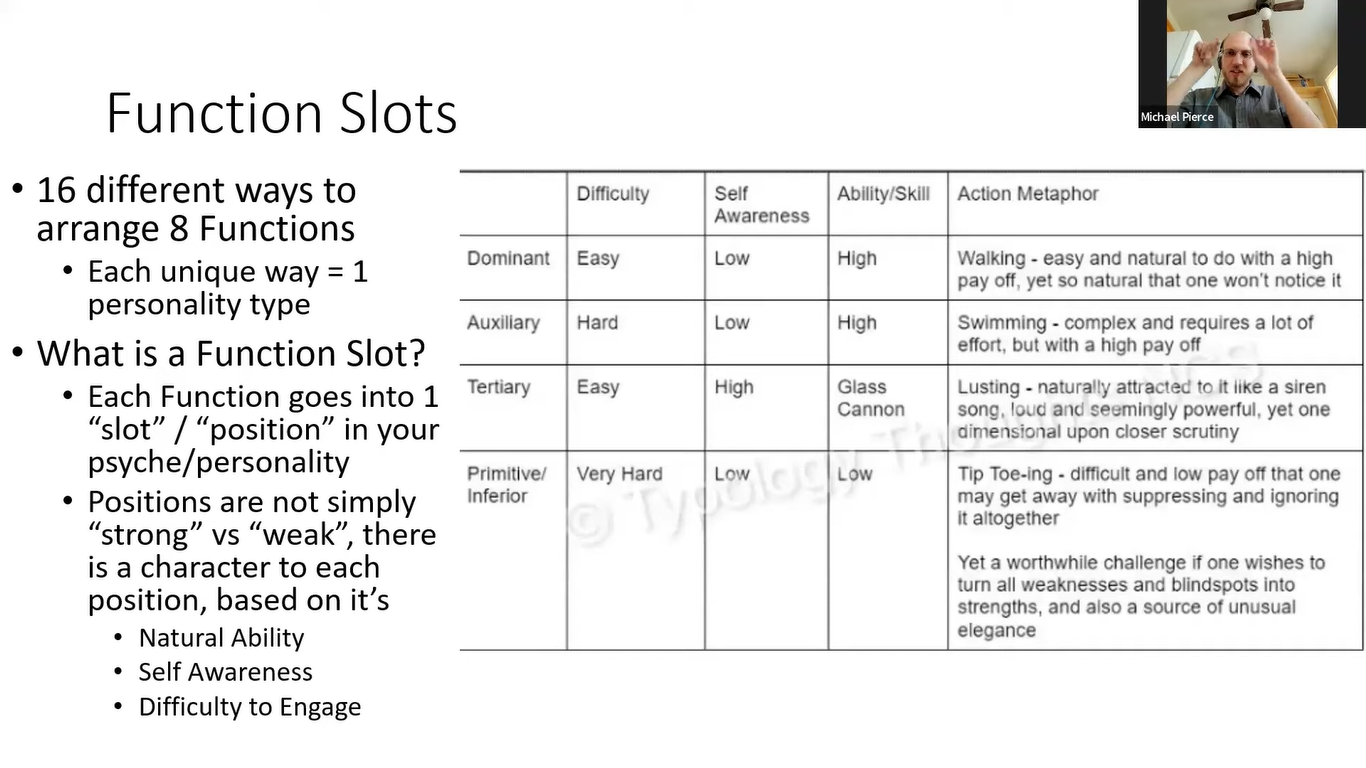
Michael:“The way that the functions are organized in a personality is that you have four function slots. You have the dominant function, you have the auxiliary function, the tertiary function, and the primitive or inferior function. We’ll start with the dominant.
The dominant function is the one that most defines you and the way that you tend to think. It’s the one that you use the most. Nicely compared with walking here, which I know is drawn from the book. Thank you, Ching. Yes, it’s the most easy and natural thing for you to do. In some cases, it can be so natural that the person will not even notice that that is definitely their mode of thinking, and that can actually sometimes be a bit of a challenge in typing people or at least in self-typing. But in any case, that’s sort of the easiest one to understand in a lot of ways. But in order to function as a person in general, you can’t just have one function, because you need multiple ways to see and to situate yourself in reality. So you have to start off with the auxiliary function, which compensates for your dominant function. So there’s always a bit of opposition there. The auxiliary function nicely compares to swimming; it requires more effort to do it, but you can do it, and it’s very useful for you to orient yourself in society. For example, I believe my dominant function is introverted intuition, so that’s what I sort of just do in the background all the time naturally. My auxiliary function is Extroverted Feeling. That is what helps compensate for my Introverted Intuition so that I’m not just sitting in my room, staring, and reading a text and trying to understand the secrets of the universe. I can actually go out and buy food and act like a normal human being. That’s a silly way of putting it, but more importantly, I associate it with my ability to situate myself in relation to other people and also a concern with social harmony.” Ching: “The Fe auxiliary really helps you in a teaching role because you’re always focused on translating that vision to something that’s palatable to the people we are speaking to, or tailoring it specifically to the people you are talking to.” Michael: “Exactly, yes. It’s not the thing that you’re naturally doing; it’s something that assists your dominant function with what it wants to do. Then you get the tertiary function. The tertiary function is something that you are very interested in, but you may not realize that you’re not actually the best there ever was at it. There can often be a bit of overestimation of one’s abilities with the tertiary function. It’s like the term here, the action metaphor, is lusting. Though you might associate it more with infatuation or fascination, you’re attracted to it, and yet it’s one-dimensional in your understanding of it, which sometimes can be a benefit. But you’re not actually, if you go up against somebody who is dominant in that function, it often becomes clear where the weaknesses lie or where the naivete lies, where the lack of cultivation there lies. So my tertiary function is Introverted Thinking, and you can see this, say, in my book where I’m creating these strict structures that are very Introverted Thinking, very logical, and they build one thing after the other. So my natural tendency would be to say, “Wow, it’s like I’m an Introverted Thinking type. I’m the master at ‘logic’ and figuring things out.” And then you compare it with my father, who is an Introverted Thinking dominant type, and he is an actual mathematician, and he can manipulate concepts and logical concepts in a way that is just completely out of my league. But in a way, he’s much more… he would not make some of the bold leaps that I make in Introverted Thinking precisely because he’s more of a veteran with it. So there’s a trade-off there. So that’s sort of scratching the surface of auxiliary and tertiary. I hope that maybe helps to differentiate them a bit.” Ching: “Oh, maybe just one point I can add to that. So, in Chinese, there is a phrase that goes “showing off in front of a master”. I use this phrase to help people differentiate between dominant and tertiary because basically when the first person, you know, who uses the tertiary function meets someone who is using it in a dominant way, they would be exactly that phrase where you are showing off in front of this master.” Michael: “Yeah, I really like that because that’s exactly what happens, that’s actually a very good phrase.” Ching: “And also, I can think of some examples. For instance, there’s a friend of mine who is an ENFJ, and she said her boyfriend is an ESTP. The ESTP’s tertiary function is extroverted feeling, making him a super party animal and a social butterfly. He’s always friendly, saying “Hey, what’s up?” to everyone and making everyone laugh. My ENFJ friend feels that he doesn’t need to be that friendly to everyone. In fact, she believes he may encourage inappropriate behaviors or enable the wrong people to become popular by focusing on only one aspect of the tertiary function.” Michael: “Yes, that’s very good, and in some sense, there is a descending order of maturity to the functions, is another way of characterizing it. The dominant function is your most mature function, the auxiliary function is pretty mature, but it’s almost like the assistant to the hero. The tertiary is much younger, much less experienced, and finally, you get the inferior function, which is the least experienced and often the most… all-or-nothing, in a lot of ways. You compared it to tiptoeing, which is very nice, difficult, and low payoff. One may get away with suppressing and ignoring it altogether. It can be a worthwhile challenge if one wishes to turn all weaknesses and blind spots into strengths and also a source of unusual elegance. So all of the functions have a function, which is the most directly opposite to it. The dominant function represses its opposite function, and its opposite function thereby becomes the inferior function. So introverted intuition is opposed to extroverted sensation, because extroverted sensation has to do with the actual objects outside of me, whereas introverted intuition has to do with the ideas inside of me. So you have this repression between the two of them, and yet it’s sort of a yin-yang, complementary association between them because you can’t have one without the other. You get a similar opposition between the auxiliary and the tertiary, where you’ll have somebody who, say, with the ESTP example that Ching gave, the ESTP is much better with Introverted Thinking, and they’ll use that in order to organize their life and give themselves principles of action. But especially as they get older, they’ll become more infatuated with Extroverted Feeling and almost think that is more important and want to associate more with that than with the introverted thinking, which they’re much better at. So, there’s this element of natural ability, self-awareness, engagement. That’s sort of the organization for the different types. So you get 16 types, in which each type has four functions, and these different slots. The reason that there are only 16 types built from eight functions is because of the natural oppositions I mentioned, where if you have Ni as your dominant function, you must have Se as your inferior function. That’s just they always go together in that way. And you can… if you have a perceiving function as your dominant, then you have to have a judging function as your auxiliary. So you get these natural oppositions, and in this almost very geometrical, mathematical way, it works out, so you only end up getting 16 distinct types.”
ENFP is one of the 16 personality types as defined by the Myers-Briggs Type Indicator (MBTI), characterized by extraversion, intuition, feeling and perception. ENFPs, also known as “champions”, are enthusiastic, outgoing and spontaneous individuals. They are considered the most optimistic of all personality types, who always tend to see the best in people. They thrive on making connections with others, and are very good at understanding their motivations.
ENFPs base their self-image on being seen as empathic, benevolent, and authentic, and are driven by intuition rather than concentrated willpower. Their lives often consist of a succession of projects, and they are stimulated by difficulties, finding themselves most ingenious in solving them. They are tireless when it comes to things that interest them, but may find it difficult to get other things done. Since ENFPs are more focused on “what could be” than “what is”, they often end up losing interest once they have accomplished a part of their vision.
Cognitive Functions of ENFPs:
To gain insight into the characteristics of ENFP personalities, it is helpful to understand the dominant and auxiliary cognitive functions that drive them. According to the MBTI system, each personality type has a set of cognitive functions that they use most frequently, which leads to consistent patterns and characteristics. For ENFPs,
Dominant Ne: Extraverted Intuition (Ne) allows an individual to come up with new ideas and possibilities, and see connections between seemingly unrelated things. It gives people the ability to see beyond the present, with a clear vision of what could be. People with a dominant Ne have a strong intuition for spotting trends and future developments, often before others have even recognized them.
Due to their dominant Extraverted Intuition (Ne), ENFPs tend to be more attracted to new possibilities and challenges than what is already verified and known, which makes them great problem solvers, innovators and visionaries. However, their dominant Ne also means that they change their mind frequently. As soon as a “possibility” becomes a “fact”, the intuitive part of their personality loses interest and starts exploring other ideas. This is because they are far more captivated by the possibilities of “what could be” than by the realities of “what is”. Furthermore, since they are so enthusiastic about their ideas, they often share them with others before they have had the opportunity to critically analyze them, which may make ENFPs come across as unrealistic, immature, and childish.
Auxiliary Fi: Introverted Feeling (Fi) helps individuals make decisions based on personal values, beliefs, and emotions. Healthy Fi users are in touch with their own emotions and have a strong sense of personal ethics and morality. An auxiliary Introverted Feeling (Fi) function enables individuals to be responsible for the decisions they make and resolve issues that cannot be dealt with through their dominant function.
ENFPs’ dominant Ne allows them to scan the environment and quickly absorb information. However, the constant influx of information can sometimes make it difficult for them to focus on what’s important. They rely on their auxiliary Fi to prioritize ideas based on their personal values. Moreover, ENFPs are forward-thinking and can see how changing a situation can improve people’s lives, but they may struggle to determine the best course of action to make their vision a reality. They use their Fi to set their priorities and determine their agenda. This allows them to focus on the ideas that are most important to them and make choices that align with their beliefs and values.
Strengths
Like all personality types, ENFPs have their own unique set of strengths, some of which include:
Imaginative and curious: ENFPs have a rich inner world and a vivid imagination, thanks to their Ne. They are constantly curious and open to new experiences, ideas, and perspectives. Their imaginative nature allows them to think outside the box and come up with creative solutions to problems.
Natural cheerleaders: ENFPs have a natural talent for uplifting and motivating others. They are natural-born cheerleaders who can inspire and encourage those around them with their optimism, enthusiasm, and support. They have a knack for boosting the morale of their peers and colleagues, helping them feel empowered and motivated to achieve their goals.
Empathetic: ENFPs are people’s people. They are able to put themselves in other people’s shoes and understand their perspectives. Their Ne helps them to pick up on subtle emotional cues of others and read between the lines. This makes them empathetic listeners as well as excellent negotiators, who are able to find common ground with different parties.
Light-hearted and fun: ENFPs are known for their ability to bring levity and humor to any situation. They have a light-hearted and playful approach to life, which can help create a positive and enjoyable atmosphere in their interactions with others.
Weaknesses
ENFPs may have some potential weaknesses that could impact their personal life, relationships, as well as their performance and effectiveness in their workplace. These weaknesses may include the following.
Difficulty with follow-through and organization: ENFPs can struggle with follow-through and organization, as they are more focused on exploring new possibilities rather than maintaining structure and routine. ENFPs can easily become distracted by their own ideas or those of others, and can lose track of the task at hand.
Overly Idealistic: ENFPs tend to be overly idealistic and can often overestimate their own abilities and the abilities of others. They have a natural trust in the environment, which can cause them to ignore sensory data that might signal danger (due to their weak Sensing function), or take risks that others might avoid. They also become easily discouraged when faced with a reality that does not live up to their expectations.
Difficulty with decision-making and structure: ENFPs can have a hard time making decisions, as driven by their dominant Ne, they want to consider all options and perspectives before making a choice. This can lead to indecision, poor time management, and difficulty maintaining boundaries and structure.
Poor Attention to Detail: ENFPs are full of ideas, owing to their dominant Ne, and they love working towards making those ideas a reality. However, due to Sensing being their weaker function, ENFPs often overlook details and struggle to pay attention to the finer points of a task, which may result in poor execution of their plans if not thought through properly.
Career choice
ENFPs are extremely enthusiastic individuals and can excel in any career they are interested in. The most suitable ones are mentioned below.
Sales or marketing: ENFPs’ dominant Ne allows them to think creatively, anticipate customer needs and tailor their pitch accordingly, which makes them great at sales and marketing. They are charismatic, persuasive and have great communication skills which help in building relationships with customers and closing deals.
Entrepreneurship or business: ENFPs are well-suited for careers in entrepreneurship, as they have a natural enthusiasm for exploring new possibilities, and are able to think creatively and identify gaps in the market.
Counseling or coaching: ENFPs are often drawn to counseling, as they enjoy the challenge of understanding each person’s unique problem and exploring potential solutions while helping them communicate their thoughts and feelings.
Human resources: ENFPs are able to connect with others and understand their needs and motivations, thanks to their Ne, which makes them well-suited for careers in human resources. Their auxiliary Fi allows them to evaluate ideas and actions in terms of their moral values and beliefs, which can help them to bring authenticity and integrity to their work in HR.
ENFPs require a career that allows them to satisfy their Ne by continuously working on new ideas and projects. Further examples of such careers could include: writing, where each book presents a different topic to explore; politics, with progression of campaigns for higher positions; education, where it would be about the renewed challenge of teaching a different class; and psychiatry, where it would be about the intricate mystery of each patient’s mind. If ENFPs feel blocked in their pursuits they may become bored and discontent in their career.
Workplace
ENFPs are often well-liked in the workplace and make great team members. Due to their extraverted nature, they have a natural tendency to be outgoing and sociable, which can help them build positive relationships with colleagues and create an inclusive work environment. They possess the ability to pick on the needs and intentions of others, and this “client-centered” approach can be particularly useful in situations such as conferences and interviews, where the ability to connect with the interviewees or colleagues can lead to more effective communication and a deeper understanding of their motivations.
ENFPs are authentic in their work approach, since their auxiliary Fi serves as their moral compass, helping them take on projects that align with their own beliefs and values. For this reason, ENFPs may have difficulty picking up on ideas and projects initiated by others. To fully lend their energy and interest to a project, it must align with their moral values, allowing them to consider that idea their own.
Moreover, ENFPs are known for their enthusiasm for new ideas and projects, which makes them highly productive employees. But this enthusiasm can also lead to inattention to time and energy limitations. They may become so absorbed in their current project that they neglect their needs to take breaks for rest, which ultimately leads to burnout. However, as soon as ENFPs see their idea turning into a factual reality, they often lose interest in the rest of the project, getting distracted by newer possibilities. They tend to rely on others to handle the follow-through of a project and may not stick with a situation long enough to see the final results.
Relationships
In relationships, ENFPs are often warm and affectionate, and they enjoy expressing their feelings to their partners. They are gentle, caring, and understanding, and tend to be spontaneous, which can often lead to pleasant surprises for their partners. Due to their dominant Ne, they tend to seek new and exciting experiences, which brings excitement and adventure to relationships. With their strong sense of curiosity, they are always excited to learn about their partners and explore new things together.
However, ENFPs can struggle with organization in relationships, as they are more focused on exploring new possibilities, rather than maintaining structure and routine. They may not prioritize practical matters such as maintaining the household, having life insurance, or keeping a steady cash flow, and be inconsistent in terms of their spending habits, sometimes indulging in luxuries while neglecting necessities.
ENFPs are known to be devoted parents, giving their children a variety of stimulating experiences, but may be unpredictable in their parenting style. They may shift between being a friend to their child to a stern authority figure. They may have strong opinions on discipline, but may not be willing to enforce them to maintain a good relationship with their children. They tend to leave it to their partner to follow through with discipline.
In conclusion, ENFPs are charismatic, outgoing, and optimistic individuals, who are passionate about their interests. They are full of ideas about different topics and are often seen as the life of the party. They are versatile, easy to get along with, and have a keen eye on the future. They possess strong initiative and a creative impulse, and can achieve anything they set their minds to. With their wisdom-like intuition, enthusiasm, and desire to make a difference, ENFPs are capable of achieving great things while embracing life to the fullest and inspiring others to do the same.
By following through each of the 4 sections below, you will be able to clarify your MBTI type as well as gain a quick overview of the 4 dichotomies. This is not meant to be a definitive MBTI test, but rather to accelerate your understanding so you can arrive at that aha moment to acknowledge your own type faster as you journey through the learning of the MBTI and Jungian functions.
The recorded bite-size lessons are made by trainer Tuan Le, founder of Our Huan Minds and a long-term learner and trainer of personality psychology frameworks such as MBTI and Enneagram
Tips to achieve the best results:
As we tend to strive to become more balanced with age, we often “stretch” our cognitive preference under the situational stress of work and social demands. To identify what is “natural”, it’s best to contemplate about 1) what naturally come to you when you were younger (as a teenager or young adult) or 2) when you feel truly at home & being yourself. Also, think about it in term of your consistent behaviors across time and not the “ought to” or “ should” adaptive behaviors.
Section 1 of 4: Introversion – Extroversion (I – E)
Learn about the fundamentals through the video above.
Based on your understanding, do you think you are more Introverted or Extroverted? Want better clarity? Go to step 3 below.
Go through the clarification table (you might need a pen and paper)
Give one tick either on the left or right of each pair of statements.
Give two ticks if you strongly believe with the statement.
If it’s too difficult for you to decide , you may leave it blank.
Tick if applies to your more
Tick if applies to you more
Regarding your overall attitude towards society or socially endorsed values and systems
Have a general dislike and often question popular ideas, standards, or tastes
Seek to achieve socially approved concepts and objectives, prioritizing the needs of the group
Quantity vs quality (hobbies, jobs, social circle…)
Prefer quality, being picky (job, relationship…)
Want to experience it all, the more the merrier
Generalist versus specialist
Often take pride in being a specialist and expert in a niche field
Often prefer working in more generalist position with variety of tasks like management and people-facing roles
How you gain energy
Energized by thinking and contemplating about a single topic alone or working one-on-one
Energized by interacting with and managing several on-going activities and people
Your approach to sharing and communicating
Reserved and private, thoughtful, contemplative, share only if necessary, you find people share too much
More ready to share personal info and enjoy brainstorming and responding quickly to others
7. Tabulating results:
The total number of ticks on the left is your score on Introversion.
The total number of ticks on the right is your score on Extroversion.
Whichever side has more ticks represents your degree of preference.
Section 2 of 4: INtuition – Sensing (N – S)
Learn about the fundamentals through the video above (From 07:49 to 16:50)
Based on your understanding, where do you put yourself? Want even better clarity? go to step 3 below.
Go through the clarification table:
Tick if applies to your more
Tick if applies to you more
When given a new task, how would you want to receive the information?
Prefer maximum details, specifics, step-by-step instruction to ensure clarity
Prefer to know the big picture and end goals first and as little details or instruction if possible
The type of information you tend to notice first
Notice what is apparent through the 5 senses or concrete, factual details
Notice patterns, concepts, ideas, metaphors, implications, possibilities, hidden meaning
Are you more pragmatic or visionary?
You tend to notice and trust what is tangible and measurable and your past experience
You are more energized by imagining what could be and possibilities in the future
Your problem-solving approach and strengths
Better at identifying the most efficient common-sense approach & focus on optimizing existing processes
Taking pride in generating many ideas or unconventional method to understand and solve problems
4. Tabulating results:
The total number of ticks on the left is your score on Sensing
The total number of ticks on the right is your score on iNtuition
Whichever side has more ticks represents your degree of preference.
Section 3 of 4: Feeling – Thinking (F-T)
Learn about the fundamentals via the video above.
Are you able to decide on your preference based on the video? If you want better clarity, go to step 3 below.
Type clarification table:
Tick if applies to your more
Tick if applies to you more
What approach should often be given a higher priority for the most satisfactory outcome?
First step back & analyze the situation impersonally
First consider how it impacts each person involved or your own value system
The thought processes that come to you naturally
Critique, evaluate & identify flaws for improvement
Notice & mention what is working well to build on it or offer moral support
In problem solving, what do you think naturally is the best way to work with others
Primarily focused on achieving set goals/outcomes
Primarily focused on developing & preserving connections with others
In presented with differing points of viewers and opinions
Comfortable asking probing questions to understand and generally comfortable with arguments
Avoid disagreements to preserve the relationship and harmonious atmosphere unless necessary to argue or fight back
4. Tabulating results:
Total number of ticks on the left is your score on Thinking
Total number of ticks on the right is your score on Feeling
Whichever side has more ticks represents your degree of preference.
Section 4 of 4: Judging – Perceiving (J-P)
Learn about the fundamentals through the video above.
Are you able to decide on your preference based on the video? Go to step 3 below for even better clarity
Go through the clarification table below:
Tick if applies to your more
Tick if applies to you more
Your overall philosophy and approach to life
Value order, predictability, structure, and milestones
Value going with the flow, see how things go, adaptability and flexibility
When plan for a trip or project
More comfortable when schedules are set and fix, milestones and deadlines are adhered to with minimal unexpected changes
Prefer loose deadlines with plenty of room for improvisation and last-minute adaptation and energy bust
Inclination for multi-tasking
Rather focused work on a single topic or project until finish
Like juggling and multi-tasking with short bursts of inspirations
Preference on starting and finishing projects
Prefer more measured and steadier pace from start to finish, especially with an emphasis on early start and timely finish
Excited by starting a new project but perform best with deadline and last-minute motivation to finish
4. Tabulating results:
Total number of ticks on the left is your score on Judging
Total number of ticks on the right is your score on Perceiving
Whichever side has more ticks represents your degree of preference.
Bonus: Pin Point Better with Cognitive Functions
A little bonus video below if you have another 5 minute to spare. This video will show you how to combine the four dichotomies above to form eight cognitive functions. Do watch till the end as I find the function tables pretty effective to get the audience to get that “aha” moment about which functions they clearly prefer. If you know your top two functions, you can easily narrow down your MBTI type using this function stack cheat sheet.
I hope this typing exercise has been both helpful and educational. You might be more sure about some pairs of letters than the others. If you happen to feel 50/50 towards a certain pairing, for example between INFP versus ISFP, you can always read the type description of each of these two MBTI types to see which overall profile resonate better with you.
P.S. What’s next after knowing your MBTI type? Have some doubts and need help with clarifying your identity? Join us to discover the transformative power of our flagship Cognitive Diversity Mastery programme and boost your self-awareness with the two most comprehensive frameworks!
Are you curious about your personality type and how it influences your thoughts, feelings, and behaviors? One popular tool for understanding personality is the Myers-Briggs Type Indicator (MBTI), which is based on the theory of cognitive functions developed by Carl Jung. If you’re interested in learning more about your MBTI type, there are several different ways to do so. In this article, we’ll explore some of the most common methods, including taking an online personality assessment, working with a qualified practitioner, and taking the official MBTI assessment.
Here is a summary of some of the most common methods, along with some pros and cons of each:
Taking an online personality assessment: One of the most popular and convenient ways to determine your MBTI type is to take an online personality assessment. There are many free and paid options available, such as 16Personalities and PersonalityPerfect.
Pros: Convenient and easily accessible; can be completed in a short amount of time; often provides detailed feedback about strengths and potential career paths. Cons: May not be as reliable or valid as more formal assessments; results may be influenced by self-perception and self-awareness.
Working with a qualified practitioner: Another option is to work with a qualified practitioner, such as a psychologist or career counselor, who is trained in administering and interpreting the MBTI. To find a qualified practitioner, you can try searching online directories of psychologists or career counselors in your area, or you can contact professional organizations such as the American Psychological Association (https://www.apa.org/) or the National Career Development Association (https://www.ncda.org/) for recommendations.
Some pros of working with a qualified practitioner include:
Personalized feedback: A qualified practitioner can provide more personalized and in-depth feedback about your personality type, as they are able to take into account your unique experiences and background.
Reliability: Working with a qualified practitioner may result in more reliable and valid results, as they are trained in administering and interpreting the MBTI.
Some potential cons of working with a qualified practitioner include:
Cost: Working with a qualified practitioner may be more expensive than taking an online assessment.
Time and effort: Working with a qualified practitioner may require more time and effort, as it typically involves multiple sessions or meetings.
Taking the official MBTI assessment: The official MBTI assessment is administered by trained professionals and is considered the most reliable and valid measure of personality type. Pros: Highly reliable and valid; provides detailed feedback about strengths and potential career paths. Cons: More expensive than online assessments; may require more time and effort to complete. To sign up for the official test, visit website: https://www.myersbriggs.org/my-mbti-personality-type/take-the-mbti-instrument/
Getting typing service from enthusiasts who specialize in MBTI and typology. This is different from option 2 above in the sense that, many of these people are more of social influencers and celebrities who gain trusts and followers through their social media channels over the years. They tend to not have serious professional qualifications but their services are often cheaper and less time-consuming. It’s recommended that you check out their channels to see whether you like and agree with their content and maybe read the reviews of the other customers.
Type yourself based on your own understanding of the MBTI. This might be the more time-consuming option but it’s free given the vast amount of content available online and will tremendously aid you in your personal growth journey through accumulated knowledge in this wonderful system. The simplest form is to understand the cognitive functions and determine which functions you identify with the most. The dominant and auxilarry function will then point you towards the corresponding type.
For a quick guide to understanding the various cognitive functions, click here. To find the corresponding MBTI type for each cognitive function, read here.
Another even better method is to combine your self-knowledge with online test. You can take any of the online test below and see if the description fit you. You can read the description of other types that possibly might fit you better by varying the result you get by 1 or 2 letter depending on whether you think you might be actually different. For example, if your test result is INFP, you might want to check out ENFP, INTP or ISFP etc.
Recommendation of other options for Online MBTI Tests:
16Personalities: 16Personalities is a free online personality assessment tool based on the MBTI theory of personality. It offers a detailed personality report and includes information about an individual’s strengths, weaknesses, and potential career paths. One potential drawback of 16Personalities is that it is based on self-report and may not be as reliable or valid as the official MBTI assessment. Website: https://www.16personalities.com/
PersonalityPerfect: PersonalityPerfect is a free online personality assessment tool that is based on the MBTI theory of personality. It offers a detailed personality report and includes information about an individual’s strengths, weaknesses, and potential career paths. Like 16Personalities, PersonalityPerfect is based on self-report and may not be as reliable or valid as the official MBTI assessment. Website: https://www.personalityperfect.com
Typefinder: Typefinder is an online personality assessment tool that is based on the MBTI theory of personality. It is not free, but it is widely available through a network of qualified practitioners and licensed organizations. Typefinder is a reliable and valid measure of personality type and is widely used in a variety of settings. One potential drawback of Typefinder is that it is based on self-report, so the results may be influenced by an individual’s level of self-awareness and self-perception. Website: https://www.typefinder.com/
Ultimately, the best way to determine your MBTI type will depend on your personal preferences, needs, and budget. Each of the methods discussed in this article has its own pros and cons, so it’s important to consider your goals and resources when deciding which option is best for you. Whether you choose to take an online assessment, work with a qualified practitioner, or take the official MBTI assessment, you can gain valuable insights into your personality and how it influences your life.
The Myers Briggs Type Indicator (MBTI) is one of the most popular personality tests and frameworks since the 1950s, created by the mother-daughter duo Isabel Myers and Catherine Briggs. Officially licensed under the Myers Briggs Company, the MBTI becomes even more popular due to the proliferation of (questionable) free online tests and generic type descriptions, often known as 16P or 16-personality test.
Why You Should Go Beyond Tests and Type Descriptions
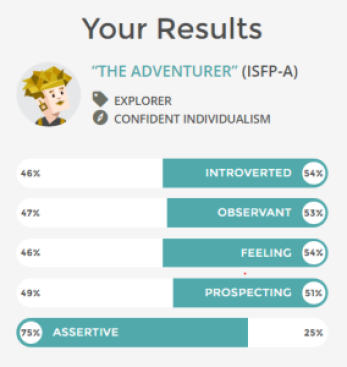
A typical result chart from 16personalities.com
As a result, there are generally two levels of understanding that we have seen. In the first group are those who came across the popular 16P personality quiz, or similar sites like truity.com. These sites peddle a type of personality assessment that simply asks “are you Extroverted or Introverted”, “are you an Intuitive or a Sensor”, “are you a Thinker or a Feeler”, “are you a Judger or a Perceiver” with percentage scores and give you your “MBTI type” based on those results.
It is a dichotomy (“strictly one or the other”) method that leaves much to be desired, because in a dichotomy system, you cannot have balance in your capability for sensing/intuition, or thinking/feeling. The end result is that many test-takers feel like they do not fit the extreme definitions of “introvert” / “extrovert” / “thinker” / “feeler”, because naturally every person is a bit introverted at times, a bit extroverted at times, and uses logic and inner values depending on the situation at hand.
Portrait of Carl Jung
In the second group are those who look further back to the origins of the modern MBTI, to the original theory introduced by Carl Jung in his 1921 book “Psychological Types” and expanded by Jungian analysts like John Beebe. Based on this theory, all our psychological thought processes can be categorized into 8 different cognitive functions.
This group also recognizes sixteen different types, but organizes each of the sixteen types by a unique combination of these 8 cognitive functions. It is a more holistic and nuanced understanding of personality types that accounts for the fact that everyone has a bit of everything, and the difference between types lies in the different order of strengths and weaknesses.
Here’s where the confusion arises: both groups have 16 types with the same 16 names, but a very different and incompatible understanding of what defines each of those 16 personality types.
Have you seen the light of the cognitive-function perspective?
We are firmly in the second group, and we have seen that generally, people in the first group who start to learn about cognitive functions will almost always “see the light” and join the second group, seeing the types through the lens of cognitive functions rather than the simple dichotomies.
Once a person sees the more robust and comprehensive system, they will naturally accept it over the simplistic dichotomies. In writing this post, I hope to bring you from the shallow pools of the 16P and truity.com to the real nuts and bolts of Jung’s theory of personality!
What are Jungian/MBTI cognitive functions?
Perception can be done in two ways; it can be in the present, the “here and now” (Sensing) and it can be looking beyond into the future and inferring patterns beneath the surface (Intuition)
Sensing means looking more in to the here-and-now and concrete details instead of abstract patterns
On the other hand, judgement can be also done in two ways; it can be done for quantifiable things, judging value between two black-and-white comparisons (Thinking). It can be also be done for unquantifiable things, judging value in aspects like love or personal values (“do I love Alice or Bob more?”) (Feeling)
So as a result, we have 4 functions (Sensing, Intuition, Thinking, Feeling) and for each of these four functions , there is an introverted and an extroverted version.
Think of introversion and extroversion like water and land, for introverts, the inner mind is the relaxing land while it takes effort to “swim” in the outer word
The extroverted functions are oriented outwards towards the external world, they are:
Extroverted Sensing (Se): Enjoying the finer aspects of life in food, fashion. Being physically in tune with the world
Extroverted Intuition (Ne): From one observation, deriving ten different ideas and possibilities
Extroverted Thinking (Te): Real-world practicality, results-driven, things that can be written down on a resume
Extroverted Feeling (Fe): Being able to “read the room”, attuned to the social atmosphere, tailoring your words to your audience
The introverted functions are oriented inwards towards the subjective personal world
Introverted Sensing (Si): Seeing and remembering things as they were in the past, taking things step by step
Introverted Intuition (Ni): From ten observations, deriving one single theory that explains everything. Projecting the one future path that most likely will happen
Introverted Thinking (Ti): Logical and consistent, having various categories to ensure that everything has its own place in a water-tight system
Introverted Feeling (Fi): Having a clear idea of individual desires, values, tastes. Living life authentically without being affected by what the rest of the world does
A more detailed explanation of each of the functions can be found here.
A flow chart that summarizes how Jung theorized the existence of 8 cognitive functions
How to determine the Function Stack of an MBTI Type?
A person’s combination of functions (i.e. the function stack) can’t simply be randomly picked from the list of 8 functions (otherwise we would have 8^8 = 16,777,216 types! There are commonly accepted rules for the positions and pairings of the functions developed by readers of Jung such as Myers Briggs and John Beebe.
Each function has a partner: its “opposite” within the same Judging/Perceiving category.
Every person’s first four function slots are comprised of one Perceiving function pair and one Judging function pair
Thus four possible combinations; there are four different ways to pair one Perceiving function pair with one Judging function pair
Democratic
Theocratic
Ne/Si + Fi/Te
Ni/Se + Fe/Ti
Atomic
Monarchic
Ne/Si + Fe/Ti
Ni/Se + Fi/Te
Within a person’s first four function slots, one function pair will occupy the 1st (“Dominant”) and 4th (“Inferior”/”Primitive”) slots. The other function pair will occupy the 2nd (“Auxiliary”) and 3rd (“Tertiary”) slots
Between the Dominant and Auxiliary Functions,
There is one extroverted and one introverted
There is one perceiving (N/S) and one judging (T/F)
To put everything together, here is an example of how we determine the functions of the ENFP type:
Step 1: Determine the orientation of the dominant function:
First letter tells you the orientation of the dominant function
The first letter “E” means Dominant function is Extroverted
Position
Orientation
Function
Dominant
Extroverted
(Intuition or Sensing or Thinking or Feeling)
Auxiliary
(Introverted or Extroverted)
(Intuition or Sensing or Thinking or Feeling
because the dominant function is Extroverted, the Auxiliary function must be Introverted
Position
Orientation
Function
Dominant
Extroverted
(Intuition or Sensing or Thinking or Feeling)
Auxiliary
Introverted
(Intuition or Sensing or Thinking or Feeling
Step 2: Use the fourth letter narrows down the extroverted function
Fourth letter “P” means the Extroverted function is a Perceiving function (either N or S)
Position
Orientation
Function
Dominant
Extroverted
(Intuition or Sensing)
Auxiliary
Introverted
(Intuition or Sensing or Thinking or Feeling)
because the Extroverted function is a Perceiving function, the Introverted functionmust be a Judging function (T or F)
Position
Orientation
Function
Dominant
Extroverted
(Intuition or Sensing)
Auxiliary
Introverted
(Thinking or Feeling)
Step 3: Use the second letter to decide whether the person is “Intuition” or “Sensing”
ENFP: “N” stands for Intuition rather than Sensing
Position
Orientation
Function
Dominant
Extroverted
Intuition
Auxiliary
Introverted
(Thinking or Feeling)
Step 4: Use the third letter to decide whether the person is “Thinking” or “Feeling”
ENFP: Letter F stands for Feeling rather than Thinking
Position
Orientation
Function
Dominant
Extroverted
Intuition
Auxiliary
Introverted
Feeling
Step 5: Determine the tertiary function
Each function has a partner: its “opposite” within the same Judging/Perceiving category.
The Tertiary is simply the function pair of the Auxiliary
Position
Orientation
Function
Dominant
Extroverted
Intuition
Auxiliary
Introverted
Feeling
Tertiary
Extroverted
Thinking
Step 6: Determine the inferior function
The Inferior/Primitive is simply the function pair of the Dominant
Position
Orientation
Function
Dominant
Extroverted
Intuition
Auxiliary
Introverted
Feeling
Tertiary
Extroverted
Thinking
Inferior / Primitive
Introverted
Sensing
Do you get it? Why not try to apply the same process above to determine the top four cognitive functions of your MBTI function stack? For a quick cheat sheet to look up different types’ stacks, click here.
So I hope you have had a better understanding of the other “deeper” aspect of MBTI and the commonly accepted model of the function stack in each type. This will unlock a more in-depth level of self-understanding for yourself based on your type.
The next step is to relook at your specific function stack and familiarize yourself with the definition and usage of each of these functions. Then, you can reflect on how these functions manifest in your life, then learn the theory further, and repeat. It will be a fulfilling and amazing journey of self-discovery with the aid of MBTI and Jungian functions!
References
Myers, Isabel Briggs, and Peter B. Myers. Gifts differing: Understanding personality type. Consulting Psychologists Press, 1980.
Beebe, John. Energies and patterns in psychological type: The reservoir of consciousness. Routledge, 2016.
Jung, Carl. Psychological types. Routledge, 2016.
This was a guest article written by CS Ng. For more content from the author, check out here.
A more detailed explanation by him on the function stack can be found here.
The four extroverted functions are oriented outwards towards the external world, they are:
Extroverted Sensing (Se): Enjoying the finer aspects of life in food, fashion. Being physically in tune with the world
Extroverted Intuition (Ne): From one observation, deriving ten different ideas and possibilities
Extroverted Thinking (Te): Real-world practicality, results-driven, things that can be written down on a resume
Extroverted Feeling (Fe): Being able to “read the room”, attuned to the social atmosphere, tailoring your words to your audience
The four introverted functions are oriented inwards towards the subjective personal world
Introverted Sensing (Si): Seeing and remembering things as they were in the past, taking things step by step
Introverted Intuition (Ni): From ten observations, deriving one single theory that explains everything. Projecting the one future path that most likely will happen
Introverted Thinking (Ti): Logical and consistent, having various categories to ensure that everything has its own place in a water-tight system
Introverted Feeling (Fi): Having a clear idea of individual desires, values, tastes. Living life authentically without being affected by what the rest of the world does
Cheat sheet: Use this table for quick reference to see which functions are in each type
Can I ask if you are left-handed or right-handed? The chance is you are a right-handed person, because it is the majority of our population. How do you know that you are right-handed? It is a very obvious question almost without a need to explain. If we need to break down the reasons, there are three ways you know that your type is a right-handed: 1) The frequency of you using your right hand in a day is higher than your left and 2) Your right hand feels a lot more natural and real and 3) Your right hand will objectively be better at handling heavier objects or more complex tasks.
That is how you should think about your opposing function of Thinking and Feeling as well. Do keep the above ideas of left and right hand in mind as we further learn about the true definition of Thinking and Feeling in Jungian psychology.
If you are a visual learner, you can also follow this video below:
The definitions
Carl Jung
Besides Introversion and Extroversion, Thinking and Feeling are the second dimension in analytical psychology (the third dimension is Intuition versus Sensing). These concepts were first introduced in the early 20th century by Carl Gustav Jung (1875 – 1961), a famous Swiss psychiatrist who developed the idea of Psychological Types, the precursor to the extremely popular Myers Briggs Type Indicator (MBTI) test and framework.
My philosophy for Our Human Minds have always been to adhere as much as possible to the original understanding and work of Carl Jung to help readers understand accurately the cognitive functions. It is a longer path, but trust me, it is more rewarding and surer way to achieve more accurate self-understanding than purely taking the online test and read the descriptions of the 16 MBTI personalities!
Unlike left and right hand, Thinking and Feeling preferences in analytical psychology are more distinct, serving very different purposes. Your two hands do not oppose each other, but Thinking and Feeling do by definition. Hence, being aware of them and knowing how to develop your weaker function and learn to make them synchronize holds the potential for not only more productivity but also psychological maturity and wholeness.
The definition of “Thinking” and “Feeling” in Jungian psychology are easily confused with the more layman definitions that we use in our daily languages. They should not be confused with logic versus emotion. You need to understand them in a more fundamental way, that they are evaluative & rational processes to judge incoming information, whether something is right or wrong, good and bad…
Thinking and Feeling aim to clearly distinguish between the two distinct preferences for decision-making: impersonal versus personal/interpersonal respectively. The easiest way to visualize this difference is in the common stereotype between men versus women in our society. Men are known to prefer to “solve problems” and break down problems “logically” while on the other hand, women simply want to be listened to, to be empathized and understood.
Thinkers (both men and women) prefer to solve problems objectively
While this is a stereotype, indeed, some of the surveys have shown that there is a slight preference (55%) among men for Thinking and a strong preference (75%) of women who have a Feeling preference. How much of this is the surveyed individuals’ true preferences and how much is a result of social expectation & conditioning, is for another debate. However, I would like to add that based on this survey, thinking that all men are or have to be super logical or women have to be relationship-oriented is a gross simplification and unfair treatment to both sexes.
To break it down further, thinking manifests itself as preference for using objective and measurable frameworks for clear-cut decision making. It is about using objective criteria, conceptual frameworks, pros and cons, structures, logical systems… People with Thinking preference value and take pride in being efficient, precise, goal and task-oriented. Something is good if it is placed in the right category, gives better measurable results, more efficient etc.
On the other hand, Feeling places stronger emphasis on human’s welfare, values and preferences. As an introverted function, it’s about knowing a strong moral sense of right and wrong, of feeling an urge to help the less fortunate, to be humanitarian, to overcome unfairness and restore equality. Extroverted version is about about maintaining a harmonious atmosphere (when hosting a house party for example), making sure common pleasantries and “civilized” etiquettes are adhered to, while making sure everyone has a good time.
Thinking
Feeling
Definition
Impersonal evaluation
Interpersonal and value-based decision-making
Related concepts
objective criteria, pros and cons, measurable results, conceptual frameworks, logical systems
values, morality, harmony, personal preferences, gut feels of right and wrong
Quick Exercise : What is your true preference based on the above definition? You might need to think about when you are younger or in a more comfortable place at home without any stress of work or “have to” pressure. Social expectation and work stresses might force us to over-compensate to the point of losing sight of who we truly are, like Feeling men are often expected to appear logical and tough, or your jobs have required you to develop your weaker function, even if in your younger years you are the opposite.
Develop Thinking
This section is more relevant for Feeler who has a natural strength in making decisions based on personal values or harmony, but as a result, devoting less consciousness energy in using systemic/impersonal perspectives. We will look at concrete steps that you can take to gradually build up confidence in using the skills and become more holistic in decision making.
Playing a big part of your ego, Feeling – the preference for using value and personal-preference based approach, is part of your identity. The cause that you care about, friends and family, the social connection and status that represent your deepest conviction and meaning of life, are valid. As much as it’s important to acknowledge the other side of the equation, in the end, Thinking should serve in a supporting role and not to dominate your preference for personal values or interpersonal harmony.
Just like this two-people bike, you should let your dominant function to take the lead and guide the other function, not the other way round!
The development of your weaker functions and achieving wholeness is a life-long quest, so the instruction below serves as a general direction and examples of the kind of steps you can take to develop Thinking.
Remember that the basic definition of Thinking is the use of impersonal systems, framework and measurable results and data. Hence, you can:
Learn from someone close to you who is strong in Thinking like your family members or colleagues. Talk to them more or reflect on the time you guys spend time together. Learn about how they conduct themselves differently, understand why they do it and see if you can learn and integrate some of their techniques or philosophy.
Develop interests in activities that require strong impersonal reasoning and decision making such as chess, finance, computer games…
Integrate productivity tools such as planner, calendar, deadlines and KPIs clearly for both personal work and managing others.
Take courses, read books, watch videos… on productivity, time and project management.
Learn to say No. It’s very natural for Feeler to go with the flow and say yes to keep harmony. Saying No doesn’t mean being harsh or rude if you can explain yourself clearly. It doesn’t have to be black and white either, you can also negotiate what you’d like to do and what you cannot do or you feel is not fair. It’s hard at first, but it’s an essential skill that will go a long way!
Knowing other ways to develop your Thinking side that can help other readers? Feel free to comment below!
Develop Feeling
This is more relevant to Thinking dominant type. Again, it’s important that you acknowledge and embrace your identity as a Thinker and develop Feeling as a support for a more holistic decision making process. Your Thinking function should still be in the driver seat!
Find friends, family or colleagues who you know well and you are fairly certain they are stronger in Feeling. Get to know them more and reflect on how they conduct things differently and see whether you can integrate some of their physiology and methods to your daily life.
Engage in reflective activities like meditation, arts, writing… to reflect on your values and what’s important to you. Remember, it’s a gradual process that requires patience and regular practices.
Engage in social activities and roles that you have to interact more with people. Recognise some of your biases and see it from a more positive light when it comes to social relationships.
Immerse yourself in nature, away from distraction of work and technology, to hear and embrace your inner voices, values and feelings.
Are you a Thinker that has other ways that work? Feel free to share below.
I hope you now have a clearer understanding of the distinction between these rational dimensions of Thinking versus Feeling. In reality, these two preferences never exist as standalone in a healthy person’s psyche but work in tandem. But since they are mutually exclusive/cancelling out, it’s natural to prioritize and put your conscious energy into one while “send to exile” the other, giving little conscious energy to nourish and maintain it.
If possible, you should learn further about how Introversion and Extroversion are combined with Thinking and Feeling to give rise to 4 distinct Cognitive Processes/Functions: Introverted Thinking, Extroverted Thinking, Introverted Feeling and Extroverted Feeling. This breakdown will bring in a whole new level of depth and opportunities for self-understanding and development. Good luck!